

 Zeeshan Khan
 Feb 26, 2026
Table of Contents
Calculating VAT shouldn’t feel like a high-stakes math exam. At its core, Value Added Tax (VAT) is a consumption tax added to the price of goods and services at every stage of production.
Whether you are a business owner managing cash flow or a consumer checking a receipt, understanding how this percentage impacts your bottom line is essential for staying financially savvy.
While the concept is universal, the numbers shift depending on where you stand. From the standard 20% in the United Kingdom to the 5% rate in the United Arab Emirates or various GST/HST structures in Canada, getting the math right is the difference between seamless accounting and a tax-season headache.
Grasping the formula allows you to navigate these global differences with total confidence.
What is VAT?
Value Added Tax, or VAT , is a consumption tax placed on a product whenever value is added at a stage of production and at the point of retail sale. Unlike a simple sales tax that is only collected at the final purchase, VAT is collected incrementally.
It is essentially a way for governments to generate revenue based on the consumption of goods and services rather than just income.
To calculate VAT on a total amount accurately, you first need to speak the language of taxation. The industry typically uses two primary pricing structures:
- VAT-exclusive price (Net price): This is the “clean” cost of the item before any tax is added. Businesses often communicate in net prices because they can often reclaim the VAT they pay to suppliers.
- VAT-inclusive price (Gross price): This is the final sticker price you see on a shelf or a checkout screen. It includes the net price plus the applicable VAT amount. When you calculate VAT from a total amount, you are essentially separating these two figures.
In the United Arab Emirates, VAT was introduced on January 1, 2018, and understanding the types of VAT in UAE is important for both businesses and consumers.
For new businesses, understanding these concepts is especially important for VAT returns for startups, ensuring that your filings are accurate and compliant from the outset.
Types of VAT in the UAE
There are three main types of VAT in the UAE:
- Standard Rate (5%)
This is the most common VAT rate applied to most goods and services in the UAE. - Zero-Rated VAT (0%)
Certain goods and services are taxed at 0%, such as exports outside the UAE and international transportation. Businesses can still reclaim input VAT on these supplies. - Exempt Supplies / VAT on Real Estate
Some sectors, such as specific financial services and residential real estate, are exempt from VAT. In the case of VAT on real estate, VAT is not charged on certain residential properties, but businesses cannot recover input VAT.
How VAT Works in the Supply Chain
VAT is designed to be self-regulating through a “credit and debit” system. It moves through the supply chain from the raw material provider to the manufacturer, then to the retailer, and finally to the consumer.
Each business in the chain acts as a tax collector for the government. They pay VAT on their purchases and charge VAT on their sales. This is referred to as Input VAT and Output VAT. The business then pays the difference to the tax authorities.
However, the final consumer who is not VAT-registered cannot reclaim the tax, meaning they bear the full cost of the VAT included in the gross price.
Understanding this flow is vital when you need to calculate vat amount of total invoices, as it ensures you are only paying or claiming exactly what is required by law.
VAT Formula Basics
To master your business accounting in the Emirates, you need to be comfortable switching between net and gross figures. Whether you are issuing an invoice to a client in Dubai or auditing your expenses in Abu Dhabi, these formulas are your foundation. Using professional types of accounting services can also help ensure accuracy and compliance.
In the UAE, where the accounting standards VAT rate is 5%, the math is straightforward but requires precision to ensure your filings with the Federal Tax Authority (FTA) are spot on.
Adding VAT to a Net Amount
When you have a base price (the VAT-exclusive price) and need to determine what the final customer should pay, you simply add the tax on top. This is the most common calculation for businesses when setting their retail prices.
The Formula:
- VAT Amount = Net Price × (VAT Rate ÷ 100)
- Total Price = Net Price + VAT Amount
Practical Example (UAE 5% Rate)
Let’s look at how this works in a real-world scenario using AED. If you are selling a consultancy service or a product with a net price of 100 AED:
- Net Price: 100 AED
- VAT Rate: 5%
- VAT Amount Calculation: 100 × 0.05 = 5 AED
- Total Price (Including VAT): 100 + 5 = 105 AED
By following this step, you ensure that your VAT-inclusive price correctly reflects the 5 AED tax that you will later report.
This simple multiplication is the first step in learning how to calculate VAT on a total amount from the ground up.
Calculating VAT from a VAT-Inclusive Total
In many business scenarios, you’ll find yourself holding a receipt or a contract for a final amount and needing to work backward.
This is a critical skill for any business owner in the UAE who needs to calculate VAT amount from total figures to accurately report their input tax to the Federal Tax Authority.
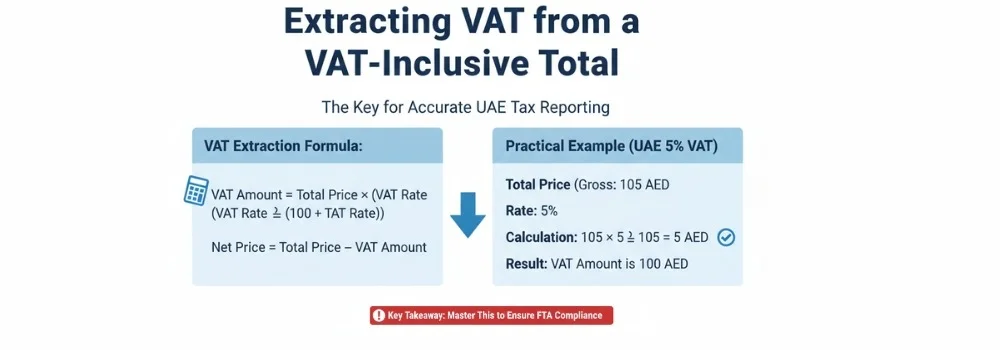
When the tax is already baked into the price, you cannot simply multiply the total by 5%. Instead, you must use a specific formula to “extract” the tax correctly.
The VAT Extraction Formula:
VAT Amount = Total Price × (VAT Rate ÷ (100 + VAT Rate))
Net Price = Total Price − VAT Amount
Practical Example (UAE 5% Rate)
If you have a total invoice amount of 105 AED and need to find the specific tax portion at the standard UAE rate of 5%, here is the breakdown:
- Total Price (Gross): 105 AED
- VAT Rate: 5%
- Calculation: 105 × (5 ÷ 105) = 5 AED
- Result: The VAT amount is 5 AED, which means the Net Price (excluding VAT) is 100 AED.
By using this method, you ensure that you don’t over-calculate your tax liability. Mastering how to calculate VAT on a total amount this way keeps your books clean and your audits stress-free.
Step-by-Step VAT Calculation Guide
Navigating tax requirements in the UAE doesn’t have to be a guessing game. Whether you are dealing with a standard 5% rate or a zero-rated export, following a consistent process ensures your financial records remain flawless.
Use this professional guide to calculate VAT on a total amount with absolute precision every time. It also explains how to do VAT Reconciliation, helping you match input and output VAT for accurate reporting and compliance.
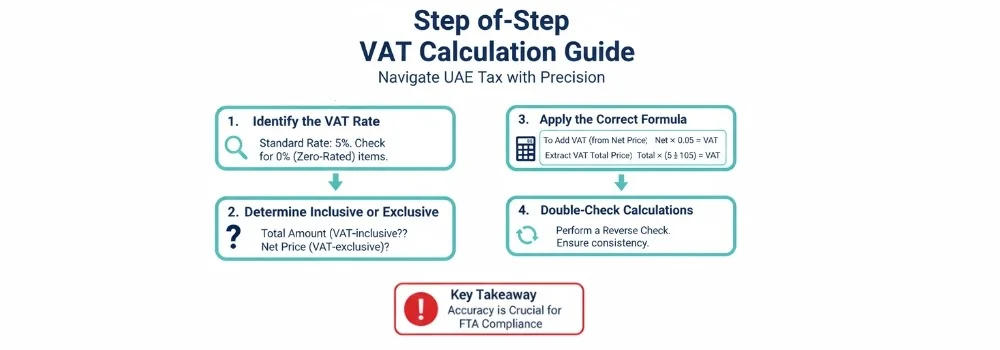
Step 1: Identify the VAT Rate
Before touching a calculator, confirm the tax rate applicable to your specific transaction. While the standard rate in the UAE is 5%, certain goods and services, such as international transportation or specific healthcare services, may be 0% (Zero-rated). Knowing the correct percentage is the foundation of an accurate calculation.
Step 2: Determine Inclusive or Exclusive
Is the figure you are looking at the final price paid by the customer (VAT-inclusive), or is it the base cost before tax (VAT-exclusive)?
- If you have the Total Amount, you need to extract the tax.
- If you have the Net Price, you need to add the tax.
Confusing these two is the most common error when businesses try to calculate the VAT amount of total invoices.
Step 3: Apply the Correct Formula
Once you know your starting point, apply the corresponding formula to find your result in AED:
- To Add VAT (from Net Price): Net × 0.05 = VAT
- To Extract VAT (from Total Price): Total × (5 ÷ 105) = VAT
By using the “105” divisor for inclusive amounts, you ensure you are calculating the 5% based on the original net value, not the gross total.
Step 4: Double-Check Calculations
Always perform a “reverse check” to verify your numbers. If you extracted 5 AED from a 105 AED total to get a 100 AED net price, simply multiply 100 by 5% to see if you land back at 5 AED. Consistency is key to avoiding filing errors with the Federal Tax Authority.
VAT Rate Examples by Country
While the fundamental math behind tax stays the same, the percentage you plug into the formula changes based on your location.
It is important to remember that tax laws are dynamic; while these rates are current for 2026, governments occasionally adjust them to meet economic needs.
Here is a look at the standard rates in three major global markets:
United Kingdom – Standard VAT 20%
The UK has maintained a 20% standard VAT rate for several years. It applies to the majority of goods and services, from electronics to professional consulting fees. For businesses in the UK, the “VAT Fraction” for extracting tax from a total is 1/6.
- Example: A product with a total price of £120 includes £20 in VAT.
United Arab Emirates – VAT 5%
The UAE introduced VAT relatively recently to diversify its national revenue. The standard rate is set at a highly competitive 5%. Because this rate is lower than in many other countries, it is crucial to calculate VAT on a total amount with high precision to avoid small but compounding errors in your FTA filings.
- Example: A service with a total price of 1,050 AED includes 50 AED in VAT.
Australia – GST 10%
In Australia, VAT is referred to as GST (Goods and Services Tax). The standard rate is a flat 10% across all states, from New South Wales to Western Australia. To quickly extract GST from a total price in AUD, simply divide the total by 11.
- Example: An invoice total of $110 AUD includes $10 AUD in GST.
Common VAT Calculation Mistakes
Even with the right formulas, it is easy to slip up when you are managing a high volume of transactions. In the UAE, where the Federal Tax Authority (FTA) requires precise reporting, small errors can lead to larger reconciliation issues.
Understanding where most people go wrong will help you calculate VAT on a total amount with much higher accuracy.
Confusing VAT-Inclusive and VAT-Exclusive Prices
The most frequent mistake is applying the tax rate to the wrong starting number. If you have a total of 105 AED (inclusive) and simply multiply it by 5%, you get 5.25 AED. This is incorrect.
The actual tax is 5 AED. Always pause to confirm if the price in front of you already includes the tax before you start your calculation.
Using the Wrong VAT Rate
While 5% is the standard in the UAE, not every transaction follows this rule. Applying 5% to a “Zero-rated” export or an “Exempt” service (like certain financial services or residential land) will result in an incorrect tax liability.
Always verify the tax status of the specific good or service, especially if it falls under UAE free zone tax regulations, before you calculate the VAT amount from total receipts.
Incorrect Formula When Extracting VAT
Many people try to “reverse” VAT by simply subtracting 5% from the total. However, this method is incorrect. To calculate VAT from a total amount, you should either divide the total by 1.05 to find the net price or use the extraction formula:
VAT = Total × (5 ÷ 105).
Using the wrong method can lead to inaccurate figures and disrupt your balance sheet.
Rounding Errors
When dealing with fils in the UAE, rounding can become a headache. If you round your VAT amounts too early in a multi-line invoice, the “Total VAT” at the bottom might not match the sum of the individual lines.
- Best Practice: Keep as many decimals as possible during the calculation and only round the final VAT amount to the nearest two decimal places (e.g., 0.50 AED).
VAT Calculation Formula Table (Quick Reference)
In the fast-paced business environment of the UAE, you don’t always have time to derive a formula from scratch. Whether you are finalizing a contract in Dubai or checking a supplier’s invoice in Abu Dhabi, having a “cheat sheet” is the best way to ensure accuracy. Use this table as your definitive guide to calculate VAT on a total amount without the assumption.
| Scenario | Goal | Formula (AED) |
| Add VAT | Find the final Gross Price | Net × (1 + VAT ÷ 100) |
| Extract VAT | Find the tax portion only | Total × VAT ÷ (100 + VAT) |
| Find Net from Total | Remove tax to find base price | Total ÷ (1 + VAT ÷ 100) |
How to Use This Table in the UAE (5% VAT)
If you are working with the standard 5% rate in the Emirates, your calculations become even simpler. To calculate vat amount from total figures quickly:
- To add VAT: Multiply your net price by 1.05.
- To Extract VAT: Multiply your total price by 0.0476 (which is 5/105).
- To Find Net: Divide your total price by 1.05.
By keeping this reference handy, you can calculate VAT on total amounts of invoices with total confidence, ensuring your financial reporting is always professional and compliant.
Where to Get Professional VAT Consultation
Choosing the right partner for your tax strategy is a critical step in maintaining a healthy, compliant business in the Emirates. HFA Consulting stands out as a premier choice for businesses that value precision and local expertise.
By utilizing professional VAT consultancy services in Dubai, you can streamline your accounting processes, ensure every calculation is accurate, and confidently meet all Federal Tax Authority requirements. This specialized support allows you to focus on scaling your operations while knowing your tax obligations are handled with the highest level of professional care.
Conclusion
Whether you are a startup in Dubai or an established firm in Abu Dhabi, getting your tax math right is the bedrock of professional bookkeeping. To calculate VAT on a total amount with zero errors, keep your core formulas close: multiply your net by 1.05 to add the 5% tax, or divide your gross total by 1.05 to find the original base cost.
These calculations ensure your invoices are transparent, your cash flow is predictable, and your business remains fully aligned with the Federal Tax Authority’s expectations.
While these standard steps cover the vast majority of daily transactions, the UAE tax landscape can present unique challenges for international trade or exempt sectors.
In these complex cases, consulting a tax professional is a smart investment that prevents costly filing errors. By committing to accuracy in every transaction, you protect your business from penalties and build a reputation for financial integrity in the competing Emirates market.
FAQs
How do I calculate 20% VAT from a total amount?
To calculate the 20% VAT included in a total price, you can divide the total amount by 6 or use the formula VAT = Total × (20 ÷ 120). For example, if the total price is 120 AED at a 20% VAT rate, the VAT amount is 20 AED, leaving a net price of 100 AED. This method ensures you accurately extract the tax from an inclusive total.
How do I remove VAT from a price?
To remove VAT and find the original net price, divide the total (gross) price by(1 + the tax rate). For a 5% rate in the UAE, divide the total by 1.05. This strips away the tax and leaves you with the VAT-exclusive figure.
What is the difference between VAT and sales tax?
VAT is collected at every stage of the supply chain where value is added (production to retail), whereas sales tax is typically a one-time tax collected only at the final point of sale to the consumer. VAT-registered businesses can often reclaim the tax they pay on business-related purchases.
Is VAT charged on shipping?
Yes, Value Added Tax (VAT) is generally charged on shipping and courier services in the UAE. In most jurisdictions, including the UAE and UK, VAT is charged on shipping if the goods being delivered are also subject to VAT. Essentially, the delivery is treated as part of the same supply, so if the item is taxable, the shipping fee usually is too.


Zeeshan Khan
My name is Zeeshan Khan, and I’m a UAE-based business and tax consulting professional with hands-on experience in VAT compliance, corporate tax advisory, business setup, and regulatory services. I work closely with startups, SMEs, and established companies to help them navigate UAE tax laws, improve compliance, and make informed financial decisions. With a strong understanding of FTA regulations, corporate structuring, and commercial taxation in the UAE, my focus is on translating complex laws into clear, practical guidance for business owners. Through my writing, I aim to provide accurate, up-to-date insights that help businesses stay compliant, reduce risk, and operate confidently in the UAE market.