

 Zeeshan Khan
 Mar 10, 2026
Table of Contents
The UAE is a top choice for businesses because of its strategic location and tax-friendly environment. It’s a hub that connects global trade, offering companies a stable place to grow.
But as the country’s tax system matures, staying compliant is about more than just having a license; it’s about knowing exactly where your business stands.
Understanding designated free zones in the UAE can significantly impact your VAT treatment and tax planning strategy. Whether you are moving goods across borders or providing services, the “Designated Zone” status is a key factor in how much tax you pay and how you file your returns.
What are Designated Free Zones in the UAE?
A designated zone in the UAE is a specific area that the government treats as “outside the UAE” for VAT purposes. This doesn’t mean it’s not part of the country, but for tax on goods, these zones have their own rules.
To keep this status, the zone must be fenced, have security, and follow strict customs controls. This setup helps traders move goods without paying the standard 5% VAT every time a shipment arrives.
Key Differences: Free Zone vs. Designated Free Zone
Here is a simple breakdown of the differences. While both offer great benefits for business owners, the way they handle taxes, specifically VAT on goods, is the main thing that sets them apart. Understanding these differences is important for businesses that want to comply with UAE Free zone tax regulations and manage their VAT obligations correctly.
| Feature | Regular Free Zone | Designated Free Zone (DFZ) |
| Location Status | Part of the UAE “Mainland” for VAT purposes. | Treated as “Outside the UAE” for VAT on goods. |
| VAT on Goods | 5% VAT usually applies to goods sold within the zone. | 0% VAT (Out of Scope) for most goods moved within or between DFZs. |
| Physical Setup | Standard office buildings or warehouses. | Must be fenced, have security, and strict customs controls. |
| VAT on Services | 5% VAT applies (standard rules). | 5% VAT applies (standard rules). |
| Customs Control | Standard free zone rules. | Under direct oversight of UAE Customs. |
| Example Zones | DMCC, Dubai Media City, IFZA. | JAFZA, DAFZA, Khalifa Port (KIZAD). |
UAE VAT Designated Zone List
Not every free zone is a designated zone. If your zone isn’t on the official UAE VAT-designated zone list, it is treated just like the mainland. Here are some of the most popular zones that hold this status:
| Emirate | Examples of Designated Zones |
| Dubai | Jebel Ali Free Zone (JAFZA), Dubai Airport Free Zone (DAFZA), Dubai South |
| Abu Dhabi | Khalifa Port Free Trade Zone, Abu Dhabi Airport Free Zone |
| Sharjah | Hamriyah Free Zone, Sharjah Airport International Free Zone (SAIF) |
| Ras Al Khaimah | RAK Maritime City, Al Hamra Industrial Zone |
VAT Treatment in Designated Free Zones
The tax system treats goods and services differently depending on where they are traded. A designated zone in the UAE VAT acts like a special bubble. Inside this bubble, many transactions involving physical goods stay outside the 5% tax net, helping businesses move inventory without extra costs.
When Is 0% VAT Applied?
Moving goods between two different designated zones in the UAE usually keeps the transaction out of scope for VAT. This means if you ship products from Jebel Ali to Khalifa Port, you typically don’t have to worry about the 5% charge, as long as the goods stay within the fenced and secure designated zone areas.
Selling products to customers outside the country also falls under the zero rate VAT in UAE. When goods are exported internationally, they are taxed at 0% VAT, meaning businesses can still reclaim input VAT while the sale itself remains tax-free. Because these items are leaving the UAE for global markets, the government applies the zero rate VAT in UAE to help local traders stay competitive internationally.
When Does 5% VAT Apply?
It is a common mistake to assume every business activity in a designated zone in the UAE is tax-free. If your company provides services like consulting, marketing, or legal advice, you usually must charge 5% VAT.
These rules apply even if your office is inside a famous free zone, as services are generally treated as being “used” within the country.
The standard 5% rate also kicks in when goods leave the fenced area to enter the local market. If you sell products to a company on the UAE mainland, or if you buy office furniture for your own use inside the zone, those transactions are typically taxed just like any other mainland business.
Key Conditions for Zero-Rating
To keep your tax at 0%, the free zone law in the UAE requires that all goods stay strictly within the designated area. If items are moved out of the secure fence without the right customs paperwork, the Federal Tax Authority will view them as having entered the mainland, which triggers a tax bill.
Documentation is the most important part of staying compliant as a qualifying free zone person in the UAE. You must keep clear records of your shipping bills, invoices, and customs entries to prove exactly where your goods are located. Without these papers, you risk facing heavy fines during an audit.
Expert Tip: Incorrect VAT classification can lead to penalties. Taking the time to double-check your UAE free zone VAT rules today can save your business from unexpected costs later.
Corporate Tax Implications for Designated Free Zones
While designated zones offer major VAT advantages, they also play a central role in the UAE’s Corporate Tax system. Being in a designated zone in the UAE is often the first step toward qualifying for a 0% tax rate on your business profits. However, this benefit is not automatic and depends on following a specific set of rules.
0% Corporate Tax Eligibility
To enjoy the 0% rate, your business must be recognized as a qualifying free zone person in the UAE. This means you must earn “qualifying income” from activities the government has approved, such as manufacturing, shipping, or distributing goods from a designated zone.
If your income comes from “excluded” activities like banking or certain retail sales to individuals, you may have to pay the standard 9% tax on those profits, as outlined under FTA Corporate Tax regulations.
Substance Requirements
The government wants to ensure that businesses receiving tax benefits are actually operating within the zone. To meet these substance requirements, you must have a physical office, adequate assets, and a qualified team working within the designated free zones in the UAE.
Running a “shell company” with no real local operations will likely disqualify you from the 0% tax rate and lead to the standard 9% charge.
Compliance Obligations
Even if your tax bill is zero, you still have work to do. Every company in a designated zone in the UAE VAT list must register for Corporate Tax and file an annual return.
You are also required to keep audited financial statements and follow “transfer pricing” rules, which ensure that any deals you make with sister companies or partners are done at fair market prices.
Mainland Transactions Impact
Doing business with companies on the UAE mainland can change your tax position. Generally, income earned from mainland customers is taxed at 9%. If this “non-qualifying” income stays very small (below 5% of your total revenue or AED 5 million), you can often keep your 0% status.
However, crossing this limit could result in your entire business being taxed at the mainland rate for several years.
Expert Tip: Incorrect VAT or Corporate Tax classification can lead to penalties. It is always best to keep your mainland and free zone income streams clearly separated in your accounting books to avoid any surprises during an audit.
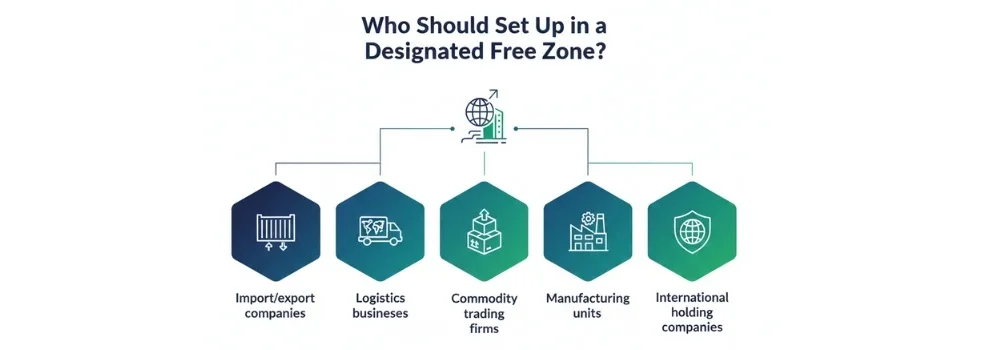
Who Should Set Up in a Designated Free Zone?
Choosing the right location for your business setup depends heavily on your industry and how you handle goods. While any free zone offers benefits like 100% ownership, designated free zones in the UAE are specifically designed for companies that need high-volume logistics and tax-efficient trading.
Import and Export Companies
If your business moves physical products across borders, a designated zone is almost essential. These zones allow you to bring goods into the country without paying customs duties or the 5% VAT upfront.
This setup is perfect for re-exporting, as you can store, repack, or even process goods within the zone and ship them to international markets without ever triggering a local tax bill.
Logistics Businesses
Companies that manage warehouses, shipping, and distribution thrive in designated zones in the UAE VAT because of their proximity to major ports and airports.
Being in a fenced area with direct customs oversight means you can offer faster turnaround times for your clients. It also simplifies your cash flow, as goods moving between other designated zones remain “out of scope” for VAT.
Commodity Trading Firms
Under the latest 2026 rules, commodity traders get significant relief in these zones. Whether you are trading metals, energy, or even environmental commodities like carbon credits, doing so through a designated zone in the UAE often qualifies you for the 0% Corporate Tax rate.
This makes the UAE one of the most competitive hubs in the world for large-scale commodity exchange.
Manufacturing Units
Manufacturers benefit from the “outside the UAE” status of these zones when importing raw materials. You can bring in the components you need, assemble your products, and then decide whether to sell them locally (paying VAT at the border) or export them globally (staying tax-free).
This flexibility is a major reason why industrial giants choose the list of designated free zones in the UAE for their regional bases.
International Holding Companies
Even if you don’t handle physical goods, a designated zone can be the right choice for an international holding structure. It provides a stable, highly regulated environment for managing global assets and subsidiaries.
As a qualifying free zone person UAE, a holding company can often enjoy 0% tax on dividends and capital gains, provided they meet the substance requirements by having a real presence in the zone.
Benefits of Operating in a Designated Free Zone
Setting up your business in a designated zone in the UAE offers more than just a prestigious address. These areas are engineered to support high-growth companies by removing the common financial and administrative hurdles found in many other global markets. From tax savings to complete control over your assets, the advantages are built directly into the free zone law of the UAE.
VAT Advantages on Goods
The biggest draw for traders is the unique VAT treatment. In a designated zone, goods are considered “outside the UAE” for tax purposes. This means you can import inventory, store it, or move it between other designated zones in the UAE VAT without paying the 5% tax upfront.
This “tax-free bubble” helps you keep your prices competitive and ensures your cash isn’t tied up in tax payments while products are sitting in a warehouse.
Customs Duty Exemptions
Operating within the list of designated free zones in the UAE also means you are exempt from customs duties on goods imported for re-export.
You can bring raw materials or finished products into the zone, process or store them, and ship them back out to international markets without paying any import duties. This makes the UAE an incredibly cost-effective hub for global supply chains and manufacturing units.
100% Foreign Ownership
Unlike some mainland setups that may require a local partner, companies in designated free zones in the UAE enjoy full ownership. You have total control over your business decisions, branding, and operations.
This 100% ownership, combined with independent regulations within each zone, gives international investors the confidence to build long-term headquarters in the region.
Repatriation of Profits
A major benefit for international firms is the freedom to move money. There are no currency restrictions or hidden taxes when you want to send your earnings back to your home country.
You can repatriate 100% of your capital and profits whenever you choose. This financial flexibility, paired with the status of a qualifying free zone person in the UAE, ensures that the wealth your business creates stays in your hands.
Strategic Port & Airport Access
Most designated zones in the UAE are physically connected to the country’s world-class infrastructure. For example, JAFZA is built around one of the world’s largest container ports, while DAFZA is located right next to a major international airport.
This “gate-to-gate” access means your goods move from the ship or plane directly into your warehouse with minimal transit time, cutting your logistics costs and speeding up your delivery schedules.
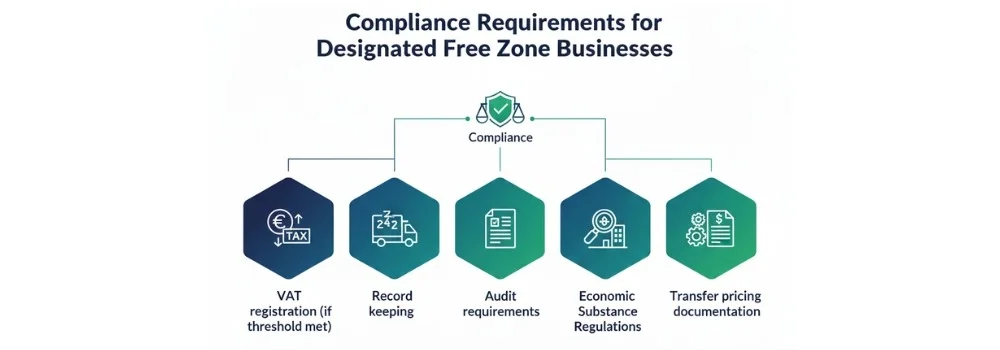
Compliance Requirements for Designated Free Zone Businesses
Running a business in a designated zone in the UAE comes with specific responsibilities. The government offers great tax benefits, but in exchange, they expect high levels of transparency and record-keeping. Staying on top of these rules ensures your business keeps its “Designated” status and avoids unnecessary fines.
VAT Registration
Even if you operate in a designated zone in the UAE VAT bubble, you must register for VAT if your taxable sales and imports exceed AED 375,000 over 12 months.
You can also choose to register voluntarily if your turnover is above AED 187,500. This is often a smart move for startups, as it allows you to reclaim VAT on your startup costs, like office fit-outs or equipment, while staying compliant with the vat registration requirement in UAE.
Record Keeping
The free zone law in the UAE is very strict about paperwork. You must keep all your financial records, including invoices, customs documents, and bank statements, for at least five years. These records must be clear enough for the Federal Tax Authority (FTA) to track every item that entered or left your facility.
If you move goods between designated zones in the UAE, having the correct “Bill of Entry” and shipping papers is the only way to prove the transaction was tax-free.
Audit Requirements
For 2026, most companies in these zones must undergo a yearly financial audit. This is especially true if you want to be a qualifying free zone person in the UAE and claim the 0% Corporate Tax rate.
An independent auditor must check your books to confirm that your income is “qualifying” and that you have followed all local regulations. These audited statements are usually required by the free zone authority to renew your trade license.
Economic Substance Regulations (ESR)
If your business performs certain “relevant activities” like shipping, distribution, or acting as a holding company, you must follow Economic Substance Regulations.
This means you must prove that your business has a real “substance” in the UAE. You do this by showing you have a physical office, a local management team, and that your core activities happen within the designated free zones in the UAE.
Transfer Pricing Documentation
If your free zone company does business with sister companies or related partners (like a parent company in another country), you must follow transfer pricing rules.
You are required to prove that the prices you charge each other are the same as what you would charge a stranger. For larger firms, this involves keeping a “Master File” and a “Local File” that explain your pricing strategy, ensuring no profits are being unfairly shifted to avoid tax.
Common Mistakes Businesses Make
Even with the best intentions, many business owners run into trouble by oversimplifying the tax rules. The free zone law in the UAE is generous, but it is also very specific.
Small errors in how you label a transaction or where you store your goods can quickly lead to unexpected tax bills or penalties from the Federal Tax Authority.
Assuming All Free Zones are Designated
One of the most frequent errors is thinking that every free zone in the Emirates offers the same VAT benefits. In reality, there is a very specific UAE VAT-designated zone list.
If you set up in a popular zone that isn’t officially “designated,” you are treated just like a mainland company for VAT purposes. Always double-check the status of your specific zone before signing a lease or moving inventory.
Misunderstanding VAT on Services
Many entrepreneurs believe that being in a designated zone in the UAE makes their entire business “tax-free.” However, the “out of scope” rules almost exclusively apply to physical goods.
If you are providing services like consulting, design, or software development, you are usually required to charge the standard 5% VAT, even if your client is also based in a designated zone.
Improper Invoicing
Invoicing is where most compliance issues start. To benefit from the 0% rate, your invoices must clearly show the correct tax treatment and include the necessary customs references.
If you fail to mention that a transaction is between two designated zones in UAE VAT, or if you miss a mandatory tax ID number, the FTA may view the sale as a standard taxable transaction during an audit.
Failing to Maintain Stock Records
Because these zones are “outside the UAE” for tax, the government needs to know exactly what is inside the fence. If your physical stock doesn’t match your digital records, or if you can’t produce the “Bill of Entry” for a specific shipment, you may be accused of “smuggling” goods into the local market.
Maintaining a real-time, accurate inventory log is a non-negotiable part of operating in designated free zones in the UAE for VAT benefits.
Ignoring Corporate Tax Qualification Tests
With the introduction of new rules for 2026, simply having a license is no longer enough to avoid tax. Many businesses fail to monitor whether they actually meet the criteria to be a qualifying free zone person in the UAE.
If you don’t meet the “adequate substance” test or if you earn too much “non-qualifying” income from the mainland, you could lose your 0% tax status and be hit with the standard 9% Corporate Tax rate.
How to Choose the Right Designated Free Zone in the UAE
With over 40 options across the Emirates, picking the right location is about more than just finding the lowest price.
A designated zone in the UAE should act as a strategic partner for your business, offering the specific tools you need to scale. For 2026, here are the key factors you should weigh before making your decision.
Type of Business Activity
The first step is matching your license to the zone’s specialty. Some zones are built for heavy industry, while others focus on high-tech or luxury goods. For example, if you trade in gold or diamonds, the list of designated free zones in the UAE points directly to DMCC.
If you are in aviation or electronics, a zone like DAFZA offers a specialized ecosystem where you’ll be surrounded by similar companies and experts.
Warehousing Requirements
If you handle physical goods, the quality and size of available warehouses are vital. In a designated zone in the UAE VAT area, your warehouse must meet strict “fenced” security standards to maintain its tax-free status.
Some zones offer small “flexi-warehouses” for startups, while others like JAFZA provide massive industrial plots for large-scale manufacturing. Always check if the facility can grow with your business so you don’t have to move as you scale.
Proximity to Ports
Time is money in logistics. Choosing a zone close to a major gateway can significantly cut your transport costs and delivery times.
Zones like KEZAD in Abu Dhabi offer direct access to deep-water ports, while designated free zones in the UAE, like Dubai South, sit right next to Al Maktoum International Airport. If your business relies on fast shipping, being “gate-to-gate” with a port or airport is a massive competitive advantage.
Banking Support
Opening a corporate bank account is one of the biggest hurdles for new businesses. Some zones have stronger relationships with local and international banks, making the “Know Your Customer” (KYC) process much smoother.
Established hubs like DMCC and JAFZA are well-recognized by UAE banks, which can lead to faster account approvals and better credit facilities for qualifying free zone person UAE entities.
Cost Comparison
While it is tempting to go for the cheapest option, you must look at the total cost of ownership. A license in a northern emirate like Umm Al Quwain or Ras Al Khaimah might have a lower upfront fee, but you need to factor in the cost of visas, office rent, and the “renewal” fees that kick in after the first year.
Use the free zone law UAE to your advantage by comparing bundled packages that include your license, office space, and visa quotas in one transparent price.
Why Work With a UAE Free Zone & Tax Consultant?
Setting up in a designated zone in the UAE is a smart move for growth, but it requires careful attention to detail. Managing your daily operations while staying up to date with the latest Federal Tax Authority (FTA) updates can be a balancing act.
Working with a dedicated tax consultant in Sharjah, like HFA Consulting, allows you to focus on your customers while experts handle the complexities of the tax system.
Free Zone Selection Advisory
Picking the right home for your business is about more than just the setup fee. We analyze your trade routes and business goals to find the specific designated zones in the UAE that offer the most strategic advantages.
Whether you need a location that simplifies international shipping or one that offers specialized licenses, we provide the data you need to make an informed choice.
VAT Structuring Strategy
We help you organize your business transactions to make the most of the UAE free zone VAT rules. By correctly identifying which sales are “out of scope” and which require the standard 5% rate, we protect your cash flow.
Our goal is to ensure your supply chain remains tax-efficient without ever stepping outside the legal boundaries.
Corporate Tax Qualification Support
Securing a 0% tax rate as a qualifying free zone person in the UAE involves more than just having a license. We review your office setup, staffing, and income streams to ensure you meet the “adequate substance” requirements.
We help you stay within the 2026 guidelines so your business can enjoy the maximum tax relief available.
Ongoing Compliance Management
The free zone law UAE requires consistent record-keeping and regular filings. From managing your VAT returns to ensuring your annual financial statements are audit-ready, we take the administrative burden off your plate.
This ongoing support prevents the small bookkeeping errors that often lead to larger issues during an FTA inspection.
FTA Representation
Communication with the authorities should be clear and professional. We act as your bridge to the government, helping with everything from registration to complex tax clarifications.
If your business is selected for a routine audit, we provide the documentation and expertise needed to represent your interests and ensure a smooth process.
Conclusion
Choosing to operate within designated free zones in the UAE is one of the most effective ways to combine global reach with a highly efficient tax structure.
By getting the details right from your initial zone selection to the way you handle every invoice, you can protect your profit margins and ensure your business remains fully compliant with the free zone law in the UAE.
As the 2026 regulations continue to evolve, staying informed and organized is the best way to turn these tax rules into a long-term competitive advantage for your brand.
FAQS
What is the difference between a free zone and a designated free zone?
A regular free zone is part of the UAE for VAT purposes. A designated zone in the UAE is a fenced area with customs security that is treated as being “outside” the country for VAT on goods, allowing for tax-free trade and storage.
Are services zero-rated in designated free zones?
Usually, no. UAE free zone VAT rules apply the standard 5% tax to services like consulting or management. The “tax-free” status of a designated zone mostly applies to physical goods, not professional services.
Is corporate tax applicable in designated free zones?
Yes, but you can often pay 0%. If you are a qualifying free zone person in the UAE with a real office and “qualifying income,” your tax rate is 0%. Otherwise, you may have to pay the standard 9% rate on certain profits.
Can designated free zone companies trade with the mainland UAE?
Yes, but it triggers tax. Moving goods to the mainland is treated as an import and requires VAT payment. Additionally, making too much money from mainland clients could affect your 0% corporate tax status.
Do I need VAT registration?
Yes, if you meet the limits. Regardless of your zone, you must register if your taxable turnover exceeds AED 375,000. Many businesses register at AED 187,500 to stay ahead of free zone law requirements in the UAE and reclaim costs.


Zeeshan Khan
My name is Zeeshan Khan, and I’m a UAE-based business and tax consulting professional with hands-on experience in VAT compliance, corporate tax advisory, business setup, and regulatory services. I work closely with startups, SMEs, and established companies to help them navigate UAE tax laws, improve compliance, and make informed financial decisions. With a strong understanding of FTA regulations, corporate structuring, and commercial taxation in the UAE, my focus is on translating complex laws into clear, practical guidance for business owners. Through my writing, I aim to provide accurate, up-to-date insights that help businesses stay compliant, reduce risk, and operate confidently in the UAE market.