
Muhammad Saad
Accountant

Zeeshan Khan
Client Accounting Manager





Are you sick to death of getting bogged down in the UAE tax compliance process? The moment you hit that VAT registration milestone is a huge one for your business, but let's be real, the paperwork is a total nightmare if you don't have your act together.
Whether you're past the mandatory threshold or you're taking the plunge early to give your brand a bit of credibility, the very first question that needs answering is: what on earth do you need to send over to the Federal Tax Authority (FTA)?
Getting your VAT registration paperwork sorted is the key to a hassle-free application that doesn't end in rejection. From your trade licences to who owns the place, having a checklist at the ready means you avoid getting into a perpetual loop of the "we need a bit more information" email, you know the one?
Ready to clear some of that clutter and get that TRN without losing your mind? Alright then, let's get down to the nitty-gritty of the documents you really need for VAT registration in the UAE so you can get back to what matters – running your business properly.
In the UAE, Value Added Tax (VAT) is a 5% indirect tax applied to the consumption of goods and services. Since its introduction, it has become a cornerstone of the nation's fiscal policy, ensuring a stable revenue stream for public services.
But what does it actually mean for your business? Essentially, VAT Registration is the process by which a business notifies the Federal Tax Authority (FTA) that it is active in the taxable market.
Once registered, the business acts as a tax collector for the government, charging VAT on sales and reclaiming VAT paid on business expenses.
Once your VAT registration is approved, the Federal Tax Authority issues a Tax Registration Number, also known as TRN. This is a unique 15-digit number that acts as your business tax identity in the UAE.
Your TRN confirms that your business is officially registered for VAT and is authorized to charge VAT on taxable goods and services. It is also required for all communication and reporting with the Federal Tax Authority.
| Where TRN is required | Why it is important |
| Tax invoices | Shows that VAT is charged by a registered business |
| Credit notes | Ensures proper adjustment of VAT in transactions |
| VAT returns | Used for filing and reporting VAT to the FTA |
| Official FTA communication | Identifies your business in all tax related matters |
Using your TRN correctly is important for compliance. Missing or incorrect TRN details can lead to issues in VAT reporting and may result in penalties.
Upon successful registration, the FTA issues a Tax Registration Number (TRN). This unique 15-digit identifier is your business's "tax identity." You must include your TRN on all:
Knowing when to register is critical to avoid heavy penalties (which can reach AED 10,000 for late registration).
The requirements depend on your "taxable turnover," which includes standard-rated supplies, zero-rated supplies, and imported goods/services.
You must register for VAT if:
You can choose to register if:
For business owners running multiple entities, tax Group VAT Registration is a strategic move.
It allows two or more "legal persons" to register as a single taxable entity if they are residents in the UAE and share common control (e.g., one person or a group of partners owns all companies).
Getting your paperwork right is the difference between a quick approval and a long, frustrating delay. To ensure your application with the Federal Tax Authority (FTA) goes off without a hitch, you need to gather specific legal and financial records.
Here is exactly what you need to have ready on your desktop before you start the online application.
The foundation of your application is your Trade License Copy. Whether you operate in the UAE difference between freezone and mainland, this document proves your business is a legal entity authorized to trade.
Along with the license, you must provide the Memorandum of Association (MOA) or a Partnership Agreement. These legal documents are essential for LLCs and partnerships because they outline the ownership structure and define who holds the authority within the company.
The FTA requires clear Passport and Emirates ID Copies for all business owners, partners, and shareholders.
If you are a resident, your Emirates ID must be valid and scanned clearly on both sides. For international investors or partners who do not reside in the UAE, a high-quality passport copy is mandatory to verify their identity and involvement in the business.
You cannot complete the registration without verified Contact Information. This includes an active UAE mobile number and a professional, monitored email address, as the FTA will send all future tax correspondence and your TRN certificate here.
Additionally, you must provide your Bank Account Details, specifically an official IBAN letter from your bank. This letter must clearly state the company's name (matching the trade license), the bank name, and the branch to facilitate future tax refunds or payments.
Perhaps the most scrutinized part of your application is the Financial Documents. You must provide concrete turnover proof for the last 12 months to show you have met the mandatory or voluntary thresholds.
This typically includes audited or unaudited financial statements, as well as a collection of sample sales and purchase invoices. These documents prove that your business is active and justify your request for a Tax Registration Number.
If your business involves moving goods across borders, a Customs Code is often required. This is specifically for import and export businesses that are already registered with UAE Customs.
Providing this code links your tax profile with your import/export activities, ensuring that VAT on imported goods is correctly accounted for through the reverse charge mechanism.
To complete your application, the FTA needs to understand the "what" and the "how much" of your operations. This isn't just a formality; it determines your tax category and confirms that you actually qualify for a TRN.
You must provide a clear and specific description of the goods or services your business sells. Avoid vague terms like "trading" or "consultancy." Instead, use precise language that aligns with your trade license, such as "wholesale of mobile electronic components" or "IT managed services for healthcare providers."
The FTA uses this to see if your activities are standard-rated (5%), zero-rated (0%), or exempt from VAT altogether. If your business has multiple revenue streams, list the primary activity first, followed by any secondary services.
The FTA doesn't just look at where you've been; they look at where you're going. You are required to provide an estimate of your taxable supplies and imports for the next 30 days.
This is a crucial metric for businesses that are just starting or have recently signed a major contract that will push them over the AED 375,000 mandatory threshold. To support this figure, you should have backup documents ready, such as:
Depending on your business structure or location, the Federal Tax Authority (FTA) may require specific "supplementary" paperwork to validate your tax status. Providing these correctly from the start prevents your application from being flagged for manual review.
If your business is based in a UAE Free Zone (such as DMCC, DIFC, or JAFZA), your Free Zone License is the primary document required to verify your legal standing. Unlike mainland companies, you must also provide a valid Lease Agreement for your physical office or warehouse within that zone.
In compliance with UAE Free Zone Tax Regulations, If your Free Zone entity is involved in the movement of goods, you must include your Customs Registration details. This ensures the FTA can track imports and apply the correct VAT treatment for "Designated Zones" versus non-designated areas.
For a Sole Establishment, the business and the individual are legally the same. Therefore, the Owner's Personal Documents, including a high-resolution scan of the Emirates ID and Passport, carry more weight.
You must also provide clear Proof of Business Activities, such as recent bank statements in the owner's name that show business-related transactions or copies of signed contracts with clients.
This helps the FTA distinguish between personal income and taxable business turnover.
When registering multiple entities under a single Tax Registration Number, you must submit Related Company Documents for every member of the group.
This includes the trade licenses and MOAs for each subsidiary. The most critical requirement here is the Proof of Common Ownership. You must demonstrate that one person, or a group of the same partners, owns or controls more than 50% of each company.
This is usually proven through a shareholder certificate or an organizational chart clearly showing the relationship between the parent company and its affiliates.
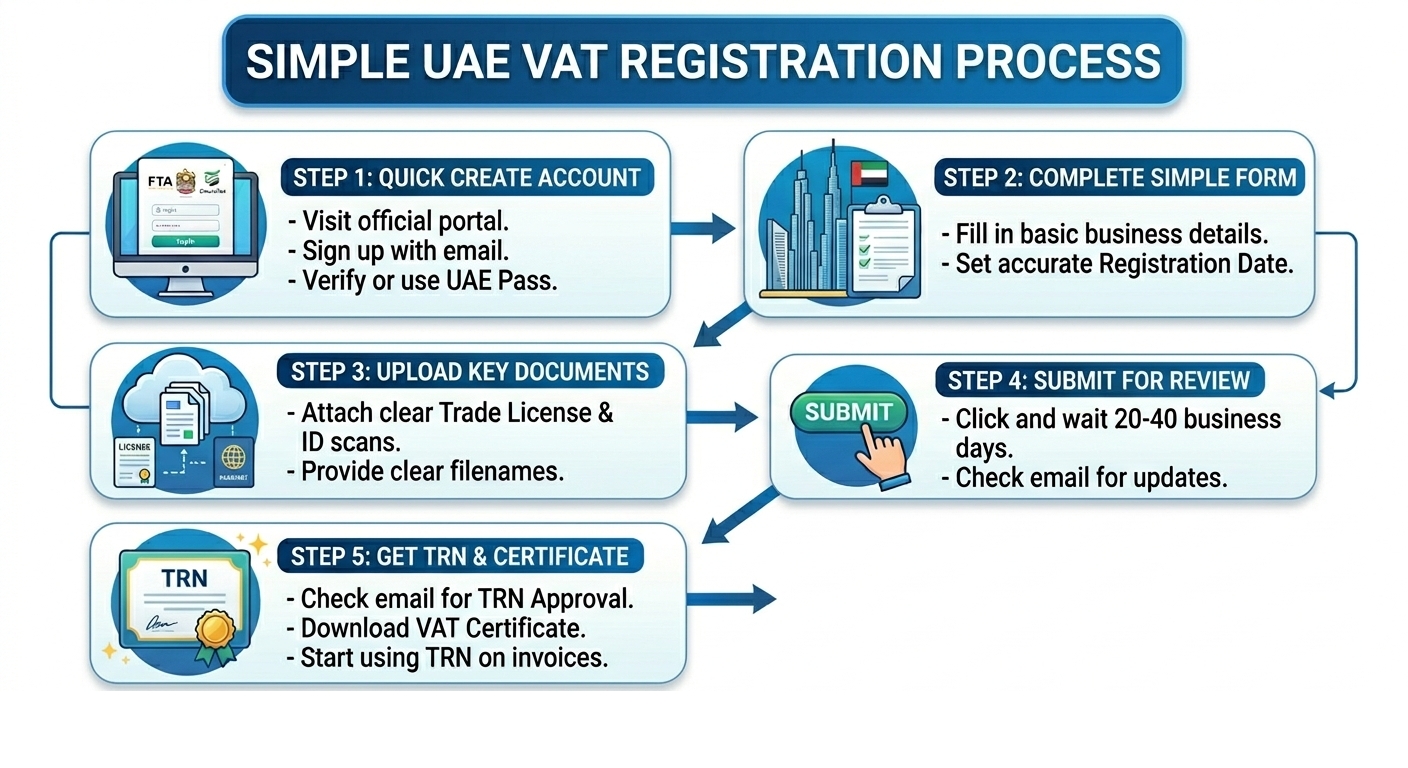
Piloting the Federal Tax Authority (FTA) portal is straightforward if you have your digital folder ready. The UAE has modernized the process through the EmaraTax platform, making it faster and more user-friendly. Here is the exact path to securing your TRN.
Your journey begins at the official Federal Tax Authority e-Services portal. You will need to sign up using a valid email address and create a strong password.
Once you verify your email, you can log in to your dashboard. For a more seamless experience, many businesses now use UAE Pass to log in, which automatically verifies your identity and speeds up the initial setup.
Once logged in, look for the option to "Register for VAT." This opens the VAT101 form. You will be asked to enter comprehensive business and financial details, including your legal name (in both English and Arabic), your trade license information, and your turnover figures.
Accuracy is non-negotiable here; ensure the "Date of Registration" you select aligns with when you actually crossed the threshold to avoid late-registration fines.
This is where your preparation pays off. You must upload all required documents as clear, high-resolution PDF or JPEG files. The portal will have specific slots for your trade license, passport copies, and financial statements.
If your files are blurry or the edges are cropped, the FTA may reject the application, causing a delay of several weeks. Ensure each file is named clearly (e.g., "Trade_License_2026.pdf") to make the reviewer's job easier.
After a final review of your data, hit the submit button. Your application enters the Review Process, where an FTA officer checks your documents against UAE tax law.
Typically, this takes anywhere from 20 to 40 business days, though it can be faster if your documentation is perfect. Keep an eye on your email, as the FTA may request "Further Information" if they find any discrepancies in your turnover proof.
Congratulations! Once approved, you will receive an official Approval Notification via email. Your 15-digit Tax Registration Number (TRN) will be active immediately.
You can then log back into the portal to download your VAT Certificate. This document should be printed and displayed prominently at your place of business, and your TRN must now be added to every tax invoice you issue moving forward.
Even a tiny error on your application can trigger a rejection or, worse, a fine. The Federal Tax Authority (FTA) is meticulous, so you must be too. To keep your registration on track, steer clear of these frequent pitfalls:
Time is money, especially when you are waiting for a TRN to start invoicing your clients. While the digital process is fast, the review period depends entirely on the quality of your submission.
In 2026, the standard processing time for a VAT application is between 5 and 20 working days. If your application is "Clean" (meaning all documents are perfect and numbers align), you could see an approval in just one week. However, the FTA technically has up to 20 business days to provide an initial response.
Understanding the costs associated with VAT registration is essential for budgeting. While the process is designed to be accessible, there are two main types of costs you should consider:
As of 2026, the Federal Tax Authority (FTA) does not charge a fee for the VAT registration process itself.
Creating an account on the EmaraTax portal, submitting your VAT101 form, and receiving your digital TRN certificate are all free services provided by the UAE government.
This is part of the nation's initiative to support business growth and simplify digital compliance.
Many business owners choose to hire a tax consultant or certified accountant to handle their application. While not mandatory, professional help ensures that your turnover calculations are accurate and your documents are "FTA-ready."
Fees for these services typically range from AED 2,000 to AED 5,000, depending on the complexity of your business structure (e.g., if you are applying for Group VAT Registration).
To ensure clarity regarding the 2026 UAE VAT legal framework, here is a comprehensive breakdown of the penalties and compliance rules formatted as a table.
Based on Federal Tax Authority (FTA) laws, including Cabinet Decision No. 75 of 2023 and the 2026 unified tax interest updates.
| Category | Violation Description | Penalty Amount (2026 Law) |
| Late Registration | Failure to submit a VAT registration application within 30 days of hitting the threshold. | AED 10,000 (Fixed Administrative Penalty) |
| Late Tax Payment | Failure to pay the tax due by the specified deadline (calculated from the date registration should have occurred). | 14% per annum interest (Calculated monthly at approx. 1.17%) |
| Late Return Filing | Failure to submit a Tax Return within the timeframe specified by the FTA. | AED 1,000 for the first time; AED 2,000 for repetition within 24 months. |
| Voluntary Disclosure | Submitting a disclosure to correct errors in a previous return before an FTA audit begins. | 1% monthly penalty on the tax difference from the original due date. |
| Post-Audit Disclosure | Correcting errors after being notified of an FTA audit or during the audit process. | 15% fixed penalty + 1% monthly interest on the tax difference. |
| Record Keeping | Failure to maintain required financial records, invoices, and ledgers (Digital or Physical). | AED 10,000 for the first time; AED 20,000 for repetition. |
| E-Invoicing (New) | Failure to issue compliant electronic invoices for businesses mandated under the 2026 Digital Tax Initiative. | AED 100 per invoice (Capped at AED 5,000 per month). |
| Tax Evasion | Intentional failure to register or pay tax with the purpose of defrauding the FTA. | Up to 3x the tax amount plus potential criminal prosecution. |
| Threshold Type | 12-Month Rolling Turnover | Action Required |
| Mandatory Registration | AED 375,000 | Must apply within 30 days of the month-end. |
| Voluntary Registration | AED 187,500 | May apply to recover input tax on expenses. |
| De-registration | Below AED 187,500 | Must apply to de-register within 20 days of the trigger. |
For businesses navigating the complexities of the 2026 tax laws, it is highly recommended to engage with a professional firm like HFA Consultant to ensure full compliance with the Federal Tax Authority's latest mandates.
These specialists provide end-to-end support, from assessing your mandatory registration triggers and managing the EmaraTax portal submissions to advising on the newly implemented e-invoicing standards.
By utilising professional VAT consultancy services in Dubai, companies can effectively mitigate the risk of the AED 10,000 late registration penalty and ensure that all backdated tax calculations and voluntary disclosures are handled with technical precision to safeguard the business audit firms UAE.
To ensure a seamless transition into the UAE's tax system, businesses must prepare a comprehensive suite of documents, including the Trade License, Passport, and Emirates ID copies of owners or partners, the Memorandum of Association (MOA), and detailed financial statements verifying the 12-month rolling turnover.
Maintaining accurate documentation is not merely a formality but a critical defense against the AED 10,000 late registration penalty and the 14% annual interest on unpaid tax liabilities as mandated by the 2026 regulations.
Given the increased complexity of the EmaraTax portal and the newly integrated e-invoicing standards, it is highly recommended to consult VAT experts to navigate the registration process correctly, thereby mitigating audit risks and ensuring long-term fiscal compliance.
Accountant
Client Accounting Manager
Clear answers to your most pressing questions about VAT registration documents, requirements, and compliance in the UAE.

Compliance and clarity starts with accurate bookkeeping. If your records aren’t accurate, your business is headed for trouble. The good news? It only takes one decision to change the course.
Phone: 052 110 1467
Email: finance@hfaconsulting.ae

70+ Businesses served
Helped businesses gain compliance and smoother financial management.

20+ Active clients
Offering specialized financial consultancy services to businesses across UAE.
Let us know your challenge and business overview to get a proposal.