

 Zeeshan Khan
 Mar 2, 2026
Table of Contents
Ever wondered if a tiny mistake on your bill could cost you thousands of dirhams? In the UAE, business moves fast, but the Federal Tax Authority (FTA) moves even faster when it comes to compliance. Since VAT became a part of daily life, keeping your paperwork in order isn’t just a “good idea”; it’s a legal must-have to keep your business running smoothly.
If you’re still using old templates or scratching your head over the latest rules, you’re in the right place. An incorrect invoice can lead to hefty penalties and even stop your customers from claiming their tax back. Let’s break down the FTA tax invoice format so you can stay safe, professional, and audit-ready in 2026.
What Is an FTA-Compliant Tax Invoice?
In the simplest terms, an FTA-compliant tax invoice is a legal document that proves a taxable sale took place in the UAE.
Under UAE VAT law, it isn’t just a piece of paper; it’s the official record the government uses to track the 5% VAT. If your document doesn’t have the words “Tax Invoice” clearly printed on it, the FTA doesn’t consider it valid.
So, when do you actually need to hand one over? As a VAT-registered business, you are required by law to issue a tax invoice whenever you sell goods or services. Usually, you have 14 days from the date of the supply to get that invoice into your customer’s hands.
Standard vs. Simplified: Which One Do You Need?
The FTA knows that a massive corporate deal shouldn’t have the same paperwork as a quick coffee run. That is why they created two specific versions of the FTA tax invoice format:
- Simplified Tax Invoice: This is the “quick” version. It is used for retail sales to everyday consumers or for B2B transactions where the total value is under AED 10,000. It requires fewer details, mostly just the seller’s info, the date, and the VAT amount.
- Standard Tax Invoice: This is the “full” version. You must use this for any B2B sale over AED 10,000. It is much more detailed and must include the buyer’s name, address, and their 15-digit TRN.
Using the correct tax invoice format, FTA guidelines ensure that your clients can actually claim back the VAT they paid you. If you give a “Simplified” invoice for a 50,000 AED deal, your client’s accounting department will likely send it right back!
Mandatory Requirements for FTA Invoice Format
Getting the details right isn’t just about looking professional; it’s about following the law. If you are issuing a standard tax invoice (for B2B transactions over AED 10,000), there is a strict checklist you must follow. Missing even one of these could lead to an audit or a fine.
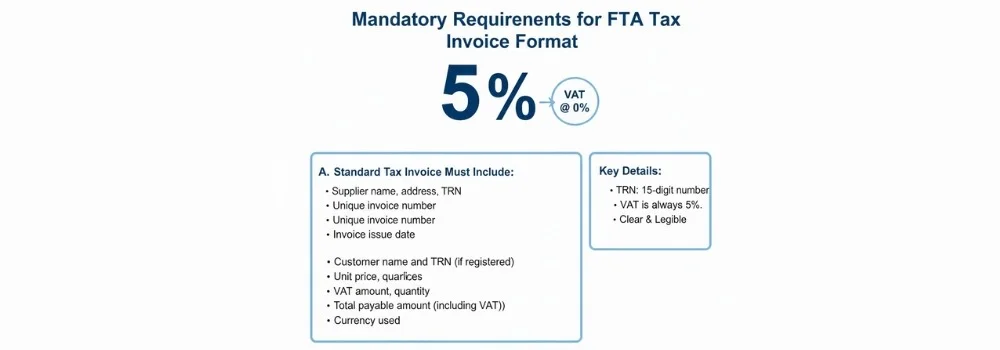
A. Standard Tax Invoice Must Include:
To stay 100% compliant with the FTA-approved invoice format, ensure your template includes:
- The Title: The words “Tax Invoice” must be clearly and prominently displayed.
- Supplier Information: Your full legal business name, physical address, and your 15-digit Tax Registration Number (TRN).
- Recipient Information: The name and address of the customer. If they are VAT-registered, you must also include their TRN.
- Identifying Numbers: A unique, sequential invoice number to keep your records organized.
- Important Dates: The date the invoice was issued and the “Date of Supply” (the actual day the goods or services were delivered, if different from the issue date).
- Product/Service Details: A clear description of what was sold, the unit price, and the quantity.
- The VAT Breakdown: You must show the 5% VAT rate separately for each item, along with the total VAT amount.
- Currency Compliance: The total amount payable must be expressed in UAE Dirhams (AED). If you are invoicing in a foreign currency, you must show the conversion rate used (from the UAE Central Bank) and the final amount in AED.
- Discounts: If you offered a discount, it must be clearly stated on the invoice to show how the final VAT was calculated.
Quick Tip: If your sale involves the Reverse Charge Mechanism (often for imports or specific construction services), you must include a statement on the invoice clearly mentioning that the “customer is liable to account for VAT.”
B. Simplified Tax Invoice (for Small Transactions)
Not every sale requires a multi-page document. The FTA allows for a “Simplified Tax Invoice” to keep things moving quickly for retail businesses and smaller deals. This is the standard receipt you usually get at a grocery store or a coffee shop.
When can you use it? You are eligible to issue a simplified invoice in two specific cases:
- B2C Sales: When the customer is an individual (not a business) or is not registered for VAT.
- Small B2B Sales: When the customer is VAT-registered, but the total value of the sale is AED 10,000 or less.
Even though it’s “simplified,” it still has to follow a specific FTA-approved tax invoice format. If you miss a field, it’s just a piece of paper, not a legal tax document.
Required Fields for Simplified Invoices
To help you stay compliant, here is a quick breakdown of exactly what needs to be on your simplified receipt:
| Feature | Requirement Details |
| Document Title | The words “Tax Invoice” must be clearly visible at the top. |
| Seller Info | Your legal business name, address, and your 15-digit TRN. |
| Date | The date the invoice was issued. |
| Line Items | A clear description of the goods or services provided. |
| Total Amount | The total amount payable (Gross amount). |
| VAT Amount | The specific amount of VAT charged (5%) must be shown. |
FTA Invoice Format Sample Structure
Visualizing the layout is the best way to ensure your FTA tax invoice format is correct. Think of your invoice as having three main “zones”: the Header (Who you are), the Body (What you sold), and the Footer (The final math).
If you place your Tax Registration Number (TRN) in a tiny font at the bottom, you’re asking for trouble. It should be bold, clear, and easy for any auditor to find at a single glance.
The Standard Layout Example
Here is how a professional, FTA-approved tax invoice format looks when structured correctly:
| Section | Content Breakdown |
| Top Header | TAX INVOICE (Must be the main title) |
| Seller Info | Your Company Name, Address, and TRN: 100xxxxxxxxxxxx |
| Buyer Info | Customer Name, Address, and Customer TRN (Mandatory for Full Invoice) |
| Invoice Meta | Invoice Number (e.g., INV-2026-001) and Issue Date |
| Line Items | Description, Unit Price, Quantity, and Taxable Amount per item |
| Tax Column | VAT Rate (5%) and VAT Amount per line item |
| Footer (Math) | Total Excluding VAT, Total VAT Amount, and Total Payable (AED) |
Understanding the Calculation Format
The FTA is very specific about how you show the money. You can’t just show a final “Total” and call it a day. Your FTA UAE tax invoice format must clearly “show the work.”
The Golden Formula:
- Unit Price x Quantity = Net Amount (Taxable Value)
- Net Amount x 5% = VAT Amount
- Net Amount + VAT Amount = Gross Total (Total Payable)
Important Note on Currency: If your business deals with international clients, you must still show the VAT amount in UAE Dirhams (AED). Use the official exchange rate provided by the UAE Central Bank for that specific day to stay compliant.
How to Check Your TRN Placement
The best practice is to place your TRN right under your company name at the very top. This confirms immediately that you are a registered taxpayer. If you are issuing a full invoice to another business, their TRN should be placed directly under their address. This “Double TRN” setup is the hallmark of a high-quality, professional invoice.
Common Mistakes to Avoid
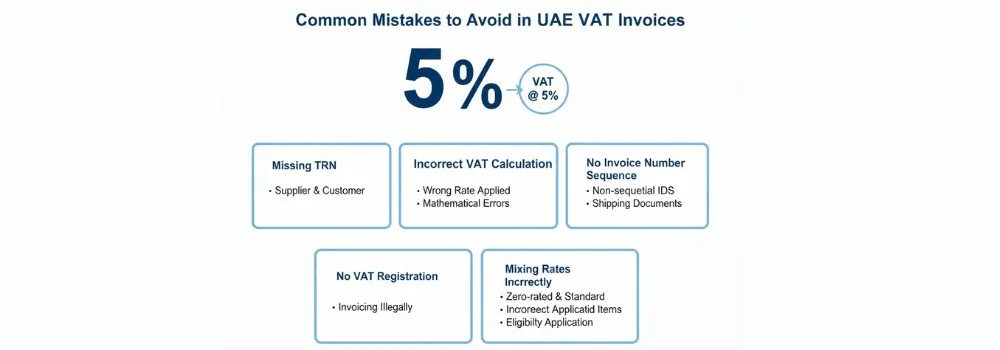
Even a small slip-up on your paperwork can flag your business for an audit. The FTA is strict about the FTA-approved tax invoice format, and “I didn’t know” isn’t a valid excuse when the fines start rolling in. Are you making any of these common blunders?
1. The “Invisible” TRN
This is the most frequent mistake. Your Tax Registration Number (TRN) is your business’s official ID. If it is missing, illegible, or even worse, incorrect, the invoice is legally invalid. A missing TRN means your customer cannot claim their VAT back, which is a fast way to lose a client.
2. Messy VAT Math
Math is hard, but the FTA expects perfection. A common error is calculating VAT on the final total instead of per line item, or rounding the numbers incorrectly. In an FTA tax invoice format, every fil (cent) counts. If your totals don’t match your line items, you’re asking for a penalty.
3. Jumping the Invoice Sequence
Your invoice numbers must be unique and sequential (e.g., INV-001, INV-002). If you have gaps in your numbering or repeat a number, it looks like you are hiding income or deleting sales. Keep your records in a straight line to keep the auditors happy.
4. Charging VAT Without a TRN
This is a serious legal offense. You cannot issue a “Tax Invoice” or collect 5% from customers unless you have an official TRN from the FTA. If you are still waiting for your registration, you should issue a regular bill, not a tax invoice.
5. Mixing Tax Rates Incorrectly
In the UAE, some items are 5% (Standard-rated), some are 0% (Zero-rated), and some are Exempt. If you sell a mix of these, your FTA UAE tax invoice format must clearly label which item falls under which category. You can’t just lump them all together and hope for the best!
Pro Tip: Always double-check that your invoice date matches the actual “Date of Supply.” If you ship goods on Monday but date the invoice for the following month, you might be accidentally shifting your tax liability to the wrong period.
Penalties for Non-Compliance
Think of the FTA as a partner who values honesty but has zero tolerance for poor record-keeping. If your FTA-approved invoice format is lacking or your math is off, the financial consequences can be swift and painful.
In 2026, the UAE updated its Tax penalty framework to be more structured, but the costs for being careless are still very high.
1. Administrative Fines
The FTA doesn’t just give warnings; it issues fines. Under the latest 2026 regulations (Cabinet Decision No. 129 of 2025), here are the typical costs of a mistake:
- Missing or Incorrect Invoices: Failing to issue a proper tax invoice or credit note can cost you AED 2,500 per instance.
- Late Tax Payments: If you don’t pay your VAT on time, you’ll face a monthly penalty equivalent to 14% per annum on the unpaid amount.
- Record-Keeping Errors: Failing to keep the required records (like your invoice copies) can lead to a fine of AED 10,000, which doubles to AED 20,000 if it happens again within 24 months.
2. VAT Reassessment Risks
If an auditor finds that your tax invoice format FTA standards were ignored, they won’t just fine you; they might reassess your entire tax history. This means the FTA could decide you owe more tax than you originally reported.
Even worse, if your invoice is invalid, your customers cannot claim their 5% VAT back. Imagine having to tell a major client they just lost thousands of dirhams because your invoice was missing a TRN. That is a relationship-killer!
3. Audit Exposure
A history of messy paperwork is like a “check me” sign for the FTA. Once you are flagged for a simple mistake in your FTA Dubai latest invoice format, you are much more likely to be selected for a full tax audit.
A full audit is time-consuming, stressful, and involves a deep dive into every single dirham that moved through your business over the last five years.
Pro Tip: The best way to sleep at night is to use VAT software Dubai that automatically locks in the correct format. It’s much cheaper to pay for good software than to pay a single FTA fine!
Tools & Software for Generating FTA-Compliant Invoices
In 2026, manually creating invoices is like trying to drive a car with a square wheel; it’s slow, bumpy, and eventually, something will break. With the UAE’s move toward mandatory e-invoicing, choosing the right tools isn’t just about convenience; it’s about survival.
The right software acts as a “safety net,” ensuring your FTA-approved invoice format is perfect every time, without you having to double-check every decimal point.
Top Accounting Software Options in the UAE
The market is full of great choices, but here are the heavy hitters that businesses in Dubai and across the Emirates trust:
- Zoho Books: Highly popular for its local focus and direct integration with the FTA portal for filing returns.
- TallyPrime: A classic favorite for its speed and reliability, especially for businesses with heavy inventory.
- QuickBooks Online: Known for being incredibly user-friendly and great for small businesses on the move.
- Xero: Perfect for startups and those who want a clean, modern interface with great cloud features.
- Wafeq: A newer, local favorite designed specifically for Middle Eastern tax laws and e-invoicing.
The Massive Benefits of Automation
Why should you bother with automated systems? Because “human error” is one of the biggest reasons for FTA fines. Automation offers:
- Real-Time Compliance: As rules change (like the 2026 e-invoicing updates), cloud software updates automatically. You don’t have to study the law; the software already knows it.
- Faster Payments: Automated systems can send “gentle nudges” to customers with overdue bills. Faster invoices lead to faster cash flow.
- Audit-Ready Records: Instead of digging through folders, you can generate a full audit report with three clicks.
- Perfect Math: No more rounding errors. The software calculates the 5% VAT per line item instantly.
Why Cloud-Based Tools are Winning
The days of being tied to a single office computer are over. Cloud-based FTA UAE tax invoice format tools allow you to:
- Issue an invoice from your phone while at a client’s office.
- Keep your data safe with bank-level encryption (no more losing files if a laptop breaks).
- Collaborate with your accountant in real-time, even if they are in a different city.
Did You Know? The UAE is shifting toward a “paperless strategy.” By using cloud-based tools, you are future-proofing your business for the upcoming mandatory digital exchange of invoices.
Who Should Consult a VAT Specialist for FTA Invoice Compliance?
If you are managing a business with complex international transactions, high sales volume, or a mix of standard and zero-rated supplies, you should definitely seek professional advice to avoid costly errors.
Partnering with a reliable firm like HFA Consulting ensures that your business stays ahead of the latest 2026 regulations and avoids the steep administrative fines associated with improper documentation.
By utilizing expert vat consultancy services in Dubai, you can streamline your accounting workflows, accurately manage the new e-invoicing mandates, and maintain a perfectly compliant financial record that protects your profits from unexpected FTA audits.
Conclusion
Managing the world of VAT doesn’t have to be a headache. As we move through 2026, the UAE is becoming a global leader in digital tax transparency. Sticking to the FTA tax invoice format isn’t just about following rules; it’s about protecting your hard-earned cash and your professional reputation.
Whether you are running a small neighborhood cafe or a large international trading firm, your invoices are your first line of defense against costly mistakes.
By keeping your TRNs visible, your math spot-on, and your records organized through modern VAT software in Dubai, you can stop worrying about audits and start focusing on growth.
The Federal Tax Authority values transparency, and a clean, FTA-approved tax invoice format shows them and your clients that you are a serious, compliant professional.
FAQs
Is it mandatory to include TRN on every invoice?
Yes, it is absolutely required. If you are VAT-registered, you must include your 15-digit Tax Registration Number (TRN) on every document. For standard B2B invoices, you must also include the buyer’s TRN. Failing to do this makes the invoice invalid and can lead to a fine of AED 5,000 per document.
What is the VAT rate in the UAE?
The standard VAT rate is 5%. While some specific items are zero-rated or exempt, most goods and services follow this 5% rule. Always ensure your tax invoice format FTA template clearly calculates this 5% amount in UAE Dirhams (AED).
When should a simplified tax invoice be issued?
You can use a simplified invoice if the sale is made to an individual consumer (B2C) or if the sale is to a business (B2B) and the total value is AED 10,000 or less. This version requires fewer details about the buyer compared to a standard invoice.
Can I issue an invoice without being VAT registered?
No, you cannot. You are prohibited from issuing a “Tax Invoice” or charging VAT unless you have an official TRN. Doing so is a serious legal violation. If you aren’t registered, you can only issue a standard commercial bill without any tax charges.


Zeeshan Khan
My name is Zeeshan Khan, and I’m a UAE-based business and tax consulting professional with hands-on experience in VAT compliance, corporate tax advisory, business setup, and regulatory services. I work closely with startups, SMEs, and established companies to help them navigate UAE tax laws, improve compliance, and make informed financial decisions. With a strong understanding of FTA regulations, corporate structuring, and commercial taxation in the UAE, my focus is on translating complex laws into clear, practical guidance for business owners. Through my writing, I aim to provide accurate, up-to-date insights that help businesses stay compliant, reduce risk, and operate confidently in the UAE market.