


 Zeeshan Khan
 Mar 4, 2026
Table of Contents
Ever feel like your business is leaving money on the table every time you pay a bill? In the UAE, that “extra” 5% you pay on office rent, supplies, and services doesn’t have to be a permanent expense for your company.
Claiming your VAT refund is more than just a paperwork hurdle; it is a vital move to protect your cash flow. If your input tax exceeds your output tax, the government owes you, and it’s time to get that money back where it belongs.
Let’s explore the blog to understand exactly how you can reclaim your funds and keep your business finances in top shape.
Understanding VAT in the UAE
Before you hit the claim button, you need to know how the system works. Taxes can be confusing. The UAE makes it pretty easy for business owners.
The UAE has a system that’s not too hard to understand.
What is VAT?
VAT is a tax on the things we buy. The services we use. In the UAE, this tax is 5%. This 5 per cent tax is added at each step when things are bought and sold.
As a business, you help the government collect taxes. You take taxes from your customers. You pay taxes to the people you buy things from.
The difference between the taxes you take and the taxes you pay will decide if you owe the government money or if you get money back.
Who Needs to Register for VAT?
Not all new businesses need to register away. The Federal Tax Authority has rules to make things fair for businesses.
There are rules to follow:
- Mandatory Registration: You have to register if the things you sell and the things you bring into the country are worth more than AED 375,000 in the last 12 months.
- Voluntary Registration: You can choose to register if the things you sell or your business expenses are more than AED 187,500. This also falls under the VAT Registration Requirement.
If you want to get a VAT refund for your company in the UAE, you need to be registered and have a Tax Registration Number. If you are not registered, you cannot get back the 5 % tax you pay for your business costs.
Note: It is very important to remember that if you do not register when you are supposed to, you could get in trouble and have to pay penalties. It is better to follow the rules from the start.
What is a VAT Refund for Businesses?
In terms of a VAT refund claim, the process involves getting money back from the Federal Tax Authority. This happens when your business paid Value-Added Tax on its expenses trather han it from customers.
Instead of this money being a “cost” to your business, the UAE government allows you to reclaim it to keep your cash flow healthy.
Definition of Input VAT vs Output VAT
To get a refund, you have to know what these two things mean.
Input VAT: The tax you pay when you buy things for your business, like a laptop or office rent. You pay five % tax on these things.
Output VAT: The tax you charge to your customers when you sell them something. You also charge them a five per cent tax on the things you sell.
So Input VAT is the tax you pay. Output VAT is the tax your customers pay to you.
Essentially, you are a middleman. You collect tax for the government (Output) and deduct what you’ve already paid (Input).
When a VAT Refund Occurs
A VAT refund UAE situation occurs when your Input VAT is greater than your Output VAT.
For example, if you spend heavily on new equipment (paying lots of Input VAT) but your sales for that month are lower (collecting less Output VAT), you end up with a “negative” tax balance. This balance is what the FTA owes you.
Difference Between VAT Refund and VAT Carry Forward
When you have a credit balance, you have two choices:
- VAT Refund: You submit a formal request to the FTA, and they send the cash directly to your business bank account.
- VAT Carry Forward: You leave the credit in your FTA account. This balance will then be used to pay off the tax you owe in the next filing period.
Eligibility Criteria for VAT Refund in the AE
You do not get your money back from the FTA easily. The Authority needs to see that you are eligible for a VAT refund.
They are very particular about the documents you need to show now that there are new rules from the 2026 reforms. These new rules say you can only claim credits for a certain period of time, which is five years.
To get your UAE VAT refund for business without any problems you need to make sure you meet these requirements, for a UAE VAT refund:
1. Valid VAT Registration with the FTA
You cannot claim a refund if you aren’t officially in the system. Your business must have a valid Tax Registration Number (TRN). If you are a foreign business visitor, you must use the specific “Business Visitor Refund Scheme” during its annual open window.
2. Proper Tax Invoices
This is where most businesses stumble. For a successful input VAT claim in the UAE, your invoices must be “FTA-compliant.” This means they must clearly show:
- The words “Tax Invoice.”
- Supplier’s name, address, and TRN
- Your business name and address
- A breakdown of the VAT amount (5%)
3. Accurate Accounting Records
The FTA can request an audit at any time during the refund process. You must maintain digital records of all purchase receipts, credit notes, and ledger entries. In 2026, the FTA will have even more power to deny claims if your “traceability” is weak, so keep your books spotless.
Following proper accounting standards in UAE is essential to ensure your records are compliant and to avoid issues during audits.
4. Timely VAT Return Filing
You can only request a refund after you have successfully submitted your VAT return for that period. If you have any VAT return filing UAE gaps or outstanding penalties, the FTA will likely put your refund on hold until your account is cleared.
5. Bank Account Registered with FTA
The money doesn’t come as a check; it’s a direct transfer. You must provide a Bank Account Validation Letter (stamped by your bank) that matches your registered business name. If the names don’t match perfectly, the system will reject the payment.
Documents Required to Claim VAT Refund
The Federal Tax Authority (FTA) doesn’t just take your word for it; they need hard evidence. In 2026, the digital auditing process is faster than ever, but it’s also more precise. If your paperwork is missing one thing, you will have to wait a long time to get your VAT refund.
To make sure everything goes well, you need to have these five important papers ready on your computer so you can send them in:
1. VAT Registration Certificate
This is your “identity card” in the tax system. It proves your business is a legal tax entity with a valid Tax Registration Number (TRN). Ensure the name on this certificate matches your trade license and bank account exactly.
2. Tax Invoices
You must provide clear copies of all invoices where you paid 5% tax. A valid invoice for an input VAT claim in the UAE must show the supplier’s TRN, the date of the transaction, and the specific VAT amount charged.
3. Customs Documentation (If Applicable)
If your business imports goods into the UAE, you likely paid VAT at the port. You will need your Official Import Documents and the Customs Declaration forms to prove that this tax was settled at the border.
4. Financial Statements
The FTA may ask for your trial balance, profit and loss statement, or a general ledger extract for the period you are claiming. This helps them verify that the numbers in your VAT return filing in the UAE match your actual business activity.
5. Bank Account Details (IBAN Letter)
The FTA only sends refunds to validated accounts. You must provide an original IBAN Letter or a bank statement stamped by your bank.
Critical Check: The account name must be the same as the legal business name registered with the FTA. If you use a personal account for a corporate refund, the transfer will fail.
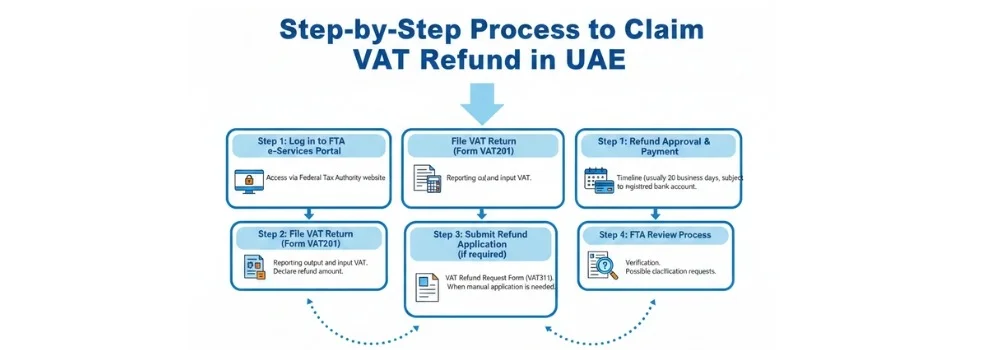
Step-by-Step Process to Claim VAT Refund in the UAE
Reclaiming your money is a digital journey. In 2026, the VAT refund process in the UAE is faster thanks to the EmaraTax platform, but you must follow the sequence perfectly to avoid being flagged.
Step 1: Log in to FTA e-Services Portal
Start by visiting the official Federal Tax Authority (FTA) website. You can log in using your registered email and password or your UAE Pass. Once inside, you’ll see your dashboard with your current “Taxable Person” account.
Step 2: File VAT Return (Form VAT201)
You need to file your VAT201 form before you can get a refund.
You have to fill out this form to show what you owe.
You will need to write down your Output VAT, which is the tax you collected from sales, and your total Input VAT, which is the tax you paid when you made purchases.
Then you need to say if you want a refund. At the end of the form, you will see how much tax you owe overall, which is called the Net Tax amount. If this number is negative, the system will ask you what you want to do. You can. Ask for a refund or save the credit for next time. You should choose Refund.
Step 3: Submit Refund Application (VAT311)
Submitting the VAT201 isn’t enough to get the cash; it only records the credit. You must then:
- Navigate to the VAT tab and select VAT Refunds.
- Open Form VAT311 (the specific request form for a business VAT refund process in the UAE).
- Fill in the amount you wish to reclaim. You can claim the full amount or just a portion.
Step 4: FTA Review Process
Once you submit your application, it goes to the “Verification” stage.
The Audit Check is a part of this process. The FTA might send you a message asking for invoices or a trial balance.
You should be responsive when the FTA contacts you. If the FTA sends you a request to clarify something, you need to answer within the time they give you. If you wait too long to answer, it can slow down the review of your application. The FTA will have to start the review process over again.
Step 5: Refund Approval & Payment
The FTA typically takes 20 business days to issue a decision. If approved:
- You will receive an email confirmation.
- The money is credited directly to your registered bank account, usually within 5 business days post-approval.
VAT Refund Timeline in the UAE
Waiting for a refund is really tough. It is even tougher when you need that money for your business plans.
In 2026, the FTA started using an automated system, but people are still reviewing things to make sure everything is okay before they give you your refund from the FTA.
Standard Processing Time
When you click the submit button for your VAT refund claim, the time starts passing. Here is what usually happens next, with your VAT refund claim:
- FTA Review: Usually takes 20 to 45 working days. During this window, the Authority verifies your numbers against your filed returns.
- Payment Disbursement: Once approved, the funds are typically transferred to your registered bank account within 5 business days.
Factors Affecting Delays
If your refund is taking longer than two months, it is usually because of one of these problems.
The main issues are:
- Verification Requests: If the Federal Transit Administration asks for invoices or extra information, the forty-five-day time limit often stops until you give them the documents. Your refund will wait until the Federal Transit Administration gets the information it needs from you.
- Bank Account Mismatches: If your bank account title differs slightly from your registered TRN name, the UAE Central Bank may reject the transfer.
- First-Time Claims: Initial refund requests often undergo a more “deep-dive” audit than subsequent claims, leading to a slightly longer wait.
- Public Holidays: You should remember that the time frame of 20 to 45 days is talking about the days when people are at work, so it does not include weekends or the official holidays in the United Arab Emirates.
How to Track Refund Status
You do not have to wait in the dark. You can track your UAE VAT refund for business now through the EmaraTax portal:
- Dashboard View: When you log in to the portal, your “Refunds” tab will show you a status bar. This bar will tell you if your refund is, Under Review” or “Approved”.
- Email Alerts: The Federal Tax Authority sends you emails whenever your refund status changes. So make sure the email address you registered in the portal is one that you check every day, so you get updates on your UAE VAT refund.
- Support Tickets: If your claim exceeds the standard 45 working days without any communication, you can raise a “Technical Support” ticket directly within the portal to ask for an update.
Common Reasons for VAT Refund Rejection
You can have the plans for your business, but sometimes things do not go as you want them to. The Federal Tax Authority made some changes in 2026. Now they use computers to check for problems, which means they can find mistakes right away.
If you want to get your VAT refund in the United Arab Emirates without any issues, you need to know what can go wrong with the VAT refund process in the UAE, so your business VAT refund process in the UAE can keep moving.
1. Incorrect Invoice Details
This is the number one culprit. A “Tax Invoice” in the UAE is a legal document with specific requirements. Your claim will likely be rejected if:
- The invoice is not titled “Tax Invoice.”
- Your TRN is missing or incorrect.
- The VAT amount is not shown as a separate line item.
- The supplier’s details are outdated or invalid.
2. Mismatch in VAT Returns
The FTA’s system cross-references your VAT return filing in the UAE with your refund request. If you claim AED 10,000 on your refund form (VAT311) but your filed return (VAT201) only shows a credit of AED 8,000, the system will trigger an automatic rejection or a deep-dive audit.
3. Non-Compliance with FTA Regulations
If your business is involved in “blocked” expenses, don’t try to claim them. For example, VAT on entertainment services (like staff parties or client dinners) or personal motor vehicles is generally non-recoverable. Including these in your VAT refund claim can lead to the entire application being denied.
4. Late Filing Penalties
In 2026, the FTA is stricter about “clean” accounts. If you have unpaid penalties for late registration or late filing, the FTA may reject your refund request until these liabilities are settled. They may also choose to “offset” your refund against what you owe in fines.
5. Incomplete Documentation
When the FTA asks for “Alternative Evidence” or bank letters, they expect a specific format. Submitting a blurry scan of a receipt or a bank statement that doesn’t show your IBAN clearly is a fast track to rejection.
VAT Refund vs. VAT Carry Forward: Which is Better?
When you have to choose between getting your money right away and using your credit later, you need to think about how well your business is doing now and what you want to achieve in the long run. The new rule that says credits can only be used for five years, which starts in 2026, makes this decision really important.
The following table shows you the differences between the two options to help you decide on your credits and your business:
| Feature | VAT Refund (Cash Payout) | VAT Carry Forward (Credit) |
| Cash Flow Impact | High. Boosts your bank balance immediately for reinvestment. | Low. Only benefits you when you have future taxes to pay. |
| Complexity | High. Requires filing Form VAT311 and often involves an FTA audit. | Low. Automatic process with zero extra paperwork. |
| Wait Time | 20–45 business days for review and payout. | Instant. The credit is applied to your next tax return. |
| Risk of Expiry | Low. Once paid, the money is yours permanently. | High. Under the 2026 rules, credits expire after 5 years if unused. |
| Best For… | Startups, exporters, and companies with large one-time expenses. | Stable companies with consistent monthly tax liabilities. |
When to Choose a Refund
You should opt for a VAT refund claim if your business falls into these categories:
- Exporters: Since you charge 0% VAT, you will almost always have a credit balance.
- Large Capital Investment: If you just bought heavy machinery or a new office, the 5% you paid back is a significant sum of money.
- Cash Flow Needs: If your business is in a growth phase and needs every Dirham for operations.
When to Carry Forward
Carrying forward is often the “stress-free” choice in these scenarios:
- Small Amounts: If the refund is less than AED 1,000, the time spent on the application might not be worth the administrative cost.
- Consistent Sales: If you know you will owe the FTA money next month, carrying the credit forward simply acts as a “pre-payment,” saving you from a bank transfer later.
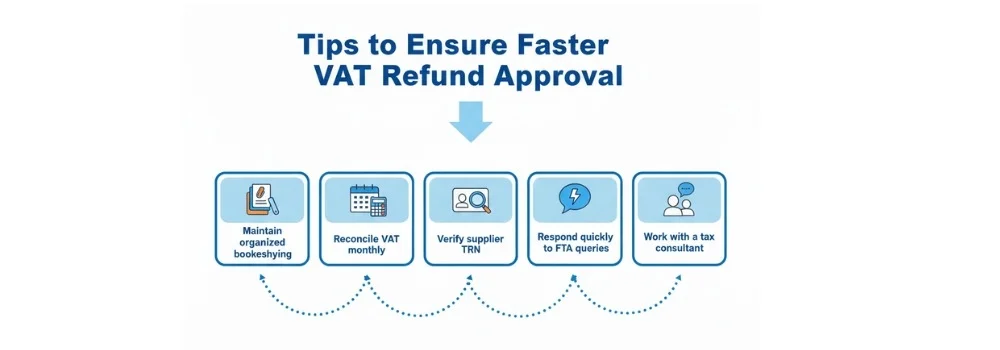
Tips to Ensure Faster VAT Refund Approval
In 2026, the Federal Tax Authority (FTA) moved toward a “real-time” audit model. While the system is faster, it is also much less forgiving.
If you want your VAT refund UAE processed without the typical 45-day wait, follow these expert-backed strategies:
1. Maintain Organised Digital Bookkeeping
The FTA now uses advanced data analytics to cross-check your filings. If they request a sample of your invoices, they expect a professional, digital audit trail.
- The 5-Year Rule: Since January 1, 2026, the FTA has enforced a strict five-year limit on all records. If your digital folders are messy, you risk failing a spot check and losing your input VAT claim in the UAE.
It’s highly recommended to follow a bookkeeping checklist to ensure all invoices, receipts, and ledger entries are properly organised and compliant.
2. Reconcile VAT Monthly (Even if You File Quarterly)
Don’t wait until the end of the quarter to check your numbers. Reconciling your sales and purchases monthly allows you to catch errors like a missing TRN or an incorrect tax rate before they become permanent on a filed return. This ensures your VAT return filing UAE is flawless every time.
3. Verify Supplier Integrity (Beyond the TRN)
As of 2026, the “should have known” rule is in full effect. The FTA now expects you to perform due diligence on your suppliers.
Action: Don’t just check if a TRN is valid on the portal; ensure the supplier actually has a physical presence and “commercial substance.” If your supplier is involved in tax evasion, the FTA can legally deny your business VAT refund process in the UAE.
4. Respond Quickly to FTA Queries
If the FTA sends a “Clarification Request” through the EmaraTax portal, the clock on your refund stops.
- The 20-Day Window: You typically have a small window to provide the requested documents. If you respond within 24–48 hours with clear, organised PDFs, it signals to the tax officer that your business is compliant, often leading to faster approval.
5. Work with a Registered Tax Consultant
Tax laws in 2026 have become more integrated with Corporate Tax and E-invoicing mandates. A registered consultant doesn’t just “do the math”; they act as a shield. They can pre-audit your VAT refund claim to find red flags that would otherwise trigger a long and expensive FTA audit.
Choosing the Right VAT Consultant for Your Business
When you think about making sure your company is safe financially, HFA Consulting is the one that can help you with this. They are very good at dealing with tax things, and they know a lot about what is going on in the local area.
Their team in Dubai is really good at helping with VAT consultancy services in Dubai and they do not just look at numbers. They try to make sure you have money, and they make sure you have all the right papers when you apply for a refund.
If you work with HFA Consulting, you will have a team that always knows what is new, with the FTA and their rules that are changing in 2026. This means you will have a partner that really cares about your business and wants to help you avoid getting in trouble and get backas much tax money as you can.
Conclusion
Claiming your VAT refund is a powerful way to reinvest in your company, provided you follow the digital steps accurately and keep your documentation spotless.
By mastering the balance between input and output tax and staying strictly compliant with FTA regulations, you protect your business from unnecessary losses and audits.
While the process is more streamlined in 2026, the complexity of new deadlines and verification rules means that even a small mistake can lead to a rejection.
If you want to ensure your application is handled with total precision, it is always a smart move to consult with experienced professionals who can secure your funds and keep your cash flow thriving.
FAQS
How long does it take to get a VAT refund in the UAE?
In 2026, it normally takes around 20 to 45 business days to get a VAT refund claim processed. When the Federal Tax Authority approves your VAT refund claim, you usually get your money back in your bank account within 5 business days after the Federal Tax Authority has approved your VAT refund claim.
Can I claim a VAT refund without being VAT registered?
For businesses that are registered, there is nominimum amount that you have to meet for a standard VAT refund in the UAE. However, a lot of businesses choose to wait until they have an amount to claim back. For people who are visiting from countries for business, the minimum amount you can claim back is usually two thousand UAE dirhams or AED 2,000, for the Foreign Business Visitor Scheme.
Is there a minimum amount required to claim a refund?
For businesses that are registered, there is no amount required to apply for a standard VAT refund in the UAE. Many businesses choose to carry smaller amounts, though. The Foreign Business Visitor Scheme has a rule. To qualify, you usually need to claim a minimum of AED 2,000.
How do I check my VAT refund status?
You can track your application in real-time through the EmaraTax portal. Simply log in, navigate to the “VAT” tab, and select “VAT Refunds.” Your dashboard will display the current status, such as “Under Review,” “Pending Information,” or “Approved.”
What happens if my refund is rejected?
If your business VAT refund process in the UAE is rejected, the FTA will provide a reason for the decision. You have the right to submit a “Request for Reconsideration” within 45 business days. Correcting documentation or addressing clerical errors often resolves these issues during the appeal process.


Zeeshan Khan
My name is Zeeshan Khan, and I’m a UAE-based business and tax consulting professional with hands-on experience in VAT compliance, corporate tax advisory, business setup, and regulatory services. I work closely with startups, SMEs, and established companies to help them navigate UAE tax laws, improve compliance, and make informed financial decisions. With a strong understanding of FTA regulations, corporate structuring, and commercial taxation in the UAE, my focus is on translating complex laws into clear, practical guidance for business owners. Through my writing, I aim to provide accurate, up-to-date insights that help businesses stay compliant, reduce risk, and operate confidently in the UAE market.