
Muhammad Saad
Accountant

Zeeshan Khan
Client Accounting Manager





VAT in the UAE isn't just another tax term you hear in business circles; it's a system that quietly shapes how companies operate every single day. Since its introduction in 2018, VAT has become a cornerstone of financial compliance, ensuring that businesses contribute fairly to the country's growth while maintaining transparency in their transactions.
For entrepreneurs and established companies alike, VAT can feel like a maze: Why was it introduced in the first place? Who exactly needs to file returns, and how often do those deadlines come around? These questions matter because filing VAT correctly isn't just about avoiding penalties; it's about building credibility, protecting your business reputation, and staying aligned with the UAE's vision of a modern, diversified economy.
As we dive into this guide, you'll discover the story behind VAT, the rules that decide whether your business must file, and the rhythm of monthly or quarterly submissions. By the end, you'll see VAT not as a burden, but as a structured system designed to keep businesses accountable and the economy thriving.
Filing VAT is not just about submitting a return on the Federal Tax Authority portal. It requires proper preparation to ensure your business is compliant, organized, and ready for review if required.
VAT Registration and TRN: The process begins with VAT registration through the Federal Tax Authority. Once approved, your business receives a Tax Registration Number (TRN), which confirms that you are officially part of the VAT system. It is important to ensure that all VAT registration requirements in the UAE are met so your TRN remains valid and active. Without a TRN, you cannot file VAT returns or claim input VAT, making this step essential for compliance.
Record Keeping: Sales, Expenses, and Invoices: VAT return filing depends on accurate financial records. Every sale, expense, and invoice should be recorded properly to reflect your business activity. The Federal Tax Authority requires businesses to maintain clear and organized records so taxable supplies and input VAT can be tracked correctly. Proper record keeping makes filing easier and helps your business stay prepared for audits.
Supporting Documents: Along with records, businesses must maintain supporting documents such as contracts, receipts, import or export papers, and credit notes. These documents act as proof of your VAT calculations and transactions. Keeping them ready ensures smooth filing and helps protect your business if the Federal Tax Authority requests verification.
Before filing your VAT return, it is important to ensure that all these requirements are properly in place. Once everything is ready, the next step is to use the Federal Tax Authority portal to submit your return accurately and on time. If you're wondering how to file VAT return in the UAE, our guide simplifies the process, ensuring you meet all necessary compliance steps.
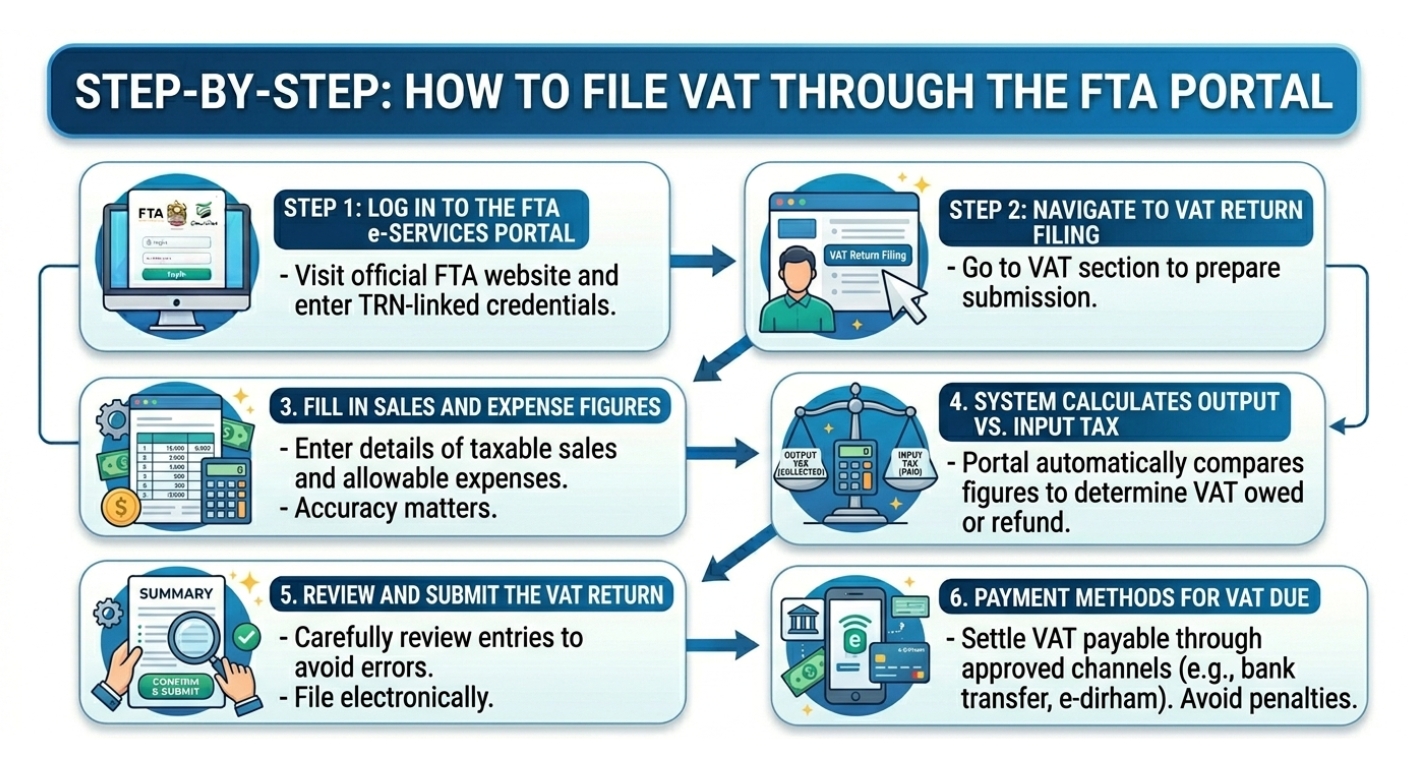
Filing VAT in the UAE may seem daunting at first, but the Federal Tax Authority (FTA) has streamlined the process through its online e‑services portal. Here's how the journey unfolds:
1. Log in to the FTA e‑services portal:
Start by visiting the official FTA website and entering your credentials linked to your Tax Registration Number (TRN). This login is your gateway to all VAT‑related services.
2. Navigate to VAT return filing:
Once inside the portal, head to the VAT section and select "VAT Return Filing." This is where you'll begin preparing your submission.
3. Fill in sales and expense figures:
Enter details of your taxable sales and allowable expenses for the period. Accuracy matters here; these figures form the backbone of your VAT calculation.
4. System calculates output vs. input tax:
The portal automatically compares the VAT you collected (output tax) with the VAT you paid on purchases (input tax). This calculation determines whether you owe VAT or are eligible for a refund.
5. Review and submit the VAT return:
Before hitting submit, carefully review all entries. Double‑checking ensures compliance and avoids costly errors. Once satisfied, confirm and file your return electronically.
6. Payment methods for VAT due:
If the system shows VAT payable, you can settle it directly through approved payment channels such as bank transfer or e‑dirham. Timely payment is crucial to avoid penalties.
Standard VAT Return Deadlines VAT returns in the UAE must be filed electronically by the 28th day of the month following the tax period. Most businesses file quarterly, while larger companies may be required to file monthly. Missing this deadline can quickly lead to penalties.
Late Filing Penalties: If a VAT return is not submitted on time, the Federal Tax Authority imposes fines that can reach up to AED 10,000. Consistent delays also put your business at risk of audits and reputational damage.
Late Payment Penalties: Submitting the return isn't enough; VAT due must also be paid promptly. Late payments attract daily penalties, adding up until the liability is cleared. Timely settlement protects your business from unnecessary financial strain.
While VAT is a recurring monthly or quarterly, businesses must also keep an eye on newer federal mandates. Knowing how to register for corporate tax in the UAE is now just as critical for maintaining your company's legal standing.
Even the most organized businesses can slip up when filing VAT. These mistakes may seem small, but they can trigger penalties or complicate audits. Here are the pitfalls to watch out for:
Incorrect Invoice Formats: VAT invoices must follow the FTA's prescribed format, including details like TRN, invoice date, and VAT amount. Skipping or misplacing these elements can make your invoices invalid.
Missing Input Tax Documents: Claiming input VAT without proper receipts or supporting documents is a red flag. Always keep contracts, purchase invoices, and receipts ready to back up your claims.
Ignoring Zero‑Rated and Exempt Categories: Not all supplies are treated the same. For instance, the treatment of VAT on commercial property in UAE differs significantly from residential sectors, and misclassifying these can lead to major errors in your return.
Currency Conversion Issues for Non‑AED Transactions: If your business deals in foreign currencies, VAT amounts must be converted into AED using the official exchange rates published by the UAE Central Bank. Incorrect conversions can result in misreporting and penalties.
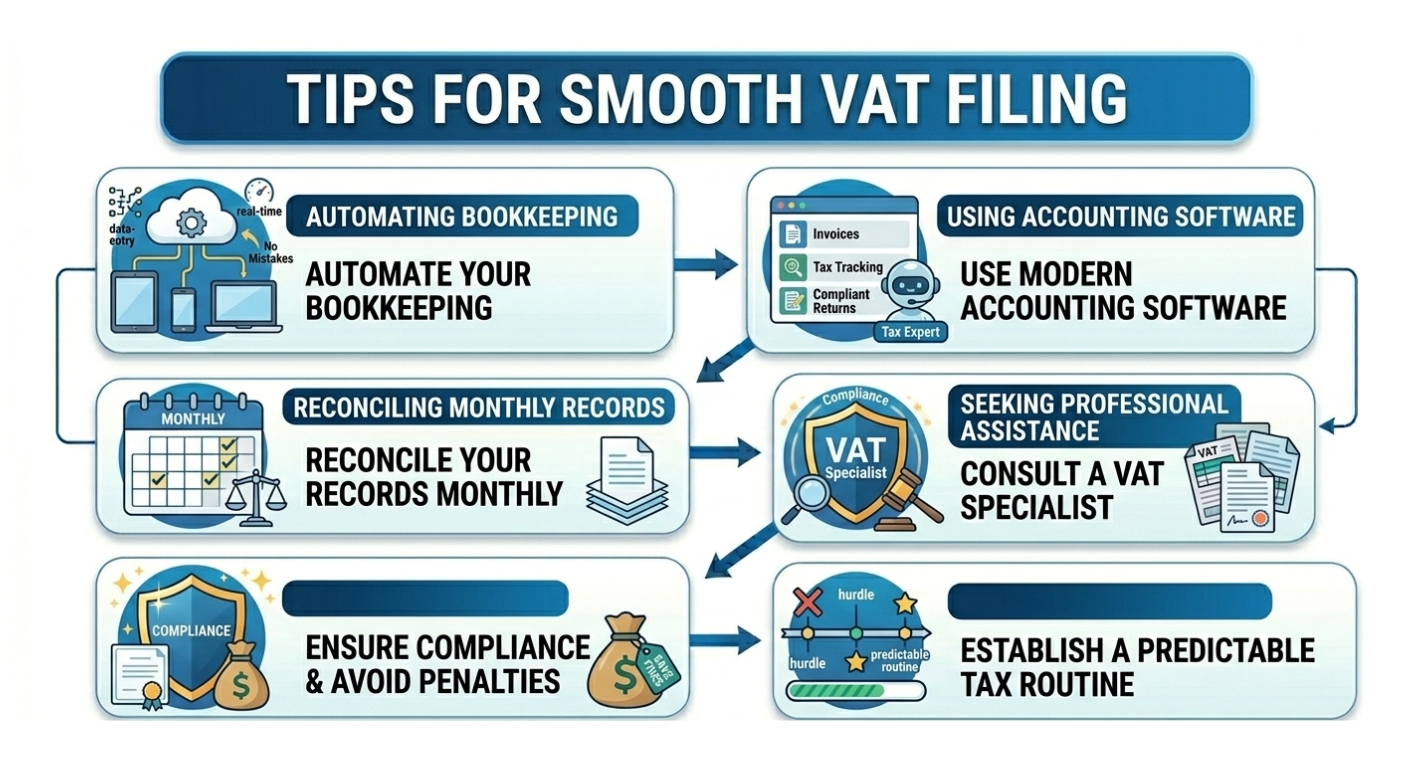
Filing VAT doesn't have to feel overwhelming. With the right habits and tools, businesses can turn it into a smooth, predictable routine. Here are some smart ways to stay ahead:
Automating Bookkeeping:
Manual entries often lead to errors. Automating your bookkeeping ensures every sale and expense is captured in real time, reducing mistakes and saving hours of work.
Using Accounting Software:
Modern accounting software integrates directly with VAT requirements, helping you generate compliant invoices, track input tax, and prepare returns with ease. It's like having a digital assistant dedicated to your finances.
Reconciling Monthly Records:
Don't wait until the quarter ends to organize your books. Reconciling records monthly keeps your data clean and makes filing faster, while also spotting discrepancies before they become problems.
When to Seek Professional VAT Assistance:
Sometimes, expert guidance is the safest route. If your business deals with complex transactions, imports/exports, or multiple VAT categories, consulting a VAT specialist ensures compliance and protects you from costly penalties.
Beyond indirect taxes, the UAE's fiscal landscape now rewards those who view tax as a holistic ecosystem. Understanding how to register for corporate tax in the UAE is the next step in leveraging specific corporation tax advantages that protect your bottom line.
VAT filing may look straightforward on the surface, but complexities often arise when businesses deal with cross‑border transactions, multiple VAT categories, or large volumes of records. In such cases, professional guidance can save time, reduce risk, and ensure full compliance with Federal Tax Authority rules. Experienced VAT registration consultants provide clarity in complex situations, helping companies avoid penalties and streamline their filing process. Seeking expert support is not just about solving problems; it’s about building confidence that your business is always in compliance with the law.
Most importantly, professional guidance helps you look beyond just basic filing. Experts can show you how to align your VAT strategy with other fiscal benefits, such as specific corporation tax advantages available to compliant UAE businesses.
Effective VAT management is merely the foundation of a robust financial architecture. As your enterprise scales, integrating strategic payroll processing and specialized accounting for restaurants or retail ensures operational fluidity. True fiscal leadership requires looking beyond the immediate filing to leverage corporate tax advantages , transforming mandatory compliance into a competitive edge for your business.
Filing VAT in the UAE may feel like a technical obligation, but in reality, it's a vital part of building trust, credibility, and long‑term sustainability for any business. From understanding why VAT exists to mastering the filing process through the FTA portal, every step reinforces the importance of compliance and transparency. Avoiding common mistakes, keeping records organized, and knowing when to seek professional help can make the difference between smooth operations and costly penalties.
Ultimately, VAT is more than numbers on a return; it's a reflection of how responsibly your business contributes to the UAE's growing economy. And while many companies manage the process independently, others choose to work with experienced partners like HFA Consulting, who can provide clarity and confidence when the rules feel complex.
By approaching VAT filing with preparation, accuracy, and the right support, businesses can turn what seems like a challenge into an opportunity to strengthen their reputation and stay ahead in a competitive market.
Accountant
Client Accounting Manager
Clear answers to your most pressing questions about VAT filing, deadlines, penalties, and compliance requirements in the UAE.

Our VAT experts help businesses file accurately, meet deadlines, and avoid penalties. Let us handle your VAT compliance so you can focus on growing your business.
Phone: 052 110 1467
Email: finance@hfaconsulting.ae

70+ Businesses served
Helped businesses gain compliance and smoother financial management.

20+ Active clients
Offering specialized financial consultancy services to businesses across UAE.
Let us know your challenge and business overview to get a proposal.