


 Zeeshan Khan
 Apr 1, 2026
Table of Contents
The UAE has built its reputation as a global business hub on the promise of a tax-friendly environment, and for the most part, that reputation still holds. But “tax-friendly” no longer means “tax-free.” VAT was introduced in 2018, and Corporate Tax became effective in June 2023.
If you own a business, freelance independently, or operate from a free zone, you almost certainly have active tax obligations you need to understand and meet.
The good news is that the UAE’s tax system is relatively straightforward compared to most countries. There is no personal income tax, no capital gains tax, and no inheritance tax. What does exist is VAT at five per cent and Corporate Tax at nine per cent above a threshold, which is managed entirely through one digital platform called EmaraTax. Once you understand how the system works, compliance is manageable.
This guide covers exactly how to pay tax in the UAE in 2026, from understanding which taxes apply to you, to registering on EmaraTax, filing your return, making the payment, and staying compliant year after year. Whether you are a freelancer, SME owner, mainland business, free zone company, or an expat trying to understand your position, this guide has you covered.
Key Takeaways
Before you read the full guide, here is what you need to know at a glance:
| What | Detail |
| UAE Personal Income Tax | Zero per cent, your salary is never taxed |
| VAT Rate | Five per cent mandatory registration above AED 375,000 in taxable supplies |
| Corporate Tax Rate | Nine per cent on net profits above AED 375,000 |
| Official Tax Portal | EmaraTax (emaratax.gov.ae). All registration, filing, and payment happen here |
| Your Payment Identifier | A unique IBAN assigned to your tax file, GIBAN, is required for every bank transfer |
| VAT Return Deadline | 28 days after the end of each tax period |
| Corporate Tax Deadline | Nine months after your financial year-end |
| Free Zone Rule | Zero per cent CT available for Qualifying Free Zone Persons on qualifying income only |
| Record Keeping | Five years for VAT, seven years for Corporate Tax |
| Expats | UAE salary is tax-free, but home-country obligations may still apply |
Types of Tax in the UAE (2026)
The first step in figuring out how to pay tax in the UAE is understanding which taxes actually apply to your situation. Not every tax type will be relevant to every reader, so here is a clear breakdown of what exists, what the rates are, and who it affects.
Personal Income Tax
Personal income tax in the UAE remains at zero per cent. This means your salary, wages, dividends, and rental income as an individual are not subject to any tax at the federal level.
The UAE Ministry of Finance has consistently reaffirmed this position, and there are no current proposals to change it. This is one of the primary reasons the UAE continues to attract high-earning professionals and entrepreneurs from around the world.
Corporate Tax (CT)
Corporate Tax was introduced with effect from June 2023 and applies to the net profits of businesses operating in the UAE. The rate is nine per cent on profits above AED 375,000. Below that threshold, the rate is zero, which effectively protects small businesses and startups from the burden of corporate taxation in their early years.
Free zone businesses operate under a separate set of rules and may be eligible for a zero per cent rate on qualifying income. This is covered in detail in its own section later in this guide. Corporate Tax applies to businesses registered in the mainland UAE, and in certain circumstances to free zone businesses earning non-qualifying income.
VAT (Value Added Tax)
VAT was the UAE’s first major tax, introduced in January 2018 at a flat rate of five per cent. It applies to most goods and services supplied within the UAE. Businesses are required to register for VAT with the Federal Tax Authority once their taxable supplies exceed AED 375,000 in any twelve months.
Voluntary registration is available from AED 187,500 useful if you want to reclaim input VAT on your business purchases before hitting the mandatory threshold.
Once registered, businesses collect VAT from their customers, offset it against the VAT they have paid on their own purchases, and remit the difference to the FTA through a regular VAT return.
Excise Tax
Excise Tax applies to a specific category of goods considered harmful to health or the environment, such as tobacco products, energy drinks, carbonated drinks, and similar items. The rates range from fifty per cent to one hundred percent depending on the product category.
If your business imports, manufactures, or stockpiles these goods, you will need to register for Excise Tax separately. For most businesses, this will not apply, but it is worth being aware of. Visit the Federal Tax Authority website for the full product list and rates.
Customs Duty
Customs duty applies to goods imported into the UAE and is governed by the GCC Common Tariff, which sets a general rate of five per cent on the customs value of most imported goods.
Certain categories are exempt or subject to different rates. If your business relies on importing goods from outside the GCC, this is a cost you will factor into your pricing and supply chain planning.
| Tax Type | Rate | Who It Applies To |
| Personal Income Tax | 0% | All individuals’ salaries, dividends, and rental income |
| Corporate Tax | 0% / 9% | Businesses with net profits above AED 375,000 |
| VAT | 5% | VAT-registered businesses on goods and services |
| Excise Tax | 50%–100% | Importers/manufacturers of specific goods |
| Customs Duty | 5% (general) | Businesses importing goods from outside the GCC |
How to Pay Tax in the UAE Step-by-Step (EmaraTax Portal)
Everything related to UAE tax registration, filing, payment, and correspondence is handled through the EmaraTax portal at emaratax.gov.ae. This is the official platform operated by the Federal Tax Authority, and it replaced the older e-Services portal. Here is a complete walkthrough of the process, step by step.
Step 1: Create Your EmaraTax Account
Navigate to emaratax.gov.ae and click Sign Up. You will be asked to provide your email address, mobile number, and either your Emirates ID (for UAE residents) or your passport number (for non-residents).
After entering your details, you will receive a one-time password (OTP) on your registered mobile number to verify your identity. Once verified, your EmaraTax account is active and ready to use.
If you already had an account on the old FTA e-Services portal, your data should have been migrated, but it is worth logging in and confirming your details are accurate before proceeding with any filings.
Step 2: Register for Tax and Obtain Your TRN
Log in and go to Register for Tax. Select your tax type: VAT, Corporate Tax, or Excise Tax and complete the application. You will need to upload your trade license, Emirates ID or passport copy, and bank account details.
Once approved, the Federal Tax Authority issues your TRN (Tax Registration Number), your unique identifier for all filings, invoices, and FTA correspondence.
For Corporate Tax, registration deadlines are tied to your trade license issue month; miss it, and penalties apply. Check the FTA’s published timeline and register before your window closes.
Step 3: Log In and Explore Your Dashboard
Your EmaraTax dashboard is the central hub for everything. After logging in, you will see a clear overview of your tax status, including any pending returns, recent payment history, upcoming deadlines, and official FTA correspondence.
Spend a few minutes getting familiar with the layout before your first filing. The portal is designed to be self-explanatory, but knowing where things are saves time when deadlines are approaching.
Step 4: Open Your Tax Return
Navigate to the Returns section of the EmaraTax portal. Select the relevant tax type, VAT or Corporate Tax, and the portal will display all available periods for which a return can be filed. Choose the correct period and click to open the return.
Step 5: Select the Correct Tax Period
This step sounds simple, but selecting the wrong period is one of the most common errors businesses make, and it cannot be corrected after submission. VAT returns are filed quarterly by default, covering three-month periods.
Monthly filing is available for businesses approved by the FTA for this frequency. Corporate Tax returns follow your business’s financial year, which may or may not align with the calendar year. Always double-check you have the correct period before entering any figures.
Step 6: Enter Your Tax Details
For a VAT return, enter your total sales (output tax) and business purchases (input tax) across each category: standard-rated, zero-rated, exempt, and imports. For Corporate Tax, enter your net profit, deduct allowable expenses, and arrive at your taxable income. EmaraTax calculates the amount due automatically once your figures are in.
Step 7: Review and Submit the Return
Before you click Submit, review every line of your return carefully. Check that the period is correct, that your output and input tax figures are accurate, and that you have not missed any deductions you are entitled to claim.
The most common errors at this stage are missed input tax credits on VAT returns and incorrect period selection. Once you click Submit, the return is finalised and cannot be amended, so take your time here.
Step 8: Generate Your Payment Reference and GIBAN
After submission, EmaraTax generates two things: your Payment Reference Number and your GIBAN (General IBAN), a unique bank account number the Federal Tax Authority assigns to your tax file. Every payment must go to this GIBAN, or it will not be matched to your account, leaving you with an outstanding balance on record.
Step 9: Pay Your Tax
The EmaraTax portal offers several payment methods to suit different preferences and processing timelines:
Bank transfer to your GIBAN: Transfer the exact tax amount from your business bank account to your GIBAN. Include your payment reference number in the transfer description field. Bank transfers typically take one to two business days to reflect in the portal.
e-Dirham card: The e-Dirham is a government-backed prepaid card system. Payments via e-Dirham are processed on the same day, making this a good option when you are close to a deadline.
Credit or debit card: You can pay directly through the EmaraTax portal using a standard Visa or Mastercard. This is the most convenient method for smaller tax amounts and processes quickly.
Whichever method you choose, always retain proof of payment before closing your browser session.
Step 10: Confirm Payment and Download Your Receipt
Once payment has been processed, log back into EmaraTax and navigate to My Payments to confirm the status has updated to paid. Download your official payment receipt and save it securely both digitally and, if your business generates significant tax liabilities, in physical form as well.
The Federal Tax Authority has the right to audit your records, and payment receipts are a core part of your compliance documentation. Receipts must be retained for a minimum of five years.
Step 11: Know Your Deadlines and Avoid Penalties
Understanding your filing and payment deadlines is not optional it is one of the most important parts of UAE tax compliance. The FTA does not offer grace periods, and penalties start accumulating from the first day after a missed deadline.
Free Zone Businesses Special Tax Rules
If you operate from a UAE free zone, your situation is more nuanced than most guides suggest.
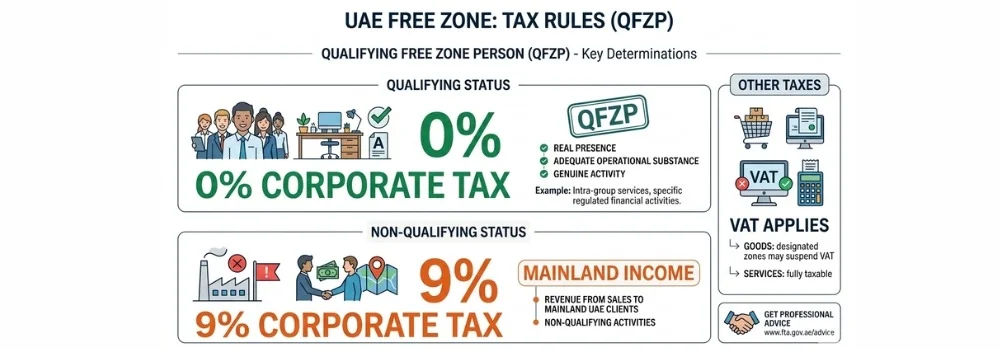
A Qualifying Free Zone Person (QFZP) is eligible for a zero per cent Corporate Tax rate on qualifying income. To qualify, your business must have a real presence in the free zone, actual employees, adequate operational substance, and genuine activity. This is not automatic just because you hold a free zone license.
Income that does not qualify, for example, revenue from sales to mainland UAE clients, is taxed at the standard nine per cent rate. This is one of the most common and costly misclassifications free zone businesses make.
VAT still applies in free zones. There is no blanket VAT exemption. However, Designated Zones operate under modified VAT rules: the transfer of goods within a Designated Zone may have VAT suspended, but services remain fully taxable.
If you’re in a free zone and regularly invoice mainland UAE clients, get advice from a registered tax agent before assuming your income is qualifying. The FTA takes this classification seriously.
Tax for Expats and Salaried Employees
The short answer: your UAE salary is not taxed. Personal income tax is zero, and that includes salaries, wages, capital gains, and inheritance. The UAE remains one of the most attractive locations in the world for this reason.
However, there are situations where tax does apply:
Freelancers and self-employed individuals who operate through a UAE entity and earn above AED 375,000 may be subject to Corporate Tax at nine per cent. This catches many people off guard.
Expats from the UK, US, Australia, and several other countries may still owe tax to their home country on UAE-sourced income. UAE’s zero-tax environment does not automatically exempt you from your home jurisdiction’s rules.
The UAE has signed over 140 Double Taxation Agreements (DTAs) with countries around the world. If you need to prove UAE tax residency to your home country’s tax authority, you can apply for a Tax Residency Certificate directly through the EmaraTax portal.
Common Mistakes to Avoid
Getting these wrong is expensive and preventable.
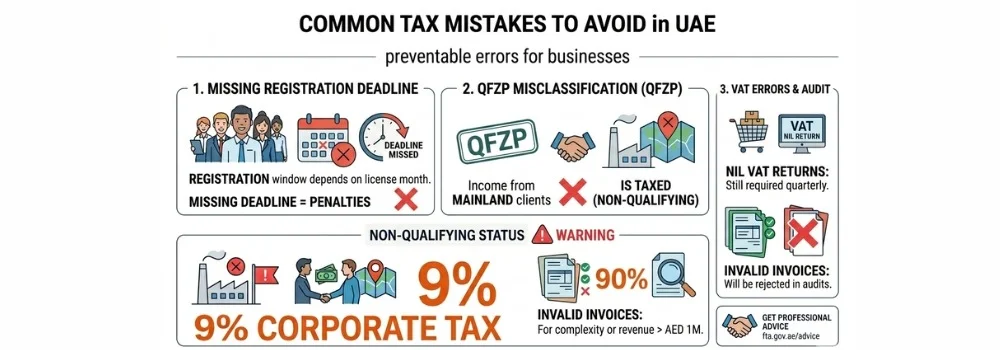
Missing your CT registration deadline is the most common first mistake. The deadline depends on the month your license is issued, and many business owners don’t find out until after the window has passed.
Filing a nil VAT return is still required even if you had zero sales in a quarter. Many businesses skip this and receive an automatic penalty.
Using the wrong bank account for tax transfers is surprisingly common. Always use your GIBAN, the unique account number the Federal Tax Authority generates for your file, not any general FTA banking detail you may find elsewhere.
Misclassifying free zone income as qualifying income is a frequent and costly error for QFZP businesses selling to mainland clients.
Claiming input VAT without valid tax invoices will be rejected during an audit. Every credit needs a proper invoice showing the supplier’s TRN.
If your annual revenue exceeds AED 1 million, seriously consider hiring a registered UAE tax agent. The compliance complexity at that level makes professional support a worthwhile investment.
Who Provides Tax Advisory Services in the UAE?
For businesses managing UAE tax requirements, HFA Consulting provides comprehensive tax advisory services designed to ensure full compliance with local regulations and Federal Tax Authority guidelines.
As experienced tax consultants in Dubai, we support corporate tax registration, return filing, transfer pricing documentation, and ongoing advisory, helping businesses maintain accurate reporting, minimise risks, and stay aligned with evolving tax laws across the UAE.
Conclusion
The UAE is low-tax, not zero-tax. VAT and Corporate Tax are real obligations with real penalties for getting them wrong. The great thing is that the EmaraTax portal handles registration, filing, and payment in one place, and the process is straightforward once you know the steps.
The biggest risks are missing deadlines, misclassifying free zone income, and assuming expat status means no obligations anywhere.
For complex situations, free zone structures, multiple income sources, or expat home-country obligations, consult a registered UAE tax agent or visit the Federal Tax Authority’s official website at tax.gov.ae for authoritative guidance.
FAQS
How Do I Pay Tax in the UAE Online?
Register on the EmaraTax portal at emaratax.gov.ae, complete your VAT or Corporate Tax return for the relevant period, generate your GIBAN and payment reference, then pay via bank transfer, e-Dirham, or credit card through the portal.
What Is a GIBAN Number in UAE Tax?
GIBAN stands for General IBAN. It is a unique bank account number that the Federal Tax Authority assigns to your tax file on EmaraTax. When making a bank transfer to pay your tax, the GIBAN ensures the payment is automatically matched to your account. Never make a transfer without it.
Can I Pay UAE Tax Through a Bank Transfer?
Yes. After filing your return on EmaraTax, use the GIBAN generated by the portal as the beneficiary IBAN and include your payment reference number in the transfer description. Bank transfers typically process within two business days.
What Happens If I Miss the UAE Tax Payment Deadline?
The FTA applies a late payment penalty of AED 500 per month minimum, plus two per cent of the unpaid tax amount. Non-registration penalties range from AED 10,000 to AED 50,000. Always file on time, even if you cannot pay in full immediately.
Do Expats Pay Income Tax in the UAE?
No. The UAE does not levy personal income tax on salaries or most investment income. However, if you operate a business earning above AED 375,000, Corporate Tax at nine per cent applies. UK, US, and Australian expats should also review their home-country tax obligations separately.
How Much Corporate Tax Do I Pay in the UAE?
Corporate Tax is zero on net profits up to AED 375,000, and nine per cent on profits above that threshold. Qualifying Free Zone Persons may be eligible for zero per cent on qualifying income if they meet the Federal Tax Authority’s substance requirements.


Zeeshan Khan
My name is Zeeshan Khan, and I’m a UAE-based business and tax consulting professional with hands-on experience in VAT compliance, corporate tax advisory, business setup, and regulatory services. I work closely with startups, SMEs, and established companies to help them navigate UAE tax laws, improve compliance, and make informed financial decisions. With a strong understanding of FTA regulations, corporate structuring, and commercial taxation in the UAE, my focus is on translating complex laws into clear, practical guidance for business owners. Through my writing, I aim to provide accurate, up-to-date insights that help businesses stay compliant, reduce risk, and operate confidently in the UAE market.