


 Zeeshan Khan
 Feb 17, 2026
Table of Contents
Are you planning to buy your dream villa in Dubai or lease a new office space for your growing business? If so, you’ve probably heard the term VAT floating around. Since 2018, VAT on real estate in UAE has been a major talking point in the UAE property market. But let’s be honest: tax laws can feel like a maze, and one wrong turn can cost you thousands of dirhams.
Whether you are a first-time buyer, a seasoned property developer, or a real estate agent, understanding how tax impacts your wallet is essential. From the 5% standard rate on commercial spaces to the “zero-rated” rules for new homes, the details matter.
In this guide, we’ll break down the VAT on real estate UAE rules, explain the VAT impact on real estate UAE, and answer those burning questions about commissions and land sales so you can move forward with confidence.
What Is VAT and How Does It Apply to Real Estate?
Value Added Tax, or VAT, is a general consumption tax that was introduced across the UAE in 2018. It is set at a standard rate of 5% and is applied to the “value-added” at each stage of the supply chain.
In the world of bricks and mortar, this means that most transactions from the architect’s blueprint to the final sale of an office building will have a tax component.
But here is the catch: not all property is taxed the same way. The UAE government makes a big distinction between where you live and where you work.
Residential vs. Commercial Property VAT
Understanding the vat on real estate UAE rules starts with knowing your property type. The UAE Federal Tax Authority (FTA) has different categories that determine whether you pay the full 5%, nothing at all, or a special “zero” rate.
- Residential Property: Generally, the government wants to keep housing affordable. This is why most residential rents and secondary sales (buying an existing home) are exempt. You don’t pay VAT, but the landlord/seller also cannot claim back tax on their expenses.
- Commercial Property: This is much more straightforward. If it’s an office, a retail shop, or a warehouse, it is “standard-rated.” You will almost always pay the 5% VAT on real estate and commercial transactions.
Key Things VAT Applies to in Real Estate
Wondering where exactly that 5% pops up? It’s not just in the purchase price. As of 2026, the UAE has tightened its digital tax tracking, making it more important than ever to know which transactions trigger a tax bill.
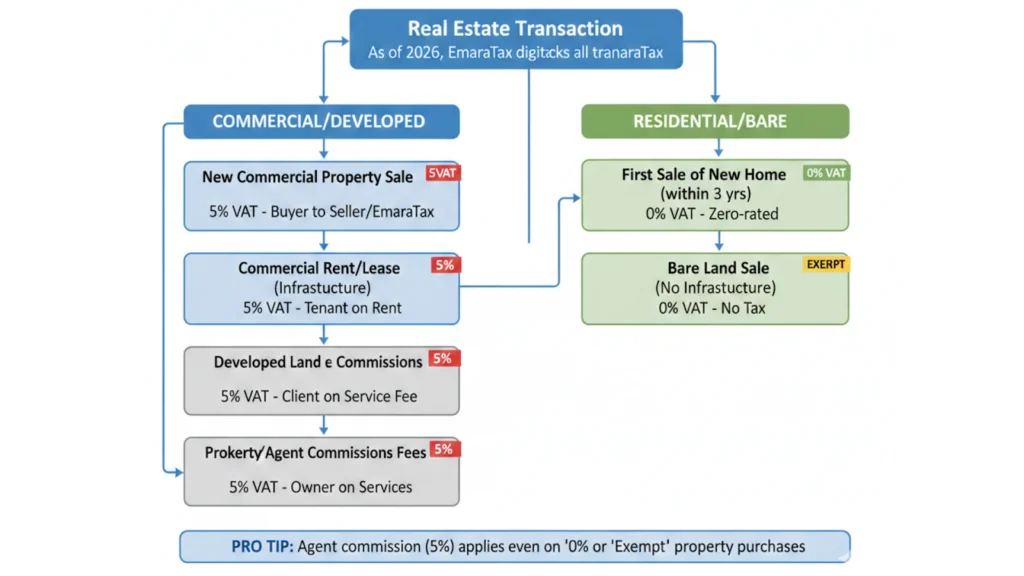
Here is a quick-reference table to help you spot where VAT on real estate applies:
| Transaction Type | VAT Rate | Who Pays/Collects? |
| New Commercial Property | 5% | Buyer pays 5% to the seller (or directly via EmaraTax). |
| Commercial Rent/Leases | 5% | Tenant pays 5% on top of the annual rent. |
| Broker/Agent Commissions | 5% | Client pays 5% on the professional service fee. |
| Sale of Bare Land | 5%* | Bare land is exempt; land with infrastructure is 5% (standard-rated). |
| Property Management | 5% | The owner pays 5% for maintenance and admin services. |
| First Sale of New Home | 0% | Zero-rated for the first 3 years of completion. |
Pro Tip: Even if you are buying a “tax-free” residential apartment, remember that the vat on real estate commission in the UAE still applies to your agent’s fee. Always factor this into your initial budget!
Why These Categories Matter
- New Commercial Properties: Whether it’s an office or a shop, the 5% rule is absolute. Since July 2026, these transactions have been increasingly tracked through the UAE’s new e-invoicing system for real-time compliance.
- Sales by Developers: For residential buildings, the “Zero-rated” status is a huge benefit for buyers. It allows Property developer VAT recovery on construction costs without passing that tax cost onto the new homeowner.
- Leasing Services: Commercial tenants can usually claim this 5% back as “Input Tax” if they are a VAT-registered business, effectively making it a wash for their bottom line.
- Commission Fees: Because this is a service and not a property sale, it follows the standard 5% rule regardless of the property’s tax status.
Knowing these details upfront helps you avoid the “sticker shock” of unexpected tax bills at the closing table. It also ensures you stay on the right side of the law, especially with the FTA’s stricter 2026 small business audit focus.
VAT on Real Estate Commission in the UAE
Many people assume that if a property is “VAT-exempt,” the entire deal is tax-free. However, there is a big difference between the property itself and the service provided by your broker.
In the UAE, real estate agency services are considered “taxable supplies.” This means that even if you are buying a residential apartment where the sale price has 0% VAT, the agent’s professional fee still attracts the standard 5% VAT rate.
How Real Estate Agents’ Commissions Are Taxed
When an agent helps you buy, sell, or lease a property, they are providing a professional service. Because this service happens within the UAE, the Federal Tax Authority (FTA) requires all VAT-registered agencies to add 5% to their final invoice.
Example: Selling a Property in Dubai. Imagine you are selling a villa for AED 2,000,000.
- Property Sale VAT: 0% (Residential resale is exempt).
- Agent Commission (2%): AED 40,000.
- VAT on Commission (5%): AED 2,000.
- Total Commission Paid: AED 42,000.
When VAT Applies to Developers and Brokers
It isn’t just the buyers who need to watch out. Developers and brokers have specific scenarios where they must account for vat on real estate commission in the UAE:
- Commission for Property Sales: Whether it is a luxury penthouse or a small studio, the 2% (typical) broker fee always carries an extra 5% VAT.
- Brokerage Fees for Rentals:
- Commercial Leases: Both the rent and the broker’s fee attract 5% VAT.
- Residential Leases: While the rent is exempt, the 2026 guidelines confirm that brokers must still charge 5% VAT on their agency fee to the tenant.
- Property Management Fees: If you hire a company to collect rent and manage repairs, their monthly management fee is a service subject to the 5% standard rate.
- Off-Plan Sales: In most cases, the developer pays the broker’s commission. Here, the developer handles the VAT internally, so the buyer usually sees a “0% commission” offer.
Note for 2026: With the UAE’s new e-invoicing laws, ensure your broker provides a valid tax invoice. This is the only way for business buyers to legally claim back that 5% as input tax!
VAT on Sale of Land and Property in Dubai
When you are looking at a plot of land or a new building in the UAE, the tax rules change based on what is actually on the ground. As we move through 2026, the Federal Tax Authority (FTA) has become even more precise about these categories.
The most important thing to remember? Bare land is treated differently from developed land.
Is VAT Charged on the Sale of Land?
This is a question every investor asks. Under UAE law, the sale or lease of bare land is typically exempt from VAT. But what qualifies as “bare”? To the FTA, land is only bare if it has no:
- Completed or partially completed buildings.
- Civil engineering works (like roads, bridges, or underground pipes) that break the surface.
If you buy a plot that already has utility connections or a foundation, it is no longer considered “bare.” In that case, it is treated as a commercial supply and attracts the 5% standard rate.
Residential vs. Commercial VAT Treatment
The VAT on the real estate Dubai market is split into two clear lanes to keep housing affordable while taxing business activities.
- Residential Property: To support residents, the sale of existing homes is exempt. However, to encourage growth, the first sale of a new home by a developer (within 3 years of completion) is zero-rated (0%). This allows developers to recover their costs without passing a tax bill to you.
- Commercial Property: There are almost no exemptions here. Whether it is an office, a retail shop, or a warehouse, the 5% VAT applies to both the sale price and the rent.
Key Scenarios Where VAT Applies
Understanding the VAT impact on real estate UAE means looking at these specific plot types:
- Freehold Land for Residential Development: If the land is truly bare, it’s exempt. If it has infrastructure, expect a 5% tax.
- Commercial Plots: These are always subject to the 5% standard rate, as they are intended for business use.
- Off-Plan Properties:
- Residential Off-Plan: Usually 0% (zero-rated) if handed over within the 3-year window.
- Commercial Off-Plan: Always 5% VAT, regardless of the construction stage.
2026 Update: The FTA now uses real-time digital tracking for land transfers. Ensure your Sale and Purchase Agreement (SPA) clearly states whether the price is “inclusive” or “exclusive” of VAT to avoid paying 5% more than you planned!
Property Developer VAT Obligations
If you are a developer in the UAE, you aren’t just building structures revolving around you is a complex web of tax responsibilities.
Since the 2026 updates to the UAE Tax Procedures Law, the Federal Tax Authority (FTA) has moved toward a “real-time” compliance model.
This means Property developer VAT management is no longer a quarterly chore; it’s a daily business essential.
Responsibilities of Developers in Registering for VAT
In the UAE, VAT registration isn’t always optional. If your taxable supplies (sales and leases) exceed a certain amount, you must jump on board the EmaraTax portal.
- Mandatory Registration: You must register if your taxable turnover exceeds AED 375,000 over the last 12 months.
- Voluntary Registration: Many developers choose to register once they hit AED 187,500 in expenses or sales. Why? Because it allows you to start claiming back the VAT you pay on construction materials and contractor fees immediately.
Collecting and Remitting VAT
As a developer, you act as a tax collector for the government. When you sell a commercial unit, you collect the 5% VAT from the buyer and pass it to the FTA.
For residential projects, you deal with the “Zero-Rated” rule, you charge 0% to the buyer but still report the transaction so you can recover your own costs.
Impact on Pricing for End Buyers
VAT directly affects the “sticker price” of property. For commercial buyers, that 5% is an upfront cost they must budget for.
For residential buyers, while the 0% rate on new homes is a relief, the developer’s inability to recover VAT on exempt secondary sales often means those costs are baked into the final price.
Key Developer Requirements (2026 Update)
To stay compliant and avoid hefty fines (which can start at AED 10,000 for late registration), developers must stick to these three pillars:
- VAT Registration Thresholds: Constantly monitor your 12-month rolling turnover. Under the 2026 rules, the FTA is stricter about backdating tax if you register late.
- Invoicing Requirements: As of July 2026, the UAE is transitioning to e-invoicing. You’ll need to issue digital, machine-readable invoices that sync with the FTA in real-time.
- Record-Keeping Obligations: You must keep all VAT-related records for a minimum of Keep records for 15 years (for real estate) from the end of the tax period for transactions. This is significantly longer than the standard 5-year rule for other businesses.
Pro Tip: With the 2026 e-invoicing rollout, ensure your accounting software is FTA-accredited. Manual PDF invoices are quickly becoming a thing of the past!
VAT Impact on Real Estate Buyers and Investors
If you are eyeing a property in 2026, the VAT impact on real estate in the UAE is more than just a line item; it’s a factor that can change your entire investment strategy. While the headline rate is 5%, the real-world cost depends on whether you are buying “new” or “used.”
How VAT Affects Total Purchase Cost
When budgeting, you must look beyond the selling price. In the UAE, the 5% VAT on commercial property is often paid upfront by the buyer directly to the Federal Tax Authority (FTA) via the EmaraTax portal before the Title Deed is even issued.
For residential properties, the tax burden is lower, but you still face a 5% tax on all service-related costs, from property management to your real estate agent’s commission.
Primary Market vs. Secondary Market: At a Sight
The market you choose to buy in drastically changes your tax bill. In 2026, with the UAE’s focus on digital transparency via the EmaraTax portal, these distinctions are more than just numbers; they are legal requirements that affect your cash flow.
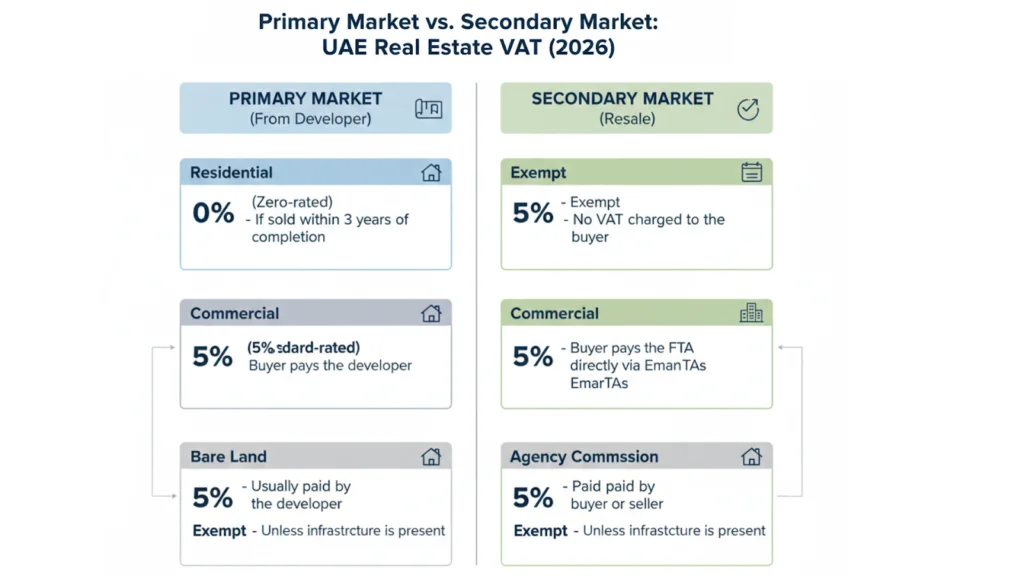
Here is how the VAT breaks down between buying brand-new from a developer versus buying a resale property from a private owner:
| Property Category | Primary Market (From Developer) | Secondary Market (Resale) |
| Residential | 0% (Zero-rated) (If sold within 3 years of completion) | Exempt (No VAT charged to the buyer) |
| Commercial | 5% (Standard-rated) (Buyer pays the developer) | 5% (Standard-rated) (Buyer pays the FTA directly) |
| Bare Land | Exempt (Unless infrastructure is present) | Exempt (Unless infrastructure is present) |
| Agency Commission | 5% (Usually paid by the developer) | 5% (Paid by buyer or seller) |
Example Scenarios: Residential vs. Commercial
| Scenario | Property Type | Property Price VAT | Agent Commission VAT |
| A | New Apartment (Off-plan) | 0% (Zero-rated) | 5% |
| B | Resale Villa (Existing) | Exempt | 5% |
| C | Office Space (Any stage) | 5% | 5% |
Tips for Budgeting VAT in Investment Planning
- Check the 3-Year Window: For residential investors, ensure the developer’s “first supply” certificate is within the 3-year limit to guarantee that 0% rate.
- Factor in Recoverability: If you are a VAT-registered business buying an office, you can often reclaim the 5% VAT as input tax. If you are an individual investor, that 5% is a “sunk cost” that eats into your ROI.
- Watch the Service Charges: Don’t forget that yearly maintenance and service charges always attract 5% VAT. Over a 10-year investment period, this adds up!
- E-Invoicing Compliance: In 2026, ensure your developer or broker issues an electronic tax invoice. Without this digital record, you might struggle to prove your tax payments during an audit or resale.
Understanding these nuances ensures that your “dream investment” doesn’t turn into a tax nightmare.
Tips for Managing VAT in Real Estate Transactions
Succeeding in the Dubai property market in 2026 requires more than just finding the right location; it requires staying ahead of the taxman.
With the Federal Tax Authority (FTA) transitioning to a real-time digital system, “winging it” with your taxes can lead to expensive delays or fines.
Here is how you can effectively manage VAT on real estate and protect your investment.
Smart Planning and Negotiation
In the UAE, property prices are often advertised as “exclusive of VAT” unless otherwise specified. This can be a shock at the closing table if you haven’t budgeted for it.
- Ask for Clarity: Always ask the seller or developer for a written confirmation of whether the listed price includes the 5% VAT.
- The 3-Year Rule: If you are buying a residential property from a developer, confirm the building’s completion date. For the VAT on real estate in the Dubai market, new homes only qualify for the 0% (zero-rated) status if they are sold within 3 years of completion.
Advantage Professional Expertise
The 2026 tax landscape is increasingly technical. Working with FTA-certified accountants or tax consultants is no longer just for big corporations; it’s a necessity for smart investors seeking both compliance and Corporation Tax Advantages.
- Verify if a plot of land is truly “bare land” (exempt) or has enough infrastructure to be taxed at 5%.
- Manage the 5-year limit for claiming back any excess VAT payments before they expire.
- Ensure your property management fees and service charges are correctly invoiced.
VAT Management Checklist
| Strategy | Action Step | Why It Matters |
| Confirm VAT Status | Identify if the unit is Residential (0%/Exempt) or Commercial (5%). | Prevents unexpected 5% price hikes during the transfer. |
| Verify Registration | Check the developer’s or broker’s TRN on the FTA portal. | Ensures you are paying tax to a legitimate, registered entity. |
| Check E-Invoicing | Request a digital “PINT AE” XML invoice (new for 2026). | As of 2026, paper or PDF invoices may not be valid for tax recovery. |
| Review Contracts | Ensure a “VAT Clause” is included in all sales agreements. | Protects you if the tax laws change between signing and handover. |
Protect Yourself with Legal Clauses
Your legal agreements should be as solid as the property itself. When drafting contracts, ensure you include specific language regarding Property developer VAT or brokerage fees.
A good contract should state that the seller must provide a valid tax invoice within 14 days of any payment.
Without this document, business investors won’t be able to reclaim their 5% VAT as input tax, effectively turning a temporary tax into a permanent cost.
By taking these steps, you move from being a reactive buyer to a proactive investor who understands the true VAT impact on real estate in the UAE.
Who Should You Consult for VAT on Real Estate in the UAE
Getting the right advice is the most critical step in ensuring your property investments remain profitable and compliant with the latest 2026 Federal Tax Authority (FTA) regulations.
Professional vat consultancy services in Dubai provide the technical oversight needed to handle complex scenarios, such as reclaiming tax on residential developments or correctly applying the 5% rate to mixed-use commercial buildings.
For expert guidance tailored to the local market, many investors turn to HFA Consulting to manage their tax registrations, e-invoicing requirements, and long-term record-keeping.
By partnering with specialists who understand the nuances of the UAE tax landscape, you can avoid costly administrative errors and focus on growing your real estate portfolio with complete peace of mind.
Conclusion
The VAT impact on real estate in the UAE is no longer a simple calculation; it is a vital part of your long-term financial strategy. As we move through 2026, the shift toward a more transparent, digital-first tax system means that being “mostly sure” isn’t enough.
Whether you are benefiting from the 0% zero-rated status on a new villa or accounting for the 5% VAT on real estate Dubai commercial leases, the key to a successful transaction lies in early planning and precise documentation.
By keeping track of the five-year limit for refunds, staying ahead of the new e-invoicing requirements, and always verifying the tax status of your property before signing, you can protect your margins and ensure a smooth handover. Real estate remains one of the UAE’s strongest sectors, and with the right tax knowledge, you can navigate it with total confidence.
FAQS
What types of properties are exempt from VAT?
Most non-serviced residential properties in the UAE are exempt from VAT to keep housing affordable. This includes apartments, villas, and townhouses, as well as residential resales, long-term leases, and bare land that has no buildings or infrastructure.
How is VAT calculated on commercial property?
Commercial properties are subject to a standard 5% VAT on the total sale or rental value. For example, if a commercial office is sold for AED 2,000,000, the VAT of AED 100,000 is added, making the total payable AED 2,100,000.
Do resale transactions attract VAT?
Resale of residential properties is generally VAT-exempt, meaning buyers do not pay any additional tax. However, resale of commercial properties, such as offices, shops, or warehouses, always attracts 5% VAT, which the buyer usually pays through the FTA before the title deed is transferred.
How does VAT affect off-plan property purchases?
Off-plan residential properties are often zero-rated (0% VAT) if the property is delivered within three years of completion, helping keep costs lower for buyers. Off-plan commercial properties, however, are charged 5% VAT on every installment paid during the construction period.


Zeeshan Khan
My name is Zeeshan Khan, and I’m a UAE-based business and tax consulting professional with hands-on experience in VAT compliance, corporate tax advisory, business setup, and regulatory services. I work closely with startups, SMEs, and established companies to help them navigate UAE tax laws, improve compliance, and make informed financial decisions. With a strong understanding of FTA regulations, corporate structuring, and commercial taxation in the UAE, my focus is on translating complex laws into clear, practical guidance for business owners. Through my writing, I aim to provide accurate, up-to-date insights that help businesses stay compliant, reduce risk, and operate confidently in the UAE market.