

 Zeeshan Khan
 Mar 3, 2026
Table of Contents
Ever feel like VAT is a maze with no exit? In the UAE, most things come with a 5% tax tag. But did you know some businesses pay 0% and still get their money back?
It sounds like a dream, but it’s actually a key part of the Federal Tax Authority (FTA) rules. If you’re a business owner, knowing the ins and outs of zero-rate VAT in uae isn’t just about following the law; it’s about protecting your cash flow.
In this guide, we’ll break down exactly what zero-rated supplies are, how they differ from “exempt” items, and why your invoice format matters more than you think
What is Zero-Rated VAT in the UAE?
Think of zero-rate VAT in uae as a “tax-free” status that still keeps you in the game. Under the rules of the Federal Tax Authority (FTA), some goods and services are taxed at exactly 0%.
Even though the customer pays nothing in tax, these are still considered taxable supplies. This is a massive win for your business! Why? Because it means you are still eligible to reclaim the input VAT you paid on your own business expenses (like rent, utilities, or stock).
Essentially, you don’t charge your customers VAT, but the government still lets you get your tax money back on the costs you incurred to run your business.
Difference Between Zero-Rated and Exempt VAT in the UAE
This is where many business owners get a bit confused. If the customer isn’t paying any tax in either case, does it really matter which one you use?
The answer is a big YES. The difference between zero-rated and exempt vat in uae mostly affects your wallet and how you deal with the FTA.
While both result in a 0% tax charge for the buyer, the “behind-the-scenes” rules for your business expenses are completely different.
Quick Comparison Table
| Feature | Zero Rated | Exempt |
| VAT Rate | 0% | No VAT (Not Taxable) |
| Input VAT Recovery | Allowed (Get your money back!) | Not Allowed (You bear the cost) |
| Tax Returns | Must be reported to the FTA | Reported differently/No recovery |
| Registration | Included in your taxable turnover | Not included in taxable turnover |
List of Zero-Rated Supplies in the UAE
The UAE government uses the zero-rate VAT in uae to support key industries and keep the country competitive. If your business falls into one of these categories, you can charge 0% VAT while still reclaiming the tax you paid on your business costs.
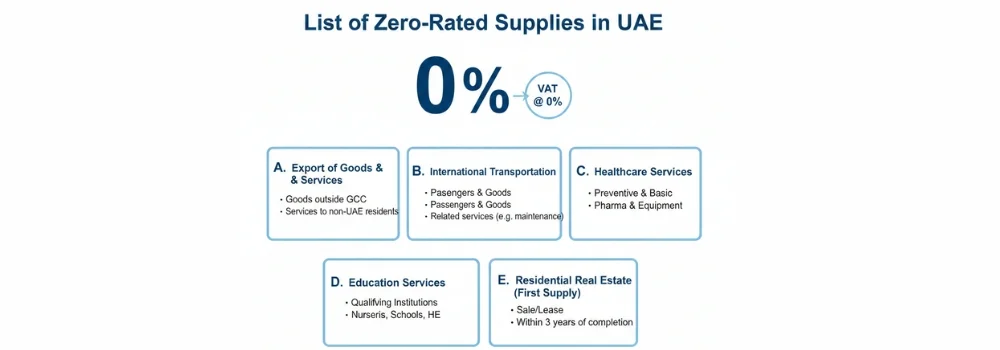
Here are the most common zero-rated supplies in uae vat:
A. Export of Goods & Services
Selling to customers outside the GCC? This is the most common example. Whether you are shipping physical products or providing remote consulting services to a client in Europe or the US, these transactions are typically zero-rated.
B. International Transportation
Think big air, sea, and land. If you are transporting passengers or goods that start or end outside the UAE, it’s a 0% rate. This also includes related services, like supplying fuel to an international aircraft.
C. Healthcare Services
The FTA wants to keep life-saving care affordable. Most “preventive and curative” healthcare services are zero-rated. This covers everything from doctor consultations to essential medicines and medical equipment.
D. Education Services
Education is a priority. Services provided by nurseries, schools, and higher education institutions owned or funded by the government are part of the list of zero rated vat in uae. This usually includes the supply of educational materials like printed books, too!
E. Residential Real Estate (First Supply)
Timing is everything here. The first supply (sale or lease) of a new residential building within 3 years of its completion is zero-rated. This helps developers recover their construction costs.
Quick Check: Did you know that after those first 3 years, the same residential property usually becomes “exempt”? This is a classic example of the difference between zero-rated and exempt vat in uae.
Conditions to Apply Zero Rating
Think of zero rating as a “reward” for being a compliant business. It’s not enough to simply say your service is tax-free; you have to prove it. The Federal Tax Authority (FTA) is very strict about this.
If you can’t show the right paperwork, they might treat your sale as a 5% supply, and that money comes out of your pocket!
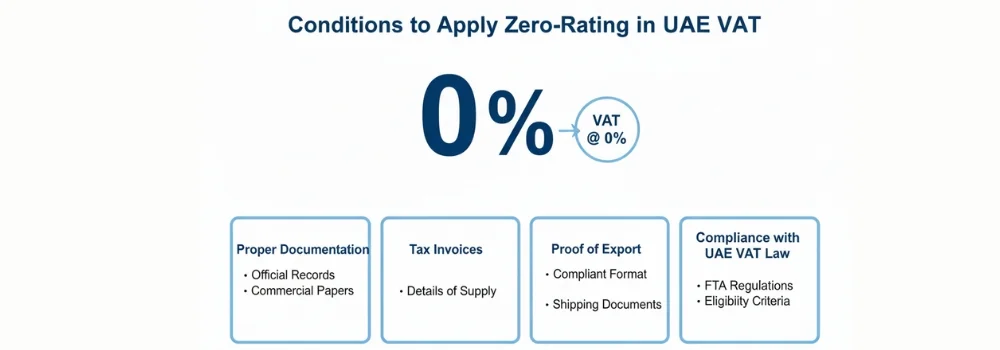
To successfully apply zero-rate VAT in uae, you must meet these four key conditions:
1. Proper Documentation
This is your foundation. You need to keep every piece of evidence that shows the transaction qualifies for 0%. This isn’t just about the sale itself; it’s about the context. For example, if you are zero-rating a service, you need to prove the recipient is actually based outside the UAE.
2. Tax Invoices
Even at 0%, you are still making a taxable supply. You must issue a valid FTA tax invoice format that clearly states:
- The VAT rate is 0%.
- The total amount of tax is AED 0.00.
- A brief mention of why it’s zero-rated (e.g., “Export of Goods”).
3. Proof of Export
If you’re shipping goods, the FTA needs more than just your word. You must keep “Official” and “Commercial” evidence.
- Official Evidence: Customs declarations and exit certificates issued by the local Customs Department.
- Commercial Evidence: Airway bills, bills of lading, or residency certificates of shipment.
- The 90-Day Rule: Generally, goods must leave the UAE within 90 days of the invoice date for the zero rating to stick.
4. Compliance with UAE VAT Law
At the end of the day, your records must be organized and easily accessible. The law requires you to keep these records for at least 5 years.
Regular audits happen, and having your zero rated vat items correctly documented is the best way to stay in the FTA’s good books.
Documentation Required
If the FTA ever decides to audit your business, your documents are your best defense. For zero-rate VAT in uae, you can’t just claim 0% and call it a day; you need a “paper trail” that proves the goods or services actually left the country or met specific criteria.
Think of this as your compliance toolkit. Here is the essential list of zero rated vat items documentation you must keep for at least 5 years:
1. Export Documents (The Evidence)
Whether you are shipping by air, sea, or road, you need official proof of movement. This includes:
- Airway Bills (for air freight)
- Bills of Lading (for sea freight)
- Consignment Notes or Certificates of Shipment
2. Customs Clearance Papers
When goods leave the UAE, the Customs Department issues specific forms. You must retain the Customs Declaration and the Exit Certificate.
These are the “official” documents the FTA looks for to verify that a physical export actually took place within the required 90-day window.
3. VAT Invoices
Every sale needs a paper trail. Even if you aren’t collecting cash for tax, you must issue a proper tax invoice format that shows the supply is zero-rated.
- It must include your TRN (Tax Registration Number).
- It must clearly state the 0% VAT rate.
- For exports, it should mention the destination country.
4. Contracts and Purchase Orders
Why are you sending these goods? The FTA wants to see the underlying agreement. Keep copies of your signed contracts, Letters of Intent (LOI), or Purchase Orders (PO) from your overseas clients.
These documents prove that the transaction was a legitimate business deal and not just a movement of goods between your own branches.
Common Mistakes Businesses Make
Even the most organized business owners can trip up when it comes to the Federal Tax Authority (FTA) rules. A small error today could lead to a massive headache (and a hefty fine) tomorrow.
Are you making any of these common blunders with your zero-rate VAT in uae?
1. Confusing Exempt with Zero-Rated
This is the #1 mistake. Remember: if you label a sale as “exempt” when it should be “zero-rated,” you lose the right to claim back the tax you paid on your costs.
That’s essentially throwing money away! Understanding the difference between zero-rated and exempt vat in uae is the first step to protecting your profit margins.
2. Incorrect Documentation
A handshake or a simple email isn’t enough for the FTA. Many businesses fail to collect the official Exit Certificate or Customs Declaration when exporting goods. Without these, your 0% tax rate is invalid, and you might be forced to pay the 5% VAT out of your own pocket.
3. Failure to Maintain Records
The law is clear: you must keep your VAT records for at least 5 years. Many businesses lose track of their tax invoice format or overseas contracts after a year or two. If an auditor knocks and your folders are empty, you’re in trouble.
4. Misclassification in ERP Systems
Is your accounting software set up correctly? Sometimes, zero rated vat items are accidentally coded as “Out of Scope” or “Exempt” in the system.
If your ERP (Enterprise Resource Planning) software isn’t configured for the specific list of zero rated vat in uae, your tax returns will be wrong every single time.
How ERP Software Helps Manage Zero-Rated VAT
Trying to keep track of every zero-rated transaction manually is like trying to catch sand with a sieve. It’s exhausting, and things will slip through. This is where modern Enterprise Resource Planning (ERP) software becomes your best friend.
In the UAE, the Federal Tax Authority (FTA) expects precision. Here is how a smart ERP system takes the weight off your shoulders:
1. Automatic VAT Classification
Stop guessing which items are 0% and which are 5%. With a localized ERP, you can pre-set tax codes for every product and service in your “Item Master.”
- Selling to a client in Germany? The system sees the “Export” destination and automatically applies zero rate VAT in uae.
- Invoicing for a healthcare service? The system knows it belongs on the list of zero rated vat in uae and sets the tax to zero instantly.
2. Smart Invoice Tagging
A common mistake is leaving the tax field blank. A good ERP ensures every invoice is tagged with the correct reason for zero-rating.
It will automatically add the necessary text, like “Zero-rated export” or “Supply of investment metalS,” onto your FTA tax invoice format. This keeps you compliant without you having to type a single extra word.
3. VAT Reporting Compliance
When it’s time to file your VAT 201 return, you shouldn’t be digging through piles of paper. An ERP system gathers all your transactions and populates the “Zero-Rated” box for you.
- It separates your zero-rated supplies in uae vat from your exempt ones.
- It calculates exactly how much Input VAT you can reclaim, ensuring you get every dirham back that you’re entitled to.
- It maintains a digital audit trail (for the required 5 years) so you are always ready for an FTA inspection.
Penalties for Incorrect VAT Treatment
Think of VAT compliance as a protective shield for your business. In the UAE, the Federal Tax Authority (FTA) is supportive of businesses, but they are also very serious about the rules. Getting your zero-rate VAT in uae wrong isn’t just a minor paperwork error; it can lead to heavy financial hits.
As of 2026, the UAE has updated its penalty framework to be more transparent, but the costs of “guessing” are still high.
Fines Imposed by the Federal Tax Authority
If you misclassify a service or fail to keep the right records, you could face several types of penalties:
- Late Registration: If you cross the AED 375,000 threshold and forget to register, you’re looking at an AED 10,000 fine right out of the gate.
- Incorrect Tax Returns: Submitting a return with wrong info (like claiming a 0% rate on a 5% item) can cost you AED 1,000 for the first time, jumping to AED 2,000 if it happens again.
- Late Payment Penalties: If you owe tax and miss the deadline, the FTA now applies a flat 14% annual interest rate (calculated monthly) on the unpaid amount.
- Failure to Issue Invoices: Not issuing a proper FTA tax invoice format can result in a fine of AED 2,500 per instance.
The Importance of Compliance
Why does this matter? Beyond just avoiding fines, staying compliant protects your cash flow. If the FTA denies your zero-rated status during an audit because your paperwork is missing, you will be forced to pay that 5% VAT yourself. For a large export deal, that could wipe out your entire profit margin!
The best way to stay safe? Keep your list of zero rated vat in uae updated, use a reliable ERP system, and always double-check your proof of export.
Who Is the Right VAT Consultant in the UAE?
Choosing the right partner can make the difference between a seamless refund and a heavy fine. For businesses looking to simplify their tax journey, HFA Consulting stands out as a leading choice, offering a team of FTA-registered experts who specialize in navigating complex tax environments.
Their comprehensive vat consultancy services in the UAE cover everything from strategic health checks and registration to audit representation and advanced ERP integration, ensuring your business stays 100% compliant while you focus on growth.
Conclusion
Understanding the ins and outs of zero-rate VAT in uae is more than just a legal requirement; it is a powerful tool for your business’s financial health. By correctly identifying zero-rated supplies in UAE VAT, you aren’t just saving your customers money; you are unlocking the ability to reclaim the tax you’ve paid on your own business expenses. That is a direct boost to your cash flow!
However, the line between success and a penalty often comes down to the details. Misclassifying an item or losing a single customs declaration can turn a 0% tax benefit into a 5% out-of-pocket cost.
Whether you are navigating the difference between zero-rated and exempt vat in uae or ensuring your zero rated vat items are documented perfectly, precision is everything.
Don’t leave your compliance to chance. To stay 100% safe, consider partnering with a professional or implementing a robust ERP system that automates your FTA tax invoice format. Taking these steps today ensures that when the FTA audits your books, you can breathe easy knowing every dirham is accounted for.
FAQS
What is zero-rated VAT in the UAE?
Zero rate VAT in uae is a tax category where the VAT rate is set at 0%. Unlike exempt items, these are still considered taxable supplies. This allows businesses to fulfill their tax obligations without charging the customer while remaining eligible for tax refunds from the Federal Tax Authority (FTA).
Is export zero-rated in the UAE?
Yes, the export of goods and services to countries outside the GCC is one of the most common zero-rated supplies in UAE VAT. To apply this, businesses must maintain specific “Official” and “Commercial” evidence, such as customs declarations and bills of lading, to prove the goods left the UAE within the required 90-day window.
Can businesses claim input VAT on zero-rated supplies?
Absolutely. This is the primary benefit of the zero-rate VAT in uae status. Because these supplies are technically “taxable” (just at a 0% rate), the law allows you to reclaim the VAT you paid on business-related expenses like rent, office equipment, and raw materials.
What is the difference between exempt and zero-rated VAT?
The main difference between zero-rated and exempt vat in uae is the ability to recover costs. Businesses selling zero-rated items can reclaim their input VAT, whereas those selling exempt items (like residential local leases) cannot. Zero-rated sales also count toward your mandatory registration threshold, while exempt sales do not.
Is healthcare zero-rated in the UAE?
Yes, most preventive and curative healthcare services are part of the list of zero rated vat in uae. This includes services provided by healthcare professionals and the supply of essential medicines or medical equipment, ensuring that vital care remains affordable for residents.


Zeeshan Khan
My name is Zeeshan Khan, and I’m a UAE-based business and tax consulting professional with hands-on experience in VAT compliance, corporate tax advisory, business setup, and regulatory services. I work closely with startups, SMEs, and established companies to help them navigate UAE tax laws, improve compliance, and make informed financial decisions. With a strong understanding of FTA regulations, corporate structuring, and commercial taxation in the UAE, my focus is on translating complex laws into clear, practical guidance for business owners. Through my writing, I aim to provide accurate, up-to-date insights that help businesses stay compliant, reduce risk, and operate confidently in the UAE market.