



Hero image

What Are the UAE Corporate Tax Registration Deadlines for 2026?

Protect your business from the Federal Tax Authority (FTA) automatic enforcement. In 2026, missing your specific UAE corporate tax registration deadline results in a guaranteed administrative fine. Whether you are a Mainland LLC, a Free Zone entity, or a Natural Person exceeding the revenue threshold, compliance is a legal mandate under Federal Decree Law No. 47 of 2022. HFA Consulting provides expedited EmaraTax portal submission, ensuring your Tax Registration Number (TRN) is secured and your trade license remains in good standing.

Partner logoPartner logoPartner logoPartner logoPartner logoPartner logoPartner logoPartner logoPartner logoPartner logoPartner logoPartner logo

What Is the Corporate Tax Registration Deadline in the UAE?

The corporate tax registration deadline in the UAE mandates that all taxable persons, including individuals and legal entities, submit their registration applications to the Federal Tax Authority (FTA) within specific timeframes. While the 2026 tax season focuses heavily on filing and payments, the obligation to register is the first and most critical step in the compliance cycle. Failing to secure a Tax Registration Number (TRN) by your assigned cutoff triggers an immediate administrative penalty, regardless of whether your business is currently profitable or falls below the tax-free threshold.

Overview of the UAE Corporate Tax Law and When It Took Effect

Federal Decree Law No. 47 of 2022 established the legislative framework for a federal tax on business profits in the Emirates. This law officially took effect for financial years beginning on or after June 1, 2023, signaling a major shift toward international tax transparency standards.

Who Needs to Register: Mainland, Free Zone, and Foreign Businesses

The registration mandate is broad and encompasses nearly all forms of economic activity. You are required to register if you fall under any of the following categories:

Entity CategoryScope and Registration Requirement
Mainland EntitiesIncludes all LLCs, PJSCs, and other juridical persons established under UAE law. Registration is a mandatory first step regardless of annual profit levels.
Free Zone EntitiesCovers all businesses in a Free Zone or Financial Free Zone, such as DIFC or ADGM. This includes those qualifying for a zero per cent tax rate who must still obtain a Tax Registration Number (TRN).
Foreign BusinessesApplies to non-resident juridical persons that maintain a Permanent Establishment or derive income from a Nexus within the UAE, requiring formal registration via the EmaraTax portal.
Natural PersonsIndividuals conducting business or commercial activities. Registration is required once the total turnover exceeds the prescribed threshold defined by the Federal Tax Authority (FTA).

The Role of the FTA in Corporate Tax Registration Enforcement

The Federal Tax Authority (FTA) is the regulatory body responsible for managing the FTA corporate tax registration deadline and ensuring all taxable persons are identified. The authority utilizes the EmaraTax portal to monitor registration statuses and issue automatic fines to entities that fail to comply within their assigned windows. To ensure your application is processed accurately, HFA Consulting manages the entire submission process to maintain your business's legal standing.

Difference Between Tax Registration, Tax Filing, and Tax Payment

Understanding the distinction between these three stages is essential for maintaining a clean compliance record:

PhaseCore FunctionDeadline Logic
Tax RegistrationThe initial step to obtain a Tax Registration Number (TRN).Based on your license issuance month or incorporation date.
Tax FilingSubmit a formal return detailing your annual financial performance.Due within nine months from the end of your financial year.
Tax PaymentSettling the actual tax liability based on your taxable income.Must be paid by the same date as your tax filing deadline.

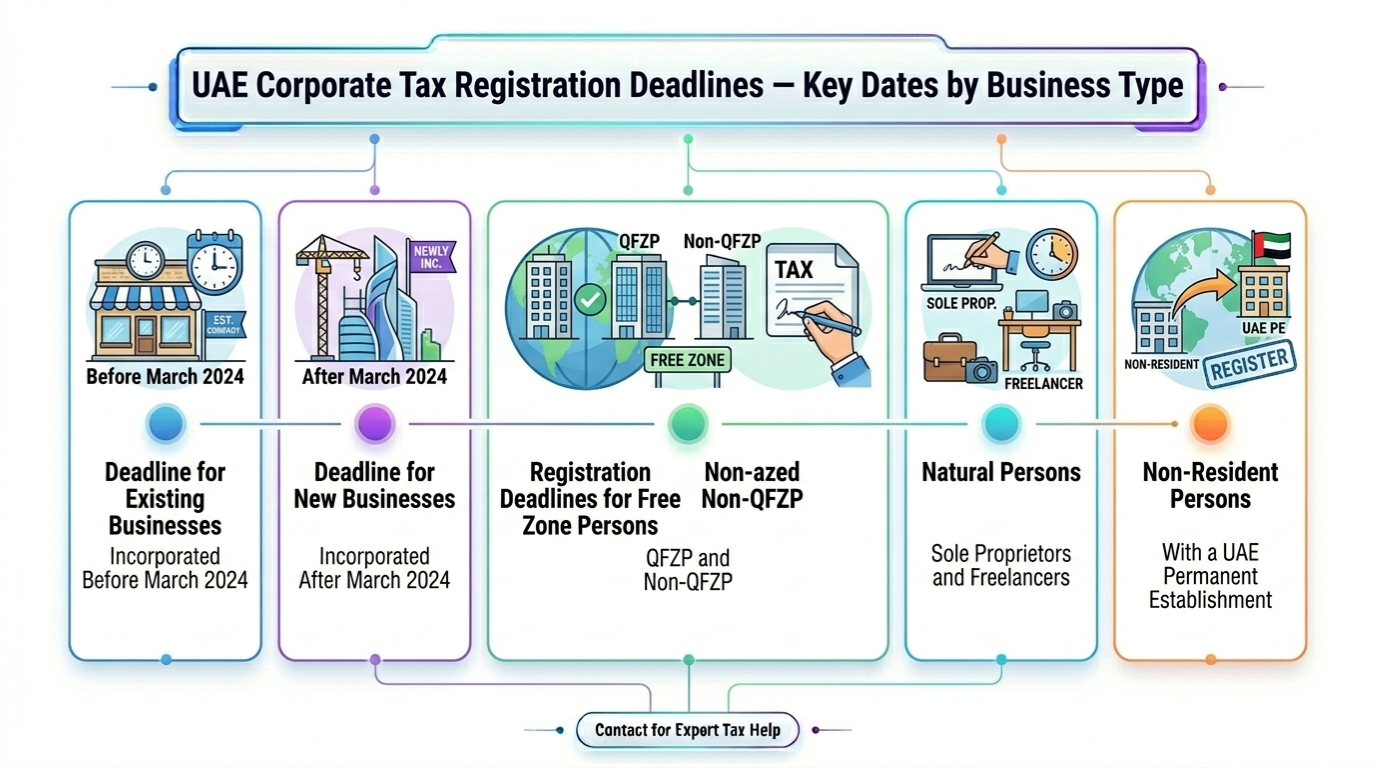
UAE Corporate Tax Registration Deadlines Key Dates by Business Type

The Federal Tax Authority (FTA) has established a staggered enforcement schedule to ensure all taxable persons are integrated into the national tax system. Missing the UAE corporate tax registration deadline specific to your entity type triggers an automatic administrative penalty. Because these dates are finalised and legally binding in 2026, verifying your exact "last date" is the only way to protect your business from unnecessary financial liability.

Deadline for Existing Businesses Incorporated Before March 2024

For juridical persons that existed before March 1, 2024, the registration window was determined by the month of their original license issuance. As we are now in 2026, all original staggered deadlines for these businesses have passed. If your license was issued in any month from January through December and you have not yet registered, you are already in a state of non-compliance and subject to the late registration penalty.

License Issuance MonthOriginal Registration Deadline2026 Status
January – FebruaryMay 31, 2024Overdue
March – AprilJune 30, 2024Overdue
MayJuly 31, 2024Overdue
JuneAugust 31, 2024Overdue
JulySeptember 30, 2024Overdue
August – SeptemberOctober 31, 2024Overdue
October – NovemberNovember 30, 2024Overdue
DecemberDecember 31, 2024Overdue

Deadline for New Businesses Incorporated After March 2024

For entities incorporated, established, or recognised on or after March 1, 2024, the registration requirement is trigger-based. These businesses must submit their application through the EmaraTax portal within three months of incorporation or recognition. This rule applies regardless of whether the business has started generating revenue or is still in the setup phase.

Registration Deadlines for Free Zone Persons (QFZP and Non-QFZP)

A common misconception is that a Qualifying Free Zone Person (QFZP) is exempt from registration because they benefit from a zero per cent tax rate. This is incorrect. Both QFZPs and Non-QFZPs must follow the same registration timelines based on their incorporation date. The zero per cent benefit is an election made on the tax return, which cannot be filed without first obtaining a Tax Registration Number (TRN).

Natural Persons, When Must Sole Proprietors and Freelancers Register?

Natural persons, such as sole proprietors and freelancers, fall under the scope of corporate tax only if their total turnover from business activities exceeds the prescribed threshold. According to Cabinet Decision No. 49 of 2023, this threshold is set at AED 1 million within a Gregorian calendar year. For those who meet this criterion, the corporate tax registration last date in the UAE is defined by FTA Decision No. 3 of 2024 as March 31 of the subsequent calendar year. For example, if your business turnover exceeded the legal limit during the 2025 period, your mandatory registration deadline is March 31, 2026. Failing to submit your application by this date through the EmaraTax portal triggers an automatic administrative penalty.

Non-Resident Persons With a UAE Permanent Establishment

Foreign entities operating within the Emirates must also adhere to strict timelines based on the nature of their presence:

Non-Resident CategoryRegistration Deadline Condition
Existing Permanent Establishment (PE)If the PE existed before March 1, 2024, the application must be submitted within nine months from the date the PE came into existence.
New Permanent Establishment (PE)For a PE established on or after March 1, 2024, the application must be submitted within six months from the date of existence.
Nexus RegistrationForeign entities with a "sequence" in the UAE (e.g., earning income from immovable property) must register within three months of the nexus being established.

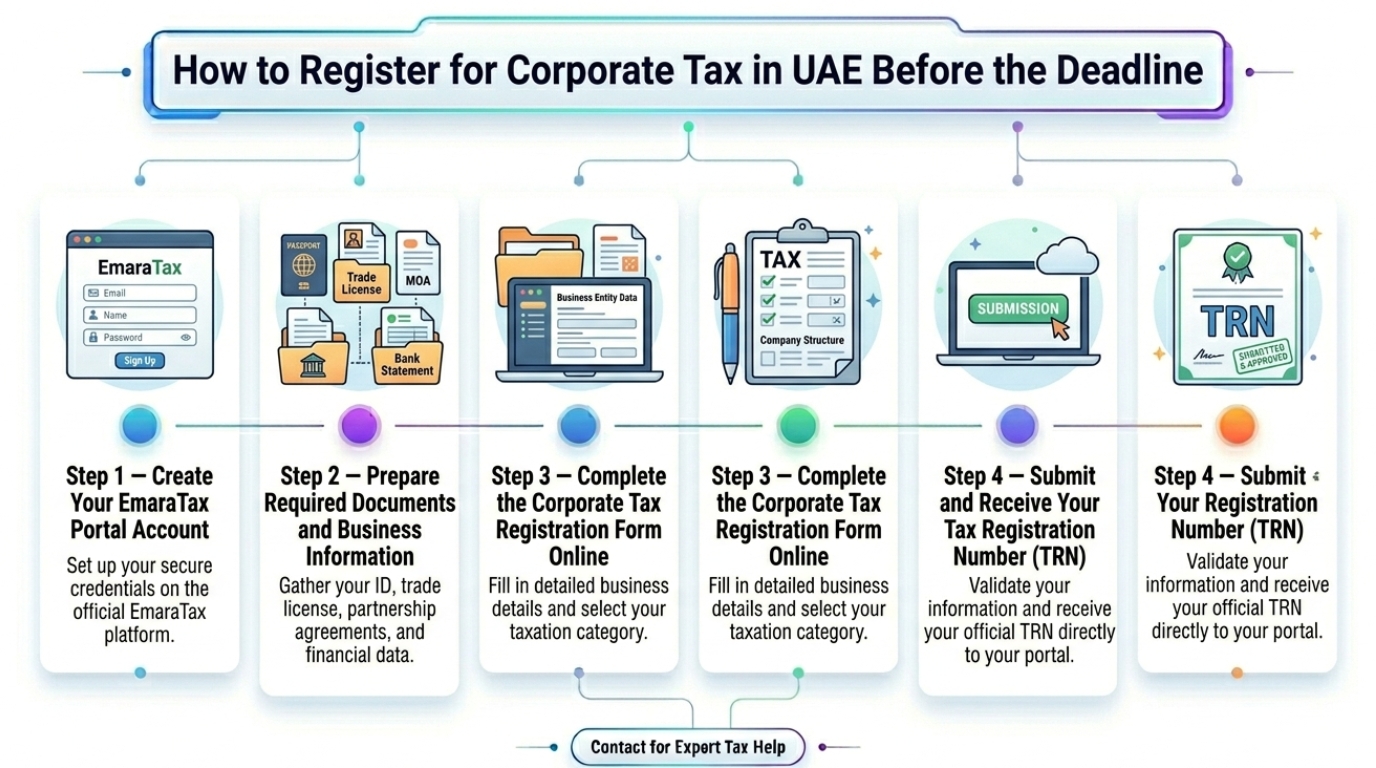
How to Register for Corporate Tax in the UAE Before the Deadline

Securing your Tax Registration Number is a mandatory procedural step that must be completed through the official digital tax environment. To ensure a smooth transition and avoid the administrative penalties associated with missing the UAE corporate tax registration deadline, businesses should initiate their application as soon as their trade license is active or they meet the residency criteria. If you are unsure when to register for corporate tax UAE, the general rule is to begin the process at least several weeks before your specific license month cutoff to allow for document verification. Professional registration services can streamline this submission to ensure your business remains in good standing with the Federal Tax Authority (FTA).

Step 1: Create Your EmaraTax Portal Account

The first concrete action is to access the EmaraTax portal, which serves as the central hub for all federal tax transactions in the Emirates. You will need to sign up using a valid email address and mobile number to create a taxable person account. Once the account is verified, you can navigate to the corporate tax dashboard to start a new registration application.

Step 2: Prepare Required Documents and Business Information

Before starting the online form, gather all necessary digital copies to avoid session timeouts. The FTA requires specific evidence to verify the legal identity and ownership of the business:

Required DocumentPurpose and Regulatory Requirement
Trade LicenseA clear, digital copy of your valid commercial or professional license issued by the relevant UAE licensing authority.
Memorandum of AssociationThe official MOA or equivalent documentation that outlines the company structure and shareholding.
IdentificationValid Emirates ID and Passport copies for the authorised signatory and all owners of the entity.
Financial DetailsDocumented information confirming the specific start and end dates of your business's financial year.
Proof of AuthorizationA legally binding Power of Attorney or board resolution if an external representative is managing the submission.

Step 3: Complete the Corporate Tax Registration Form Online

The digital application is divided into several sections covering entity details, business activities, and branch information. Ensure that the name of the entity matches the trade license exactly and that all address details are current. The system will also ask you to specify whether you are a Mainland or Free Zone entity, as this affects how your future tax returns are categorised.

Step 4: Submit and Receive Your Tax Registration Number (TRN)

Once the form is submitted, the FTA will review the data. If the application is complete and accurate, you will be issued a Tax Registration Number (TRN). This unique identifier is essential for all future correspondence, including tax filing and making payments. While processing times can vary depending on the volume of applications, having a TRN in hand is the only way to prove your business is officially compliant with Federal Decree Law No. 47.

Common Registration Errors That Cause Delays or Rejections

Even small discrepancies can lead to an application being sent back for clarification, which risks pushing you past your mandatory deadline:

Registration ErrorImpact and Regulatory Context
Mismatched DatesEntering financial year dates that do not align with your company's official articles of association. Under Federal Decree Law No. 47, your tax period must match your financial reporting period to avoid reconciliation failures.
Expired DocumentsSubmit a trade license or identification that is nearing expiration. The Federal Tax Authority (FTA) requires all uploaded evidence to be valid at the time of approval to prevent processing delays.
Incorrect Entity TypeSelecting "Natural Person" for a business that is legally a "Juridical Person" (such as an LLC). This classification error affects your tax base and is a leading cause of registration rejection.
Unauthorized SignatoriesProviding identification for an individual who does not hold the legal power of attorney or board authorisation. Only verified signatories can legally bind the entity for tax purposes.

Penalty for Late Corporate Tax Registration in UAE: What You Risk by Missing the Deadline

Missing your registration window triggers an automatic AED 10,000 administrative penalty as mandated by the Federal Tax Authority (FTA). Under Cabinet Decision No. 75 of 2023 (as amended by Cabinet Decision No. 10 of 2024), this fine is applied per violation to any taxable person who fails to submit their application within the timeline prescribed for their license month or entity type. Because the 2026 enforcement cycle is now fully active, the FTA systems are designed to identify non-compliant entities automatically, making immediate registration the only way to halt further regulatory action.

AED 10,000 Fixed Penalty: What the FTA Charges for Late Registration

The Federal Tax Authority imposes a fixed AED 10,000 administrative penalty for the failure to submit a corporate tax registration application within the specified timeframe. This penalty applies to all taxable persons, including Mainland companies, Free Zone entities, and foreign businesses with a Permanent Establishment in the Emirates. Even if your business qualifies for a zero percent tax rate or has not yet reached the taxable profit threshold, the legal obligation to register remains absolute.

Can You Appeal an FTA Penalty? The Reconsideration Process Explained

If your business has been issued a fine, you have the right to submit a Reconsideration Request through the EmaraTax portal. According to the Federal Tax Authority Reconsideration Guide, this formal appeal must be filed within 40 business days of the penalty notification. You must provide documented proof of "Excusable Neglect" or technical errors that prevented timely submission. The FTA typically issues a decision within 45 business days, though it may extend this period for complex cases.

Additional Risks: Banking, License Renewal, and Reputational Issues

Beyond the immediate financial cost, remaining unregistered creates significant operational bottlenecks that can stall your business growth:

Operational RiskImpact on Business Continuity
Trade License BlockageLocal licensing authorities may suspend or deny the renewal of your commercial license if your tax compliance status is not verified. A valid license is a prerequisite for all legal operations in the country.
Banking RestrictionsFinancial institutions in the Emirates increasingly require a Tax Registration Number (TRN) to maintain active corporate accounts, process international transfers, or approve new credit facilities.
Customs DelaysThe movement of goods may be restricted or delayed at the border if an entity is flagged as non-compliant within the federal tax database, impacting supply chain efficiency.
Contract EligibilityPossession of a valid TRN is now a mandatory requirement for bidding on government and semi-government tenders, effectively barring unregistered entities from lucrative public sector contracts.

How to Avoid Further Penalties Even If You Have Already Missed the Deadline

If you have already passed your assigned corporate tax registration last date in the UAE, the priority is to stop the accumulation of secondary compliance failures. Registering immediately through the EmaraTax portal allows you to fulfill your filing obligations on time, which prevents additional fines for late tax returns. Furthermore, under Public Clarification CTP006, certain entities may be eligible for a penalty waiver if they meet specific accelerated filing conditions. Proactive registration is the only pathway to regaining your standing as a compliant UAE business.

Corporate Tax Return Due Date in UAE: What Comes After Registration

Obtaining your Tax Registration Number (TRN) is only the first phase of compliance. Once registered, every taxable person must prepare for the second phase: the annual filing of a tax return. A common point of confusion for many business owners is the distinction between the registration deadline and the corporate tax return due date. While registration is a one-time setup requirement based on your license issuance month, the tax return is a recurring annual obligation based on the closing of your financial books.

When Is the Corporate Tax Return Due? The 9-Month Rule Explained

Under Federal Decree Law No. 47 of 2022, the deadline for filing a corporate tax return and settling any payable tax is exactly nine months after the end of the relevant tax period. This is widely known as the "9-Month Rule." For the vast majority of businesses in the Emirates that follow a standard calendar year (January to December), the first tax return for the 2024 financial year must be submitted no later than September 30, 2025. For the 2025 financial year, the deadline will be September 30, 2026.

Difference Between Registration Deadline and Filing Deadline

It is vital to understand that these two dates operate on entirely different logic. Missing either one will result in separate administrative penalties.

RequirementTrigger LogicFrequency
Tax RegistrationBased on the month your Trade License was issued.One-time (unless details change).
Tax Return FilingBased on the End of your Financial Year (e.g., Dec 31).Annual recurring obligation.

Tax Period, Financial Year, and How They Affect Your Due Date

Your specific corporate tax return due date is dictated by your "Tax Period," which normally aligns with the financial year recorded in your company's Articles of Association. Standard Year: If your year ends on December 31, your filing is due by September 30 of the following year. Off-Cycle Year: If your financial year ends on March 31, your filing and payment must be completed by December 31 of that same year. First Tax Period: For most existing businesses, the first tax period began on January 1, 2024, meaning the first major wave of filings concludes in late 2025.

What Happens If You Miss the Corporate Tax Return Deadline?

Failing to file your return or pay the tax due by the nine-month cutoff triggers a different set of penalties than the initial registration fine. According to Cabinet Decision No. 75 of 2023, the penalties for late filing include: Late Filing Penalty: An initial administrative fine for failing to submit the return on time. Late Payment Penalty: A percentage-based fine applied to the unpaid tax amount, which increases the longer the balance remains outstanding. Correctness Penalty: Fines for submitting inaccurate data if the FTA discovers errors during an audit.

Who Is Exempt From Corporate Tax Registration in the UAE?

While the UAE corporate tax regime is broad, the Federal Tax Authority (FTA) has defined specific categories of "Exempt Persons." For these groups, the administrative burden is either removed or significantly reduced. However, it is a common legal pitfall to assume that a zero percent tax rate is the same as an exemption from registration. In the 2026 tax landscape, understanding these nuances is critical for maintaining a compliant business standing.

Government Entities and Government-Controlled Entities

Under Article 4 of Federal Decree Law No. 47, the UAE Federal Government, Local Governments, and their departments are considered "Exempt Persons" by default. This automatic exemption also extends to certain government-controlled entities that perform mandated activities. For these specific organizations, there is generally no requirement to register with the FTA or obtain a Tax Registration Number (TRN), provided they do not engage in commercial business activities that fall outside their sovereign scope.

Qualifying Public Benefit Entities Under FTA Recognition

Non-profit organizations, charities, and social welfare groups can qualify for an exemption if they are officially listed in a Cabinet Decision. To be recognized as a Qualifying Public Benefit Entity (QPBE), an organization must operate exclusively for religious, charitable, scientific, or educational purposes and must not distribute any income or assets for personal gain. Unlike government bodies, these entities must typically apply for exempt status and, once granted, must maintain rigorous record-keeping to prove their public benefit activities continue to align with Cabinet Decision No. 37 of 2023.

Clarifying the Threshold: Profit vs. Registration Obligation

One of the most frequent misconceptions is that a business with an annual profit below AED 375,000 is exempt from registration. This is incorrect because the threshold only applies to the tax rate and not the legal registration obligation. Under Federal Decree Law No. 47 of 2022, all taxable persons including startups and small mainland LLCs—must register for corporate tax and obtain a Tax Registration Number (TRN) through the EmaraTax portal. While your tax liability may be zero percent on the first AED 375,000 of profit, failing to register still triggers the AED 10,000 administrative penalty as defined by Cabinet Decision No. 75 of 2023.

Small Business Relief: Who Qualifies and How to Apply

To support the growth of smaller enterprises, the Ministry of Finance introduced Small Business Relief (SBR) under Ministerial Decision No. 73 of 2023. This allows eligible resident taxable persons with gross revenue below AED 3 million in a relevant tax period to elect to be treated as having "no taxable income." This relief is available for tax periods ending on or before December 31, 2026, but it is important to note that you must still register for corporate tax and obtain a Tax Registration Number (TRN) to claim this benefit. The election itself is made during the annual tax return filing process through the EmaraTax portal.

How Our Tax Experts Help You Meet Every Corporate Tax Registration Deadline

Navigating the Federal Tax Authority requirements in 2026 demands precision to avoid the automatic administrative penalties now in effect. Our consultancy provides the technical oversight and regulatory knowledge needed to secure your Tax Registration Number (TRN) without the risk of document rejection or data mismatches. By outsourcing the submission process, you ensure your business remains compliant with Federal Decree Law No. 47 while maintaining full focus on your commercial operations.

End-to-End EmaraTax Registration

Our team manages the entire EmaraTax portal submission, from initial account creation to the final issuance of your TRN. We eliminate the friction of technical filing by accurately categorizing your entity type—whether Juridical or Natural Person—and ensuring all uploaded evidence meets the current FTA standards. This results in a "Right First Time" submission that bypasses the common processing delays caused by incomplete or incorrectly formatted applications.

Deadline Tracking and Proactive Reminders for All UAE Tax Obligations

Compliance does not end with a successful registration. We provide a structured oversight system that tracks your specific corporate tax registration last date in the UAE alongside your annual filing and payment windows. By mapping your financial year to the mandated nine-month filing rule, we provide proactive alerts well in advance of any regulatory cutoff. This continuous monitoring protects your business from the AED 10,000 late registration fine and the escalating penalties associated with overdue tax returns.

What to Expect When You Work With Us

Engagement with our tax specialists follows a transparent, three-stage framework designed for speed and accuracy:

PhaseProcess and DeliverablesOutcome
Document AuditA comprehensive review of your Trade License, MOA, and Emirates ID to ensure every document is valid and aligned with Federal Tax Authority (FTA) requirements.Error Free Foundation: Prevents application rejections caused by expired IDs or mismatched business details.
Portal SubmissionYour application is professionally drafted and submitted through the official federal tax environment within 48 hours of document verification.Expedited Processing: Ensures your data is entered correctly into the EmaraTax system to trigger immediate review.
TRN Delivery & RoadmapDelivery of your official Tax Registration Number (TRN) along with a customized calendar highlighting your first corporate tax return due date and any Small Business Relief eligibility.Long Term Compliance: Provides a clear path for future filing obligations and protects your business from secondary fines.
Testimonials

What our clients say about us

Working with HFA Consulting over the past years I can only say they are the best at every level. All projects we collaborated on were excellent. Not only their strategy, but overall professionalism.

Working with HFA Consulting over the past years I can only say they are the best at every level. All projects we collaborated on were excellent. Not only their strategy, but overall professionalism.

Working with HFA Consulting over the past years I can only say they are the best at every level. All projects we collaborated on were excellent. Not only their strategy, but overall professionalism.

Working with HFA Consulting over the past years I can only say they are the best at every level. All projects we collaborated on were excellent. Not only their strategy, but overall professionalism.

HFA one of the best consultation companies ever worked with them for one year and so happy with them


Questions

Frequently Asked Questions (FAQs)

Clear answers to your most pressing questions about UAE Corporate Tax registration obligations and deadlines.

Image

What is the corporate tax registration deadline in the UAE?

The UAE corporate tax registration deadline for existing businesses was determined by their license issuance month, with the final staggered date ending on December 31, 2024. For new businesses incorporated on or after March 1, 2024, the deadline is exactly three months from the date of incorporation or recognition. Because 2024 deadlines have already passed, any existing business that has not yet secured a Tax Registration Number (TRN) is currently in a state of non-compliance and subject to administrative penalties.

What is the penalty for not registering for corporate tax in the UAE on time?

The penalty for late corporate tax registration in the UAE is a fixed AED 10,000 administrative fine as mandated by Cabinet Decision No. 75 of 2023. This fine is applied automatically through the EmaraTax portal once a late application is processed. If a business can prove valid technical or legal grounds for the delay, it may submit a Reconsideration Request to the Federal Tax Authority (FTA) within 40 business days of the penalty notice.

Do Free Zone companies need to register for UAE corporate tax?

Yes, all Free Zone entities must register for corporate tax regardless of whether they are a Qualifying Free Zone Person (QFZP) or a Non-QFZP. While many Free Zone businesses benefit from a zero percent tax rate on qualifying income, the legal obligation to obtain a TRN and file annual tax returns remains absolute under Federal Decree Law No. 47. Registration is the only way to officially claim the zero percent benefit during the tax filing process.

When is the corporate tax return due date after registering?

The corporate tax return due date is exactly nine months after the end of your relevant tax period. For businesses following a standard calendar year ending on December 31, the first return for the 2024 period is due by September 30, 2025. It is crucial to distinguish this from the registration deadline; registration is a one-time setup requirement based on your license, while the tax return is an annual recurring obligation based on your financial year-end.

Can I register for corporate tax after the deadline has passed?

Yes, you can and should register immediately, even if your specific UAE corporate tax registration deadline has passed. While the AED 10,000 penalty will still apply, registering now prevents the accumulation of secondary penalties related to late tax return filings and potential trade license blocks. The FTA encourages late registrants to regularize their status as soon as possible to avoid further legal complications or banking restrictions.

Is corporate tax registration different from VAT registration in the UAE?

Yes, corporate tax registration and VAT registration are two entirely separate processes with different thresholds and reporting requirements. VAT is a consumption tax applied to the supply of goods and services (typically with a registration threshold of AED 375,000 in taxable supplies), while Corporate Tax is a direct tax on business profits. Having a VAT TRN does not automatically register you for Corporate Tax; you must submit a distinct application through the EmaraTax portal to comply with the corporate tax regime.
Contact Us

Let's Get Your Tax Registration Sorted

Compliance and clarity starts with a valid Tax Registration Number. If your business isn't registered, you're headed for trouble. The good news? It only takes one decision to change the course.

70+ Businesses served

Helped businesses gain compliance and smoother financial management.

20+ Active clients

Offering specialized financial consultancy services to businesses across UAE.

Book a Consultation

Let us know your challenge and business overview to get a proposal.

Select a service...