



Hero image

VAT on Medical Services in the UAE for Healthcare Providers and Patients

We help healthcare providers and businesses understand how VAT applies to medical services in the UAE so you can stay fully compliant with Federal Tax Authority regulations, avoid costly classification errors, and manage your tax obligations with confidence. HFA Consulting supports healthcare providers across the UAE with accurate VAT classification, compliance, and reporting to ensure smooth operations and regulatory alignment.

Partner logoPartner logoPartner logoPartner logoPartner logoPartner logoPartner logoPartner logoPartner logoPartner logoPartner logoPartner logo

Intro

Understanding your hospital bill should be simple, yet many patients and healthcare providers are often confused when VAT is applied differently across services. The challenge comes from the three-tier VAT structure in the UAE, where some medical services are zero rated, others are exempt, and certain treatments are subject to standard VAT. This complexity can lead to incorrect billing, compliance risks, and financial losses if not handled properly.

In this guide, we clearly explain how VAT on medical services in the UAE works, how services are classified, and what healthcare businesses must do to stay compliant with Federal Tax Authority regulations. You will learn how to identify taxable services, avoid common errors, and manage VAT responsibilities with confidence.

This guide is designed for hospitals, clinics, pharmacies, healthcare administrators, accountants, and patients who want clarity and accuracy in medical VAT handling.

How VAT Applies to Medical Services in the UAE

VAT on medical services in the UAE is applied under three categories zero rated exempt, and standard-rated, depending on the nature of the treatment and whether it qualifies as essential healthcare under Federal Tax Authority guidelines. Correct classification is critical to ensure compliance and avoid billing errors.

Zero-Rated Healthcare Services (0 Percent VAT)

Zero-rated healthcare services are essential medical treatments provided to diagnose, treat, or prevent illness. These services are taxed at zero percent but still allow healthcare providers to recover input VAT on their expenses.

Key Benefits:

  • No VAT charged to patients
  • Full recovery of input VAT
  • Improved cash flow for healthcare providers

Common Zero-Rated Services:

  • Preventive care and vaccinations
  • Medical treatments by licensed professionals
  • Diagnostic services such as lab tests and imaging
  • Surgeries required for medical conditions
  • Physical therapy and rehabilitation
  • Dental services that are medically necessary

A critical requirement is that the service must be provided by a licensed healthcare professional or facility. Without proper licensing, the same service may become taxable.

Standard-Rated Healthcare Services (5 Percent VAT)

Standard-rated healthcare services are those that do not qualify as essential medical treatment. These services are subject to 5 percent VAT and must be billed accordingly.

Services That Attract 5 Percent VAT:

  • Cosmetic procedures not linked to medical necessity
  • Elective cosmetic surgery
  • Alternative therapies without proper licensing
  • Over-the-counter medications
  • Medical reports for non-medical purposes, such as insurance or legal use
  • Wellness and lifestyle treatments

The key distinction is medical necessity versus personal choice. If a procedure is performed for health reasons, it may qualify as zero-rated, but if it is done for cosmetic or non-medical purposes, it becomes subject to VAT.

VAT Treatment of Prescription Medicines vs OTC Drugs

The VAT treatment of medicines in the UAE depends on whether a product is classified as a prescription medicine or an over-the-counter drug. This distinction directly impacts pricing, compliance, and VAT recovery for pharmacies and healthcare providers.

Prescription medicines are zero-rated because they are considered essential for treating diagnosed medical conditions. These medicines are strictly regulated and can only be supplied with a valid prescription from a licensed healthcare professional, which establishes their medical necessity.

Over-the-counter drugs are subject to 5 percent VAT because they can be purchased without a prescription and are not always linked to a specific medical diagnosis. They are typically used for general relief or minor health conditions, which places them outside zero-rated healthcare treatment.

This difference is important because incorrect classification can lead to billing errors, compliance risks, and penalties during Federal Tax Authority reviews. Even small mistakes at the pharmacy level can create larger financial and reporting issues.

Pharmacies must ensure proper classification, accurate invoicing, and clear documentation for prescription-based sales. Strong processes are essential to maintain compliance and support accurate VAT return filing in Dubai.

New medications can create challenges when their VAT treatment is not immediately clear. Delays in regulatory updates or confusion at the operational level can lead to incorrect VAT application, making regular review and expert guidance necessary.

CriteriaPrescription MedicinesOver-the-Counter Drugs
VAT RateZero rated5 percent VAT
Medical RequirementRequires a valid prescriptionNo prescription required
PurposeTreatment of diagnosed conditionsGeneral use or minor relief
Regulatory ControlStrictly regulated and approvedLess restrictive availability
Input VAT RecoveryAllowedAllowed
Compliance RiskLower if properly documentedHigher due to frequent misclassification

VAT Compliance Requirements for Healthcare Providers

Healthcare providers in the UAE must follow strict VAT compliance rules to ensure accurate reporting, correct billing, and alignment with Federal Tax Authority regulations. From registration to invoicing and VAT recovery, each step requires careful handling to avoid penalties and financial inefficiencies.

Who Must Register for VAT

Healthcare providers are required to register for VAT if their taxable supplies exceed AED 375,000 annually. This includes both standard-rated and zero-rated services, as zero-rated supplies are still considered taxable under UAE VAT law.

Businesses generating revenue above AED 187,500 may choose voluntary registration. This is often beneficial for clinics and hospitals because it allows them to recover input VAT on operational expenses, even if most of their services are zero-rated.

Healthcare providers should also understand VAT registration in the UAE fees, which typically include professional service charges depending on the complexity of the business structure and documentation.

Tax Invoice Requirements

Healthcare providers must issue tax invoices that clearly reflect the VAT treatment of each service. The invoice should include the supplier details, patient or customer details, description of services, and the applicable VAT rate.

It is essential that the correct VAT rate is applied based on service classification, whether zero-rated or standard-rated. Incorrect invoicing is one of the most common compliance issues identified during audits.

All VAT-related records, including invoices and supporting documents, must be retained for a minimum of five years as required by UAE regulations.

Input VAT Recovery for Hospitals and Clinics

Hospitals and clinics can recover input VAT on expenses that are directly linked to taxable supplies, including zero-rated services. This helps reduce overall operational costs and improves financial efficiency.

Recoverable expenses typically include medical equipment, utility costs, professional services such as accounting or legal support, and facility maintenance. These are considered essential for delivering healthcare services.

However, input VAT cannot be recovered on expenses related to exempt supplies. In cases where a healthcare provider offers a mix of zero-rated, exempt, and standard-rated services, an apportionment method must be applied to determine the recoverable portion.

Due to the complexity of mixed supplies, VAT calculations, and regulatory scrutiny, many providers rely on VAT consultancy services in Dubai and VAT audit services in Dubai to ensure accurate recovery, proper documentation, and full compliance.

VAT Deregistration for Healthcare Businesses

Healthcare providers may need to apply for deregistration if their taxable supplies fall below the required threshold or if business activities change. This process must be handled carefully to avoid penalties and ensure compliance with Federal Tax Authority rules.

Healthcare providers must evaluate eligibility and follow proper procedures for VAT Deregistration UAE to ensure accurate closure of tax obligations and avoid future compliance risks.

VAT Refunds for Healthcare Providers

Healthcare providers offering zero-rated services can benefit from recovering input VAT on eligible expenses. This helps improve cash flow and reduce overall operational costs when managed correctly.

Healthcare providers offering zero-rated services may be eligible to claim a VAT refund in Dubai, provided they maintain proper documentation and meet Federal Tax Authority requirements.

Common VAT Mistakes Healthcare Providers Make

Healthcare providers in the UAE often face challenges in applying VAT correctly due to the complexity of service classification and compliance requirements. Even small errors can lead to financial losses, audit risks, and penalties from the Federal Tax Authority. Understanding these common mistakes helps prevent costly issues and ensures smooth operations.

To avoid these issues, many healthcare providers work with a professional tax consultant in Dubai and registered tax agents in UAE to ensure accurate classification, proper VAT treatment, and full compliance with Federal Tax Authority regulations.

Incorrect Service Classification

One of the most frequent issues is misclassifying medical services. For example, a clinic may treat a procedure as zero-rated without confirming whether it meets the criteria of medical necessity or proper licensing. This can result in undercharging VAT and compliance risks.

The solution is to establish clear internal guidelines for service classification based on FTA rules. Each service should be reviewed against medical necessity criteria and supported with proper documentation to justify its VAT treatment.

Improper Input VAT Claims

Healthcare providers sometimes claim input VAT on expenses that are not eligible, especially when dealing with exempt services. For instance, claiming full VAT recovery while offering a mix of zero-rated and exempt services can lead to incorrect filings.

The correct approach is to apply proper apportionment methods where mixed supplies exist. This ensures that only the eligible portion of input VAT is recovered, keeping the business compliant and audit-ready.

Missing Documentation

Incomplete or missing documentation is another common issue. Providers may fail to maintain proper invoices, patient records, or supporting evidence for VAT treatment, which becomes a major concern during audits.

To avoid this, healthcare businesses should implement strong record-keeping practices. All invoices, prescriptions, and supporting documents must be properly stored and retained for the required period to support VAT claims and classifications.

Cosmetic vs Medical Procedure Classification

Distinguishing between cosmetic and medically necessary procedures is often a gray area. The VAT treatment depends on the purpose of the procedure and whether there is a valid medical justification supported by clinical records.

CriteriaMedical ProcedureCosmetic Procedure
PurposeTreatment of a diagnosed medical conditionEnhancement of appearance
VAT TreatmentZero rated5 percent VAT
Medical JustificationRequired with a documented diagnosisNot required
Performed ByLicensed healthcare professionalMay be a medical or aesthetic provider
Supporting DocumentationStrong clinical evidence is requiredMinimal or none
ExampleSkin condition treatment prescribed by a doctorBotox for aesthetic improvement

Special Scenarios in Healthcare VAT

Healthcare VAT in the UAE becomes more complex in certain situations where the nature of the patient, contract structure, or service delivery changes. These scenarios require careful evaluation to ensure correct VAT treatment and avoid compliance risks.

Medical Tourism and International Patients

Medical tourism introduces unique VAT considerations, especially when services are provided to non-resident patients. While healthcare services may still qualify as zero-rated if they meet medical criteria, the involvement of international patients can raise questions around whether the service is treated as a local supply or an export of services.

Healthcare packages that include accommodation, transport, or additional services must be carefully structured. Only the qualifying medical component may be zero-rated, while other elements could be subject to standard VAT.

Proper documentation is essential in these cases. Providers must maintain patient records, treatment details, and supporting evidence to justify VAT treatment, particularly when dealing with cross-border transactions.

Insurance Company Contracts

Many healthcare providers operate under agreements with insurance companies, creating business-to-business arrangements that affect VAT treatment. A key consideration is identifying the actual recipient of the service, whether it is the patient or the insurance provider.

Contract clarity is critical to determine how VAT should be applied. In some cases, the medical service remains zero-rated, while administrative or support services provided to insurers may be subject to standard VAT.

Clear invoicing and well-defined contractual terms help prevent confusion and ensure compliance with Federal Tax Authority requirements.

Government vs Private Healthcare

VAT treatment can vary depending on whether services are provided through public healthcare facilities or private providers. The structure, funding, and contractual arrangements play a key role in determining how VAT is applied.

CriteriaGovernment HealthcarePrivate Healthcare
VAT TreatmentMay have specific exemptions or special rulesStandard VAT rules apply
Funding StructureGovernment-funded or subsidizedPrivately owned and operated
Service ClassificationMay vary based on public policy and structureMust strictly follow FTA classification
Compliance RequirementsMay differ depending on entity statusFull compliance with VAT regulations is required
Reporting ObligationsCan have unique reporting frameworksStandard VAT return filing required
Public-Private PartnershipsDepends on contract terms and the role of each partyDepends on contract structure and service responsibility

Medical Equipment Sales vs Services VAT Treatment

The VAT treatment of medical equipment depends on whether it is supplied as a product or provided as part of a service. Correct classification is essential to ensure accurate billing and compliance with UAE VAT regulations.

CriteriaEquipment SalesEquipment Services
Nature of SupplySale of physical medical equipmentService related to equipment
VAT TreatmentZero-rated or 5 percent, depending on approval statusGenerally, 5 percent VAT
ExamplesSale of approved medical devices or machinesMaintenance, repair, installation
Approval ImpactZero-rated if approved by the relevant authoritiesNot applicable, usually standard rated
Used EquipmentMay require special evaluation based on prior VAT treatmentNot applicable
Input VAT RecoveryAllowed if linked to taxable suppliesAllowed if used for taxable activities
Compliance FocusCorrect product classification and approval statusProper service invoicing and VAT application

FTA Guidelines for the Healthcare Sector

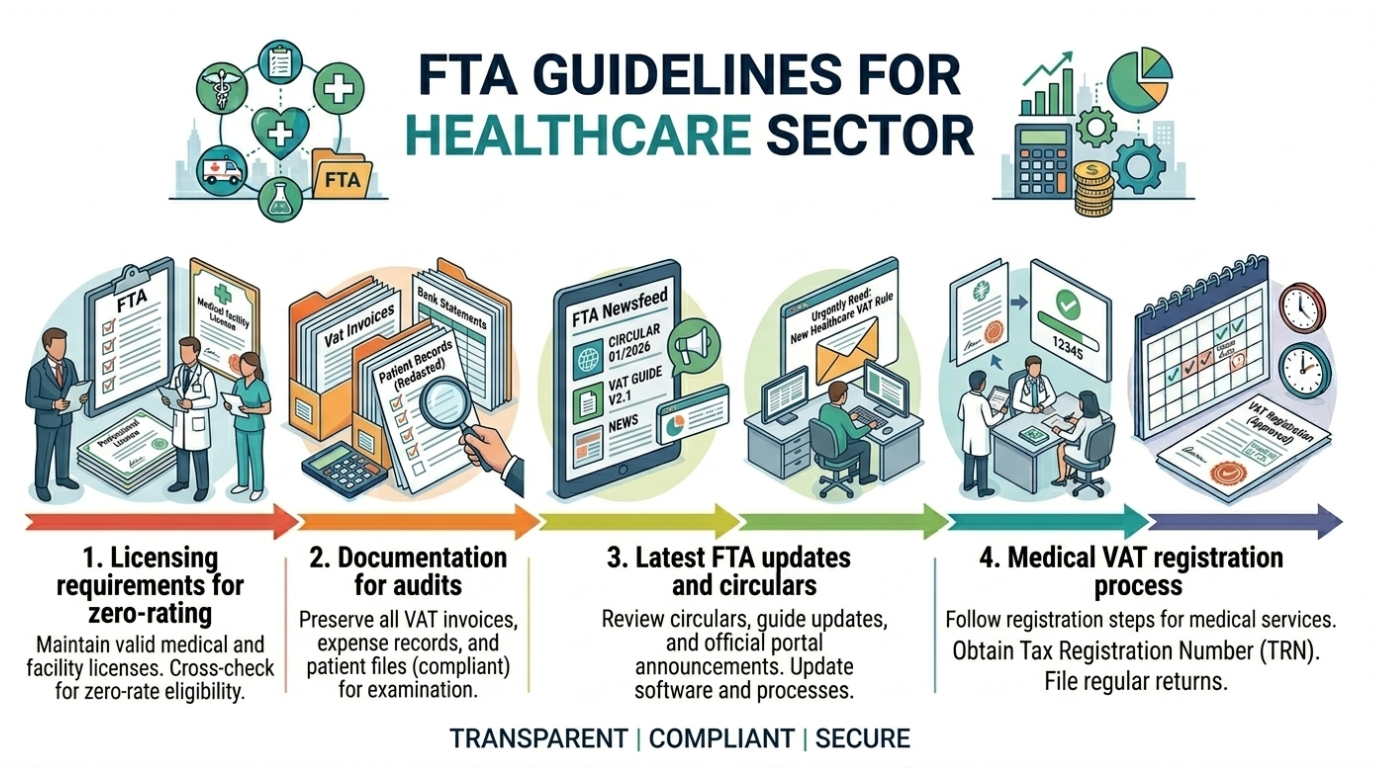
The Federal Tax Authority provides specific guidelines for how VAT should be applied in the healthcare sector. These rules focus on proper licensing, accurate documentation, and correct registration to ensure that medical services are classified and reported in line with UAE regulations.

Licensing Requirements for Zero Rating

For a healthcare service to qualify as zero-rated, it must be provided by a licensed healthcare professional or facility recognized by the relevant UAE health authority. Licensing is a critical condition because even medically necessary treatments may become subject to 5 percent VAT if performed by an unlicensed provider.

Healthcare businesses must ensure that all practitioners, branches, and services are properly licensed and aligned with regulatory approvals to maintain zero-rated eligibility.

Documentation for Audits

Maintaining proper documentation is essential for VAT compliance and audit readiness. Healthcare providers must keep clear records of patient treatments, invoices, prescriptions, and service classifications to support the VAT treatment applied.

During an audit, the Federal Tax Authority reviews whether services were correctly classified and supported by valid medical justification. Missing or incomplete documentation can lead to penalties and reassessment of VAT liabilities.

Latest FTA Updates and Circulars

The healthcare sector is subject to ongoing regulatory updates, and the Federal Tax Authority may issue new guidance or clarifications that impact VAT treatment. Providers must stay informed about these updates to ensure continued compliance.

Changes in classification rules, approved medicines, or documentation standards can directly affect how VAT is applied, making regular review and internal updates essential.

Medical VAT Registration Process

Healthcare providers must register for VAT if their taxable supplies exceed the mandatory threshold. The registration process involves submitting business details, licensing information, and financial data through the Federal Tax Authority portal.

Accurate registration ensures that healthcare providers can correctly charge VAT where applicable, recover input VAT on eligible expenses, and meet their reporting obligations without compliance risks.

How Healthcare Providers Can Ensure VAT Compliance

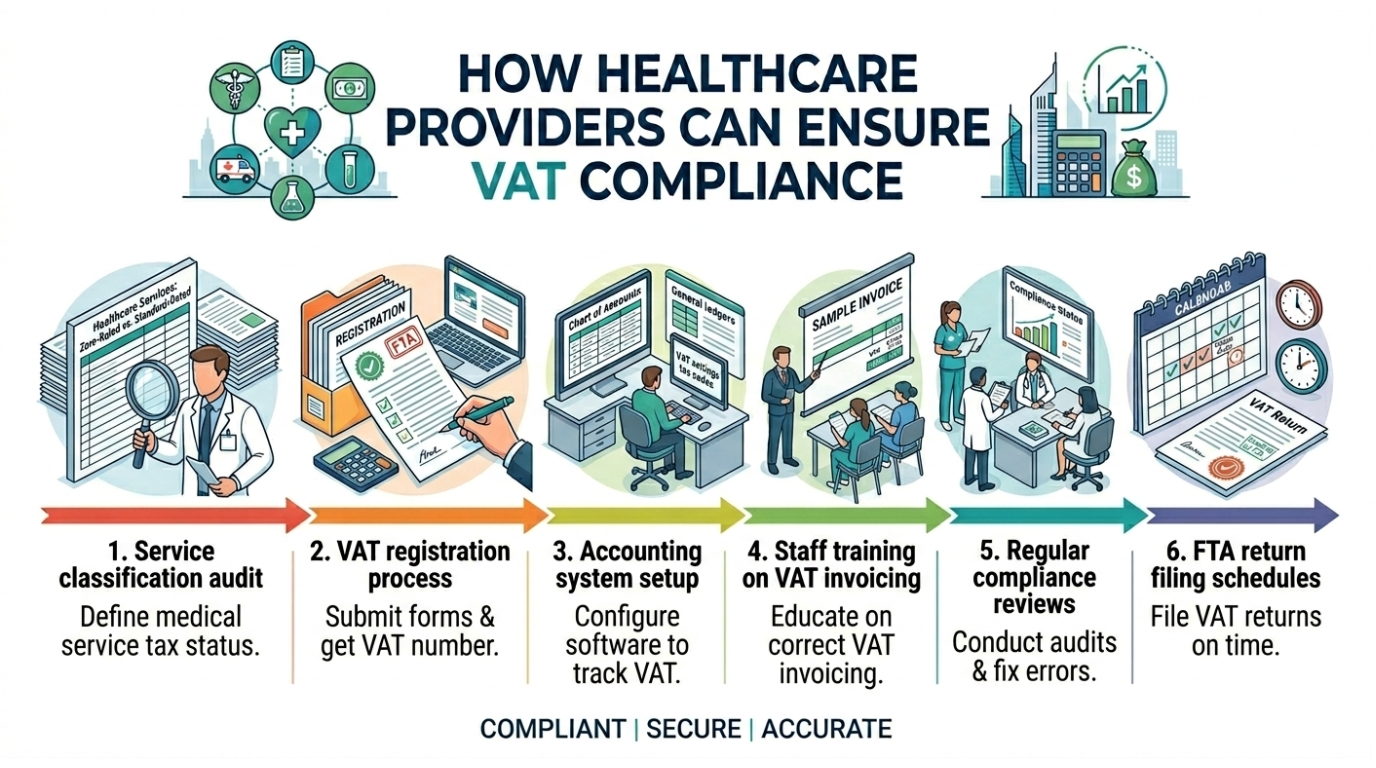
Ensuring VAT compliance in the healthcare sector requires a structured approach that covers classification, systems, and ongoing monitoring. A clear process helps reduce errors, improve reporting accuracy, and protect businesses from penalties.

Step 1: Service Classification Audit

The first step is to review all medical and non-medical services offered by the facility. Each service must be correctly classified as zero-rated, exempt, or standard-rated based on medical necessity and licensing. This audit forms the foundation for accurate VAT treatment.

Step 2: VAT Registration Process

Healthcare providers must assess whether they meet the mandatory registration threshold and complete the registration process with the Federal Tax Authority. Even providers offering mainly zero-rated services may benefit from registration to recover input VAT.

Step 3: Accounting System Setup

A proper accounting system should be configured to handle different VAT categories. This includes separating zero-rated, exempt, and standard-rated transactions, ensuring accurate tracking and reporting across all services.

At this stage, many healthcare providers choose to work with a tax consultant in Dubai to ensure their VAT setup, classification, and reporting systems are aligned with Federal Tax Authority requirements from the start.

Step 4: Staff Training on VAT Invoicing

Front desk teams, billing staff, and finance departments must understand how VAT applies to different services. Proper training ensures that invoices are issued correctly, with the right VAT treatment applied at the point of billing.

Step 5: Regular Compliance Reviews

Ongoing reviews are necessary to identify errors, update classifications, and stay aligned with regulatory changes. Regular internal checks help detect issues early and maintain consistent compliance.

To strengthen compliance and prepare for regulatory inspections, healthcare providers often engage VAT audit services in Dubai to review records, validate VAT treatment, and ensure audit readiness.

Step 6: FTA Return Filing Schedules

Healthcare providers must follow the required VAT return filing schedule and ensure timely submission through the FTA portal. Accurate reporting of output VAT and input VAT is essential to avoid penalties and maintain compliance.

It is important to prepare all documents required for VAT registration in UAE, including trade license, financial records, and identification details, to avoid delays in approval.

Impact of VAT on Healthcare Costs in the UAE

VAT in the UAE healthcare sector is designed to balance compliance with affordability. While certain services are taxed, the structure ensures that essential medical care remains accessible while maintaining transparency and regulatory control.

How Zero Rating Keeps Care Affordable

Zero rating plays a critical role in keeping healthcare costs manageable for patients. Essential medical services are not subject to VAT, which means patients are not burdened with additional tax on necessary treatments.

At the same time, healthcare providers can recover input VAT on their expenses. This reduces operational costs and prevents price inflation, ensuring that quality care remains financially accessible.

Price Transparency for Patients

VAT regulations have improved billing transparency across the healthcare sector. Patients can clearly see how services are priced and whether VAT is applied, which builds trust and reduces confusion around medical bills.

Accurate classification also ensures that patients are not overcharged due to incorrect VAT application, making compliance directly linked to patient experience.

Comparison with Other GCC Countries

Compared to other GCC countries, the UAE maintains a balanced approach by applying zero rating to essential healthcare services while taxing non-essential treatments. This model supports both affordability and regulatory consistency.

Some GCC countries follow similar VAT structures, but differences in implementation and classification can affect pricing and compliance requirements across the region.

Future Regulatory Considerations

The healthcare sector continues to evolve, and VAT regulations may be updated to address new treatments, technologies, and service models. Providers must stay informed about regulatory changes to ensure ongoing compliance.

Future updates may impact service classification, documentation requirements, and reporting standards, making proactive compliance strategies essential for long term stability.

What our clients say about us

Working with HFA Consulting over the past years I can only say they are the best at every level. All projects we collaborated on were excellent. Not only their strategy, but overall professionalism.

Working with HFA Consulting over the past years I can only say they are the best at every level. All projects we collaborated on were excellent. Not only their strategy, but overall professionalism.

Working with HFA Consulting over the past years I can only say they are the best at every level. All projects we collaborated on were excellent. Not only their strategy, but overall professionalism.

Working with HFA Consulting over the past years I can only say they are the best at every level. All projects we collaborated on were excellent. Not only their strategy, but overall professionalism.

HFA one of the best consultation companies ever worked with them for one year and so happy with them


Frequently Asked Questions (FAQs)

Clear answers to your most pressing questions about VAT on medical services, healthcare compliance, and FTA regulations in the UAE.

Image

Are all medical services in the UAE exempt from VAT?

No, not all medical services are exempt. Most essential healthcare services in the UAE are zero-rated, which means no VAT is charged to patients, but providers can still recover input VAT. Some services may be exempt, where VAT is not charged, but input VAT cannot be recovered, while others, such as cosmetic treatments, may be subject to 5 percent VAT.

What is the VAT rate on healthcare services in the UAE?

There is no single VAT rate for all healthcare services. Depending on the nature of the service, it may fall under zero-rated, exempt, or standard-rated at 5 percent. The classification is based on medical necessity, licensing, and Federal Tax Authority guidelines.

Do patients pay VAT when visiting hospitals in Dubai?

In most cases, patients do not pay VAT on essential medical treatments because they are zero-rated. However, VAT may apply if the service is cosmetic, elective, or not considered medically necessary under UAE regulations.

Can private clinics reclaim VAT on medical equipment?

Yes, private clinics can recover input VAT on medical equipment if it is used for providing taxable or zero-rated services. If the clinic also provides exempt services, then only a portion of the VAT may be recoverable based on apportionment rules.

What is the VAT on prescription medicines in the UAE?

Prescription medicines are generally zero-rated because they are considered essential for treating medical conditions and are regulated by health authorities. This means patients are not charged VAT, while providers can still recover input VAT.

How does VAT apply to cosmetic surgery procedures?

Cosmetic procedures that are performed for aesthetic reasons are subject to 5 percent VAT. However, if the same procedure is carried out for medical reasons and supported by a proper diagnosis, it may qualify as zero-rated. The purpose of the treatment is the key factor in classification.

Do healthcare providers need to register for VAT if services are zero-rated?

Yes, healthcare providers must register for VAT if their taxable supplies exceed the mandatory threshold, even if those supplies are zero-rated. Registration allows them to remain compliant and also recover input VAT on expenses.

What documentation is required during an FTA healthcare audit?

Healthcare providers must maintain detailed records, including tax invoices, patient treatment records, prescriptions, and documentation supporting service classification. These records are essential to justify VAT treatment and ensure compliance during Federal Tax Authority audits.

Need Help with Healthcare VAT?

Our VAT experts specialize in the healthcare sector. We help hospitals, clinics, and pharmacies with accurate classification, compliance, and FTA reporting.

70+ Businesses served

Helped businesses gain compliance and smoother financial management.

20+ Active clients

Offering specialized financial consultancy services to businesses across UAE.

Book a Consultation

Let us know your challenge and business overview to get a proposal.

Select a service...