


 Zeeshan Khan
 Apr 22, 2026
Table of Contents
Filing a corporation tax return is now a critical legal requirement for businesses operating in the Emirates. As the regulatory prospect matures in 2026, the Federal Tax Authority (FTA) has shifted its focus toward strict enforcement and audit readiness.
Many companies still struggle with complex deadlines, specific form requirements, and the nuances of qualifying income, making the filing process feel overwhelming.
Missing a UAE corporate tax return deadline or submitting inaccurate information can trigger hefty administrative penalties and extra scrutiny from the authorities. This straightforward guide for 2026 walks you through everything you need to know: who has to file, the current tax rate, and the key steps to get your return submitted accurately and on time for full compliance.
What Is a Corporation Tax Return in the UAE?
A corporation tax return is a formal financial report that businesses must submit to the Federal Tax Authority (FTA) to declare their financial activities for a specific tax period.
Rather than just a summary of sales, this document provides a comprehensive look at a company’s profits, deductible expenses, and overall tax liability. It serves as the official record used by the government to verify that a business is contributing the correct amount based on the current corporation tax rate.
In the UAE, most registered businesses, including those in Free Zones, must file a corporate tax return every year. Even if you owe nothing due to exemptions or thresholds, submitting one keeps you compliant and in good standing.
This step promotes transparency, helps the Federal Tax Authority (FTA) track economic activity, and upholds the UAE’s tax standards.
In addition to your corporation tax return, businesses must also stay compliant with VAT regulations. If you’re unsure about the VAT registration process, keep in mind that there are VAT registration UAE fees if you need professional help to navigate the registration process.
Who Needs to File a UAE Corporation Tax Return?
The scope of the UAE corporate tax regime is broad, covering nearly all legal entities operating in the country. Under UAE corporate tax regulations, a corporation tax return must be filed by the following entities:
Corporations and Limited Liability Companies (LLCs)
All juridical persons incorporated in the UAE, including mainland companies such as LLCs and PJSCs, are required to file a corporation tax return. This also applies to entities registered in different jurisdictions within the UAE, regardless of their size or revenue.
Free Zone Businesses
Free Zone entities, including those qualifying for the 0% corporate tax rate, are still required to file a UAE corporation tax return. Filing ensures compliance and confirms their eligibility for tax benefits under UAE regulations.
Foreign Companies Operating Locally
Non-resident legal entities must file a corporation tax return if they have a Permanent Establishment (PE) in the UAE, such as a branch or office, or if they derive income from UAE-based sources like real estate or business activities.
Businesses with Taxable Profits
Any business exceeding the tax-free threshold must declare its earnings. However, even businesses with profits below AED 375,000 or those qualifying for Small Business Relief (for revenues up to AED 3 million) are still legally obligated to file a return to confirm their tax status.
Partnerships
Partnerships may not always be taxed as separate legal entities, but they are still required to file relevant tax information. This ensures that income is properly reported and allocated to individual partners in line with UAE tax regulations.
Non-Profit Organizations
Certain non-profit organizations may be required to file a corporation tax return or submit informational filings to maintain their tax-exempt status and demonstrate compliance with Federal Tax Authority (FTA) requirements.
Trusts and Estates
Trusts and estates that generate business income or hold income-producing assets in the UAE may also fall under corporate tax filing obligations, depending on their structure and activities.
Who Is Exempt from Filing a Corporation Tax Return in the UAE?
In the UAE, certain entities are classified as exempt from corporate tax under Federal Tax Authority (FTA) regulations. These exemptions apply only to specific categories of entities and activities.
Government Entities
Federal and local government bodies, including ministries and public institutions, are exempt from corporate tax provided they do not engage in commercial business activities.
Government-Controlled Entities
Entities that are wholly owned and controlled by the government and carry out mandated activities may also qualify for exemption.
Extractive and Natural Resource Businesses
Businesses involved in the extraction of natural resources, such as oil and gas, are exempt from corporate tax, as they are subject to separate Emirate-level taxation.
Qualifying Public Benefit Entities
Charities, non-profit organizations, and other approved public benefit entities listed by the UAE authorities are exempt, provided they meet regulatory conditions.
Qualifying Investment Funds
Certain regulated investment funds may qualify for exemption if they meet the criteria set by the FTA.
Pension and Social Security Funds
Public and private pension funds, along with social security funds, are generally exempt from corporate tax.
What Documents Are Required for a UAE Corporation Tax Return?
To file a UAE corporation tax return accurately, businesses must prepare and maintain supporting financial and legal documents. These documents are used to calculate taxable income, justify deductions, and ensure compliance with Federal Tax Authority (FTA) requirements.
Financial Statements
Businesses must maintain proper financial records, including the profit and loss statement and balance sheet. These form the basis for calculating accounting profit, which is later adjusted to determine taxable income.
General Ledger and Trial Balance
Detailed accounting records such as the general ledger and trial balance are required to support the figures reported in the tax return. These documents provide a breakdown of income, expenses, and closing balances.
Bank Statements
Bank statements help verify cash flow, income receipts, and expense payments. They are essential for reconciling financial records and ensuring consistency between reported and actual transactions.
Sales and Revenue Records
All income reported in the return must be supported by documents such as sales invoices, contracts, and payment records. These confirm the nature and value of business transactions.
Expense Invoices and Receipts
Businesses must retain invoices and receipts for all claimed expenses. Only expenses that are clearly business-related and properly documented are allowed for tax purposes.
Fixed Asset Register
A record of company assets, including purchase value and depreciation, is required to support capital expenditure and any related tax adjustments.
Payroll Records
For businesses with employees, payroll records such as salary summaries, contracts, and WPS data are necessary to support staff-related expenses.
Tax Adjustment Schedules
Since UAE corporate tax is calculated after adjustments to accounting profit, businesses should maintain working papers for items such as non-deductible expenses, exempt income, and tax relief claims.
Trade License and Legal Documents
Key legal documents, including the trade license, memorandum of association, and Tax Registration Number (TRN), are required to verify the entity’s identity and compliance status.
How to File a Corporation Tax Return in the UAE?
Filing a UAE corporation tax return is completed online through the Federal Tax Authority (FTA) portal, known as EmaraTax. The process requires accurate financial data, proper documentation, and timely submission to avoid penalties.
Step 1: Log in to the EmaraTax Portal
Access your account on the EmaraTax portal using your registered credentials or UAE PASS. Ensure your business is already registered and has a valid Tax Registration Number (TRN).
Step 2: Select the Relevant Tax Period
Choose the correct financial year for which the corporation tax return is being filed. The selected period must match your company’s accounting records.
Step 3: Enter Financial Information
Input your financial data based on prepared statements, including:
- Total revenue
- Cost of goods sold
- Operating expenses
- Net accounting profit
This forms the base for calculating taxable income.
Step 4: Apply Tax Adjustments
Adjust accounting profit to arrive at taxable income. This includes:
- Removing non-deductible expenses
- Accounting for exempt income
- Applying reliefs such as Small Business Relief
- Adjusting related-party transactions, where applicable
Step 5: Review and Validate the Return
Carefully review all entered data before submission. Ensure consistency between financial records, supporting documents, and reported figures to avoid errors or future audits.
Step 6: Submit the Corporation Tax Return
Once verified, submit the return through the EmaraTax portal. After submission, changes may require a formal correction process, so accuracy is essential.
Step 7: Pay Any Tax Due
If your taxable income exceeds the threshold, complete the tax payment through the portal’s available payment methods before the deadline to avoid penalties and interest.
What Are the Penalties for Late Filing of Corporation Tax Return?
Staying updated on the UAE corporate tax calendar is essential to avoid unnecessary financial strain. Businesses are required to file their corporate tax return within a specified period after the end of their financial year, making timely preparation critical for compliance.
For companies operating on a standard financial year, this means planning ahead for key filing deadlines and ensuring all records are accurate and complete well in advance.
It is also important to note that the deadline for filing the corporate tax return and the payment of tax typically fall on the same date. Delaying payment after submission can lead to penalties and additional charges.
Below is a breakdown of typical filing timelines based on different financial year-ends:
Risks of Late Filing
The FTA has implemented a tiered penalty system to encourage timely submissions. These fines apply even if your business has zero taxable income or qualifies for a 0% corporation tax rate.
Late Filing Penalties
If you miss the deadline, a monthly fine of AED 500 is applied for the first 12 months. From the 13th month onwards, this increases to AED 1,000 per month. These charges accumulate automatically on the EmaraTax portal the day after the deadline passes.
Late Payment Interest
In addition to filing fines, any unpaid tax attracts a 14% per annum interest charge. This is calculated monthly on the outstanding balance, making a late filing of corporation tax return an expensive oversight for profitable firms.
Failure to Register
Before you can file, you must be registered. Missing the specific registration deadline assigned to your license issuance month carries a one-time penalty of AED 10,000.
Record-Keeping Violations
Businesses must keep all financial records for at least seven years. If an audit reveals that you have failed to maintain proper books, invoices, or balance sheets, the FTA can impose a fine of AED 10,000 per violation, which doubles for repeat offenses.
Can You File a UAE Corporation Tax Return Online?
In the UAE, the Federal Tax Authority (FTA) has moved away from traditional paper-based filings to a fully digital system. All registered businesses must submit their UAE corporate tax returns electronically via the EmaraTax portal. This all-in-one platform covers everything from registration to payments, keeping things centralized and available around the clock.
The portal integrates with national digital identity systems like UAE PASS, allowing business owners to log in securely and manage their tax obligations without needing separate physical appointments.
This digital-first approach aligns with the nation’s goal of streamlining business operations and maintaining high standards of tax transparency.
Benefits of Online Filing
Switching to a digital filing system offers several practical advantages for businesses in 2026:
Faster Processing
Unlike manual submissions that require physical review, online returns are processed through automated workflows. This means your submission status is updated in real-time, and any potential issues are flagged early in the process.
Reduced Errors
The EmaraTax portal features built-in validation checks and auto-calculated fields. By fetching data directly from your profile, the system reduces the risk of manual entry errors, ensuring that the applied corporation tax rate and profit thresholds are calculated accurately based on the data provided.
Easier Tracking
One of the biggest advantages of the online system is the comprehensive digital history it maintains. You can access previous filings, view payment receipts, and track pending deadlines from a single dashboard.
This makes it much simpler to retrieve records during an audit and ensures you never lose track of your corporate tax return due date.
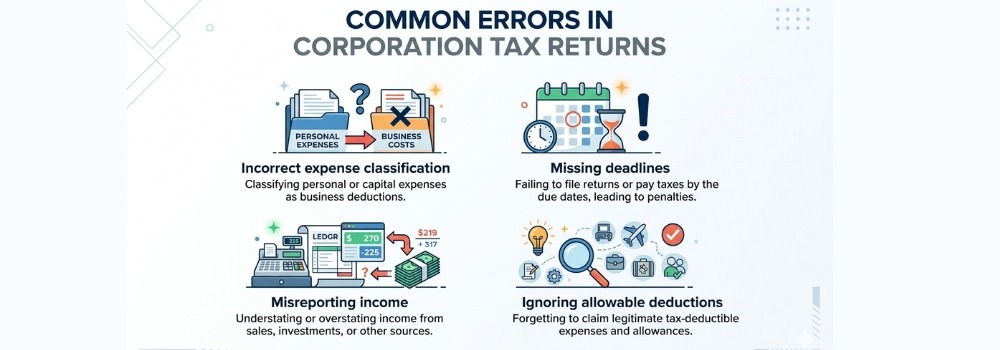
What Are Common Errors in Corporation Tax Returns?
As businesses in the UAE move through the 2026 tax cycle, the Federal Tax Authority (FTA) has increased its focus on accuracy. Filing a return that contains inaccuracies can be just as problematic as missing a deadline. Many businesses unintentionally trigger audits or penalties by failing to align their internal accounting with specific tax regulations.
Identifying these common pitfalls early is the best way to maintain a clean compliance record:
Incorrect Expense Classification
A frequent mistake is the misclassification of business expenses. For example, while standard accounting might record all meals as business costs, the UAE tax law only allows a 50% deduction for entertainment expenses.
Additionally, personal expenses of owners or shareholders are strictly non-deductible. Mixing these up leads to an understated tax liability, which can result in a 1% monthly fine on the tax difference.
Missing Deadlines
The “nine-month rule” is non-negotiable. Whether it is a registration deadline based on your license issuance month or the final corporate tax return due date, timing is everything.
Many SMEs mistakenly wait until they have a taxable profit to register, but the law requires registration regardless of their earnings. Failing to register on time carries a heavy one-time penalty of AED 10,000.
Misreporting Income
Errors in revenue recognition can raise concerns with the FTA, especially when VAT filings don’t match the figures reported in your corporation tax return in the UAE.
In 2026, the FTA uses automated systems to cross-check these figures. If your reported sales on VAT returns do not match the revenue on your tax return without a valid reconciliation, it significantly increases your risk of a tax audit.
Ignoring Allowable Deductions
On the flip side, some businesses overpay because they fail to claim legitimate reliefs. For instance, many are unaware they can carry forward tax losses from previous periods to offset up to 75% of current taxable income.
Others miss the “Small Business Relief,” which allows companies with revenue under AED 3 million to be treated as having no taxable income, provided they make the correct election in their return.
What Happens If You File a Corporation Tax Return Late or Incorrectly?
Compliance is a continuous obligation in the UAE, and the Federal Tax Authority (FTA) has established a clear framework to enforce it. In 2026, the updated penalty regime emphasizes self-correction and timely reporting.
Whether your business owes tax or qualifies for a 0% rate, the failure to submit a UAE corporation tax return accurately and on time results in immediate consequences.
Financial Penalties
The FTA applies administrative fines for a variety of violations, regardless of your company’s profitability:
Late Filing:
If you miss the corporate tax return due date, you face a fine of AED 500 per month (or part thereof) for the first 12 months. This increases to AED 1,000 per month starting from the 13th month.
Incorrect Tax Returns:
Submitting a return with errors triggers a fixed penalty of AED 500 for the first violation. If you do not correct the error via a Voluntary Disclosure before an audit, you may also face a percentage-based penalty on the tax difference.
Late Registration:
If your business failed to register by its assigned deadline, a one-time penalty of AED 10,000 applies. While some first-time waivers exist for those who file their first return promptly, these are exceptions rather than the rule.
Interest on Unpaid Tax
Missing the payment deadline is particularly costly. In 2026, any unsettled tax amount attracts a flat 14% per annum interest rate, which is accrued monthly.
This interest starts the day after the payment is due and continues until the balance is fully settled. Unlike fixed fines, this cost grows the longer the debt remains unpaid, making it vital to settle your tax liability alongside your filing.
Increased Audit Risk
A history of late filing of corporation tax returns or frequent self-corrections serves as a major red flag for the FTA.
In the current tax environment, the authority uses automated data-matching to flag inconsistencies between VAT returns, customs records, and corporate tax filings.
Automated Flags:
Mismatches in reported revenue or unusually high deductions can trigger a formal tax audit.
Audit Scrutiny:
Once an audit begins, the FTA may request records for the last seven years. If your documentation is found to be incomplete or missing, additional fines of AED 10,000 per violation (rising to AED 20,000 for repeats) can be imposed.
Loss of Relief:
For Free Zone entities, failing to file accurately can lead to the retroactive loss of the 0% tax rate for five years, forcing all income to be taxed at the standard 9% rate plus interest.
What Expenses Can Be Claimed in a Corporation Tax Return?
One of the most effective ways to manage your tax liability is by identifying all “allowable” expenses. According to Article 28 of the UAE Corporate Tax Law, an expense is generally deductible if it is incurred wholly and exclusively for business purposes and is not capital in nature.
Here are the primary categories of deductible expenses for 2026:
Business Operating Costs
Day-to-day operational expenses are fully deductible. This includes rent for office or warehouse space, utility bills (electricity, water, and internet), insurance premiums, and marketing or advertising costs aimed at generating business revenue.
Salaries and Wages
Payments made to employees, including basic salaries, allowances, bonuses, and other incentives, are deductible. However, if you are a business owner or a “Connected Person,” your salary must reflect the fair market value.
Paying yourself an excessively high salary to reduce company profit can lead to the FTA disallowing the excess portion.
Office Expenses
General administrative costs such as office supplies, software subscriptions, and maintenance fees can be claimed. Additionally, professional fees paid for legal, accounting, and tax consultancy services are allowable, provided they relate directly to your business operations.
Depreciation (Where Applicable)
You cannot deduct the full cost of a major asset (like a vehicle or machinery) in the year you buy it. Instead, you claim “depreciation” or capital allowances over the asset’s useful life. This allows you to gradually recover the investment cost while reflecting the asset’s wear and tear in your tax return.
What Cannot Be Claimed?
The FTA maintains a strict list of “disallowed” or “non-deductible” expenses. Including these in your return can result in adjustments and penalties during an audit.
Personal Expenses
Any expenditure that is personal in nature, such as family holidays, private school fees, or household groceries, cannot be claimed, even if paid from a business bank account.
If an expense has both personal and business elements (like a mobile phone plan or a personal vehicle used for deliveries), you must clearly allocate and only claim the business portion.
Non-Business Costs
Expenses that do not contribute to the generation of taxable income are disallowed. This includes:
- Fines and Penalties: Government fines, traffic violations, and late-filing penalties are not deductible as they result from legal non-compliance.
- Entertainment Restrictions: While staff-only events are generally 100% deductible, expenses for entertaining clients, suppliers, or shareholders are only 50% deductible.
- Bribes and Illegal Payments: Any payment that violates UAE law is strictly non-deductible.
- Corporate Tax Payments: The actual amount of UAE Corporate Tax paid to the FTA is not a deductible expense.
What Are the Best Practices for Corporation Tax Compliance in the UAE?
Maintaining compliance in 2026 requires a shift from simple registration to active, data-driven management.
As the Federal Tax Authority (FTA) implements more advanced monitoring tools, following a set of established best practices is the most effective way to protect your business from penalties and audits.
Maintain Accurate Records
The cornerstone of a successful tax strategy is rigorous documentation. Under the current law, all businesses must retain their financial records, including invoices, bank statements, and contracts, for at least seven years.
In 2026, the FTA emphasized that these records must be capable of proving the figures reported in your tax return even years after the fact. If you carry forward a tax loss, for example, you must keep the original evidence from the year that the loss occurred until it is fully utilized.
Use Accounting Software
Moving away from manual spreadsheets is no longer just a recommendation; it is a necessity for modern compliance. Using FTA-accredited accounting software ensures that your financial data is structured correctly for tax reporting.
These systems can automate the calculation of taxable income, track the AED 3 million revenue threshold for Small Business Relief, and generate the required audit files (FAF) instantly.
Starting in mid-2026, the rollout of electronic invoicing (e-invoicing) will further integrate your accounting software directly with the FTA’s systems for real-time reporting.
Work with Tax Professionals
Tax laws in the UAE are maturing, and the introduction of complex rules like Transfer Pricing and the 15% Domestic Minimum Top-up Tax for large multinationals has made expert advice invaluable.
A registered tax agent or consultant can help you identify legitimate deductions, ensure your related-party transactions are at “arm’s length,” and assist with Voluntary Disclosures if you discover an error.
Their goal is to ensure your “self-assessment” is accurate, reducing the likelihood of a formal audit.
Monitor Deadlines
The “9-month rule” is the most critical timeline to track. You must both file your return and settle any tax payable within nine months of your financial year-end. For example, if your financial year ends on December 31, 2025, your final deadline is September 30, 2026.
Should You Hire a Professional for UAE Corporation Tax Return Filing?
Expert Tax Advisors HFA Consulting provides reliable corporate tax support for businesses operating in the UAE. As trusted corporate tax consultants in Dubai, we help you manage registration, filings, and ongoing compliance with complete confidence.
Our team ensures your business is structured correctly, your tax obligations are clearly defined, and all documentation is prepared in line with Federal Tax Authority requirements. From handling Free Zone eligibility to managing transfer pricing, we take care of every detail with precision.
Helps Reduce Errors
Professional consultants act as a final gatekeeper, reviewing your financial records to catch common mistakes such as misclassified personal expenses or missed tax-exempt income.
By ensuring your accounting profit is correctly adjusted into taxable income, they help you avoid the fines associated with incorrect filings.
Ensures Compliance
Tax laws are not static; they change with new cabinet decisions and administrative guides. A dedicated firm keeps your business ahead of these changes by implementing future-proof compliance roadmaps.
This proactive strategy ensures you are not just filing a return, but maintaining a clean financial record that signals reliability to both the authorities and potential investors.
Saves Time
Business owners shouldn’t waste time decoding complex tax guides when they could be driving growth. By outsourcing the entire tax process from initial registration and grouping to hitting submit, you free up your schedule for core operations.
Pros take care of gathering data and dealing with the FTA, so your UAE corporation tax return is accurate, timely, and stress-free.
Conclusion
Adhering to the 2026 regulations for your corporation tax return is no longer just a matter of annual paperwork; it is a fundamental part of maintaining a sustainable business in the UAE. By understanding the core requirements, from calculating taxable profit to meeting the strict nine-month filing window, you protect your company from unnecessary financial strain.
While the 9% corporation tax rate is competitive, the penalties for non-compliance are significant, making it vital to stay proactive with your documentation and digital filings.
As the Federal Tax Authority continues to enhance its oversight through the EmaraTax portal, the most successful businesses will be those that prioritize transparency and accurate record-keeping.
Whether you are a startup navigating your first tax cycle or a large enterprise managing complex cross-border transactions, staying informed of your corporate tax return due date and seeking professional guidance when necessary are the best ways to ensure long-term stability. Strategic tax planning today will safeguard your business reputation and financial health for years to come.
FAQS
What is a corporation tax return?
A corporation tax return is an annual filing submitted to the Federal Tax Authority (FTA) through the EmaraTax portal. It reports a business’s revenue, expenses, and tax adjustments to calculate the final corporate tax liability.
Who needs to file a corporation tax return in the UAE?
Most legal entities in the UAE must file a corporation tax return, including mainland companies, Free Zone businesses, and foreign entities with UAE operations. Even businesses with 0% tax liability are generally required to file to confirm their status.
When is corporation tax due in the UAE?
A UAE corporation tax return must be filed within 9 months after the end of the financial year. For example, if your financial year ends on December 31, 2025, the filing and payment deadline is September 30, 2026.
How is corporation tax calculated in the UAE?
Corporation tax is calculated by adjusting accounting profit for non-deductible expenses and exempt income. A 9% tax rate applies only to taxable profit exceeding AED 375,000.
Can I file a UAE corporation tax return myself?
Yes, businesses can file their corporation tax return through the EmaraTax portal using UAE PASS. However, due to complex tax adjustments and compliance risks, many businesses choose professional support to avoid errors.
What happens if I miss the corporation tax deadline?
Late filing results in penalties starting at AED 500 per month, increasing to AED 1,000 after 12 months. In addition, unpaid tax is subject to 14% annual interest, and the risk of an FTA audit increases significantly.



Zeeshan Khan
My name is Zeeshan Khan, and I’m a UAE-based business and tax consulting professional with hands-on experience in VAT compliance, corporate tax advisory, business setup, and regulatory services. I work closely with startups, SMEs, and established companies to help them navigate UAE tax laws, improve compliance, and make informed financial decisions. With a strong understanding of FTA regulations, corporate structuring, and commercial taxation in the UAE, my focus is on translating complex laws into clear, practical guidance for business owners. Through my writing, I aim to provide accurate, up-to-date insights that help businesses stay compliant, reduce risk, and operate confidently in the UAE market.