

 Zeeshan Khan
 Mar 19, 2026
Table of Contents
Ever looked at a new invoice and felt a slight nudge of doubt? In the UAE’s fast-paced market, a VAT number isn’t just a random string of digits on a page; it’s your shield. But here’s the problem: what happens if you pay a “tax” amount to a supplier who isn’t actually registered?
You can’t claim that money back, and the FTA won’t be happy about it. That’s why you need to verify VAT number details before you hit “send” on that bank transfer. It’s not just about paperwork; it’s about protecting your cash flow from avoidable mistakes.
Why You Can’t Skip the Check
Think of VAT verification UAE as a quick background check for your business partners. If you aren’t 100% sure about a vendor, how do you know your tax invoice is even legal?
Taking a moment for VAT number verification ensures you are only dealing with legitimate, tax-registered businesses. Luckily, the process is straightforward. By using the official FTA VAT number verify portal, you get instant peace of mind. Whether you are a small startup or a growing agency, knowing how to verify VAT number entries is the simplest way to keep your compliance 100% human-error-free.
What Is a VAT Number?
At its heart, Value Added Tax (VAT) is a consumption tax that is added to the cost of goods and services at every step of the supply chain. Instead of being a one-time charge at the final sale, it is collected incrementally.
Businesses act as “tax collectors” for the government, picking up the 5% tax from their customers and passing it on to the Federal Tax Authority (FTA).
A VAT number, or Tax Registration Number (TRN), is the unique 15-digit code that proves a business is part of this official system. It’s more than just a tracking ID; it is a legal requirement for any business that wants to issue tax invoices or claim back the VAT they’ve paid on their own expenses.
Without this number, a company cannot legally charge you tax, and you cannot claim any tax credits from transactions with them.
How VAT numbers are assigned
The process of getting a VAT number is handled entirely through the FTA’s digital portal, EmaraTax. When a business applies, it must provide proof of its activities, such as a trade license, bank details, and financial records showing its turnover.
The FTA then reviews these documents to ensure the business is legitimate. Once approved, the system generates a TRN that follows a specific structure:
It always starts with “9” (the UAE’s country code) and includes digits that identify the type of entity and its registration date. This structured format is what makes it possible for you to verify VAT number details every digit has a meaning that the FTA system can cross-check in seconds. This accuracy also plays an important role in processes like VAT reconciliation, where businesses match their records with official filings to ensure compliance.
Who is required to hold a VAT number?
In the UAE, the law doesn’t care if you are a massive corporation or a solo freelancer; what matters is your revenue. If your taxable supplies and imports have crossed AED 375,000 over the last 12 months, registration is mandatory. You have 30 days to apply once you hit this limit, or you risk facing heavy administrative penalties.
However, the system also allows for voluntary registration. If your turnover is above AED 187,500, you can choose to register even if you aren’t legally forced to yet.
Many startups and small companies do this because it makes them look more professional to big corporate clients. It also allows them to recover the “Input VAT” they pay on things like office rent, laptops, and software, which can save a lot of money in the long run.
Why You Should Never Skip a VAT Number Check
Imagine paying a large invoice, including the 5% tax, only to find out later that the supplier’s tax ID was fake. In the UAE, this isn’t just a minor mistake; it’s a financial trap. When you pay VAT on a deregistered UAE entity, that money is effectively gone. You cannot reclaim it from the government, and your business takes a direct hit to its profit margins.
Verifying a VAT number is the simplest way to protect your business from fraud. Some dishonest operators use “ghost” numbers or expired IDs to collect extra cash from unsuspecting partners.
By taking a few seconds to run a check, you confirm that you are dealing with a legitimate, law-abiding company. It’s the ultimate due diligence step that keeps your professional reputation and your bank account secure.
Staying on the right side of the law
Tax compliance isn’t just about your own filings; it’s about the integrity of your entire supply chain. The Federal Tax Authority (FTA) expects you to ensure that every tax invoice you process is 100% valid. If you consistently submit returns linked to invalid numbers, it could trigger a formal audit or lead to heavy administrative penalties.
Properly verifying these details ensures your records are audit-ready at all times. It proves to the authorities that you take your fiscal responsibilities seriously and aren’t inadvertently supporting tax evasion.
In the long run, this level of care prevents costly legal disputes and keeps your business operations running smoothly without unexpected government intervention.
Confirming legitimacy in global trade
If your business handles international transactions, especially involving regions like the EU, verification becomes even more critical. Many cross-border tax treaties and “reverse charge” mechanisms rely on both parties having valid, active tax identities. Without a verified number, your shipments could be delayed at customs, or you might be hit with double taxation.
Beyond the legalities, a verified VAT status acts as a badge of trust. It tells international partners that your business is a stable, registered entity capable of handling high-value contracts.
Whether you are importing goods or exporting services, a quick verification check confirms that you are a legitimate player in the global market, opening doors to more secure and professional partnerships.
How to Verify a VAT Number
Checking a tax ID shouldn’t feel like a chore. Most governments have simplified the process by offering free, public search tools that give you an answer in seconds. Whether you are dealing with a local supplier or a partner halfway across the world, using an official government website is the only way to get data you can actually trust.
In the UAE, the Federal Tax Authority (FTA) makes this very simple. You don’t even need to log in to an account to run a quick check. By visiting the official FTA portal, you can access the public VAT number verification tool directly.
You just enter the 15-digit Tax Registration Number (TRN) found on your invoice, and the system will cross-reference it with the national database. If the number is valid, the business’s legal name will appear, confirming that they are authorized to collect tax.
Using national tax authority portals
Every country has its own way of managing these records, but the logic remains the same. For instance, if you are working with a business in the UK, you would use the GOV.UK “Check a VAT number” service.
These national portals are designed to be user-friendly, allowing you to search by the specific tax ID to see the registered name and address of the business.
The biggest advantage of using these official sites is the “consultation number” or proof of search they often provide. This is vital for your own tax compliance records.
If the FTA or your local tax office ever asks why you didn’t pay tax on a specific transaction, having a screenshot or a record from the official portal proves you did your due diligence. It shows that, at the time of the transaction, the VAT verification check came back green.
Using the EU VIES System
For businesses operating within the European Union, there is a specialized tool called VIES (VAT Information Exchange System). Since the EU moves goods across borders constantly, it has created this centralized search engine to check IDs across all member states. It is an essential tool for VAT verification that UAE businesses might use when importing or exporting to Europe.
The process is straightforward: you go to the official VIES website, select the specific member state from a dropdown menu, and enter the VAT ID. The system then talks to that country’s national database in real-time.
If it’s valid, you’ll see a “Yes, valid VAT number” message. This is the “gold standard” for intra-EU trade because it ensures both the buyer and seller are following the rules for tax-free cross-border sales.
Using online VAT verification tools
If you find yourself needing to check dozens or even hundreds of numbers at once, clicking through government portals one by one becomes impossible. This is where third-party online tools come in. Many of these services offer “bulk verification,” allowing you to upload a list of numbers and get a report back in minutes.
While these tools are huge time-savers, they do have a catch. Because they are not official government portals, there can sometimes be a slight delay in their data updates.
They are great for a quick internal audit, but for high-stakes transactions, nothing beats the official source. Many professional firms use these third-party tools for daily checks and then manually verify VAT number details on government sites for their most expensive invoices to be 100% safe.
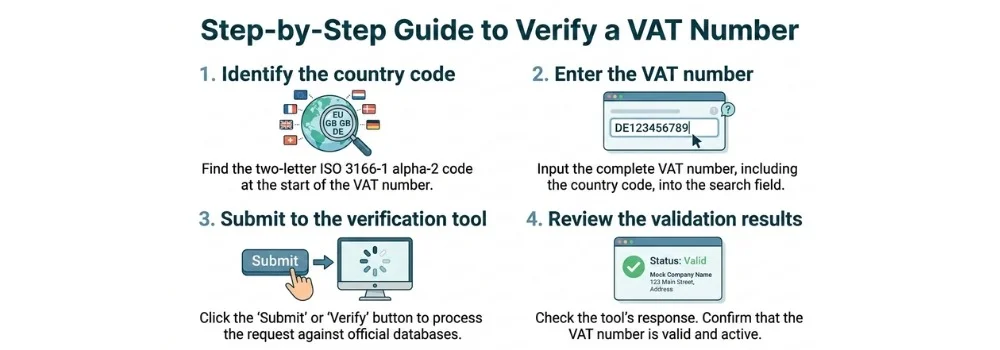
Step-by-Step Guide to Verify a VAT Number
Checking the validity of a tax ID doesn’t have to be a technical struggle. Most official portals follow a very similar flow. If you have an invoice in front of you, you can usually complete a VAT verification in under a minute by following these simple steps.
Identify the country code
Before you even open a search tool, look at the first two letters of the number provided. These letters represent the country where the business is registered. For example, a number starting with “GB” belongs to the United Kingdom, while “DE” is for Germany.
In the UAE, the 15-digit Tax Registration Number usually starts with “100” or similar, but the portal will specifically ask you for the “TRN.” Knowing the correct country is vital because you must use the specific portal for that region to verify VAT number UAE or international records correctly.
Enter the VAT number
Once you are on the correct government website, find the input field for the tax ID. Be very careful with the formatting. Some systems want you to include the country code, while others only want the digits. Also, watch out for common “typos” like mistaking the letter “O” for the number “0.”
Accuracy is everything here; a single wrong digit will cause the system to say the number is invalid, which might lead to unnecessary tension with your supplier.
Submit to the verification tool
After entering the digits, most portals will ask you to complete a quick security check, like a “captcha,” to prove you aren’t a bot. Hit the submit or “verify” button to start the search.
The system will then ping the national database to find a match. This is the moment of truth for your VAT number verification. The system is looking for an active registration. If the business has recently closed or forgotten to renew its status, the system will flag it immediately.
Review the validation results
When the results pop up, don’t just look for a “Valid” green light. You need to cross-check the details. Does the company name shown on the screen match the name on your invoice? Does the address look correct? If the system says the number is valid, but the names don’t match, you might be looking at a case of “identity theft” where a fake business is using a real company’s ID.
If everything aligns, you can proceed with your payment confidently, knowing your VAT verification UAE check is complete, and your tax records are secure.
VAT Number Formats by Country
Ever noticed how a tax ID from the UAE looks completely different from one in Germany or the UK? If you’re dealing with international suppliers, you’ve probably seen a wide variety of lengths, letters, and symbols. These aren’t just random choices; every country has its own logic for how they track and verifies a business’s tax status.
Knowing these formats helps you spot a fake or a typo before it turns into a compliance headache. In the UAE, for example, your Tax Registration Number (TRN) is a 15-digit code. But if you’re importing a specialized tool from Germany, you’ll be looking for their “Ust-IdNr,” which follows a much shorter 9-digit pattern.
Examples of VAT formats in different countries
While almost every country starts its VAT number with a two-letter country code (like AE for the UAE or GB for the UK), the string of characters that follows varies wildly. Here is a quick look at how some common formats appear:
- United Arab Emirates (UAE): 15 digits (e.g., 123456789012345).
- United Kingdom (UK): 9 digits, usually prefixed with “GB” (e.g., GB 123 4567 89).
- Germany: 9 digits following the “DE” prefix (e.g., DE 123456789).
- France: 11 characters after “FR,” which can include both numbers and letters (e.g., FR XX 123456789).
- Saudi Arabia (KSA): 15 digits, similar to the UAE format (e.g., 300012345600003).
Why formats differ across borders
You might wonder why there isn’t just one global standard for these numbers. The main reason is that tax systems are deeply tied to a country’s local history and existing business registries. In many places, the VAT number is actually derived from a company’s primary registration or commercial license number.
For instance, in Sweden, the VAT number is basically the company’s 10-digit organization number with “SE” at the start and “01” at the end. In France, the 11-digit format includes a two-digit “validation key” that helps their internal systems catch errors immediately.
Because each nation has its own unique way of organizing its business data, its tax identities follow suit. This is why a VAT verification check is so important; you can’t just guess the format. You have to use the specific rules for the country you’re dealing with.
Why a VAT Number Might Not Verify
Sometimes, you follow all the steps, and the system still gives you an “Invalid” result. Before you panic or accuse a supplier of being a fraud, it’s worth checking for a few common hiccups. Even the best vat verification tools can fail if the data going in isn’t perfect.
Using the wrong country code
The most frequent mistake is simply starting with the wrong prefix. If you are trying to verify VAT number UAE records but accidentally use a code from a different region, the system will hit a dead end.
Remember, the country code tells the database which national registry to search. If you’re dealing with a business in Dubai but your search tool is set to the UK or the EU, you won’t find a match. Always double-check those first two letters on the invoice to ensure you are looking in the right place.
Missing or extra digits
VAT numbers are long, and it is incredibly easy to miss a single digit or add an extra one by mistake. A standard VAT number verification check requires exactly 15 digits. If you enter 14 or 16, the system won’t even try to search; it will just tell you the format is wrong.
Many people also struggle with spaces or dashes. While some invoices print the number as “123-456-789,” most official portals want you to enter the string as one continuous line of numbers. If your check fails, try re-entering the digits slowly without any special characters.
Recently registered businesses
What happens if the company is brand new? If a business just received its registration from the Federal Tax Authority (FTA) yesterday, it might not show up in the public database immediately.
There is often a “sync” period where it takes a few days for the internal government records to reflect on the public-facing VAT verification UAE tools. This is also common during the early stages after submitting the documents required for VAT registration in UAE, as processing and system updates take time.
If a supplier insists they are registered but the system isn’t showing it, ask them for their official “VAT Registration Certificate.” This document is issued directly by the FTA and serves as legal proof of their status while the digital databases catch up. If the number still doesn’t appear after a week or two, that’s when you should start asking more serious questions about their tax status.
What to Do If a VAT Number Is Invalid
It can be a bit of a shock when you run a check, and the system returns a “not found” or “invalid” message. Before you take any further steps, stop all VAT-related payments to that entity.
If the number isn’t active, you cannot legally reclaim the tax you pay them, and doing so could land you in hot water with the authorities.
Contact the business immediately
The first step is a simple conversation. Reach out to the supplier and let them know their TRN didn’t show up on the official portal. In many cases, it’s a simple clerical error, perhaps they sent an old invoice template with an expired number, or there was a typo in the digits.
Ask them to provide their official VAT Registration Certificate. This is a government-issued document that proves their status. If they are hesitant to show it or give you excuses, treat it as a major red flag.
Legitimate businesses are always happy to prove their compliance to keep a partnership moving.
Recheck the number manually
Before assuming the worst, do a quick manual audit of the number they gave you. Does it have exactly 15 digits? Does it start with the correct digits for the region (like “100” in the UAE)? Sometimes, people accidentally include spaces, dashes, or the country code in the search box, which can cause the portal to fail.
Try entering the digits again, one by one, into the FTA VAT number verify tool. If the supplier recently changed their legal name or restructured their company, the old number might have been canceled and replaced with a new one. A quick double-check can save everyone a lot of stress.
Verify with the tax authority
If the business insists they are registered but the portal still says otherwise, you can take the matter directly to the source. You can contact the Federal Tax Authority (FTA) via their helpline (800 82923) or their official email. Provide them with the TRN and the company name shown on the invoice.
If you suspect that a business is deliberately using a fake number to collect extra money, you can report it through the FTA’s “RAQEEB” portal or their feedback channels. Reporting suspected fraud doesn’t just protect your business; it helps keep the entire market fair and transparent for everyone.
Tools and Resources for VAT Verification
You don’t have to do all the heavy lifting yourself. There are several digital tools designed to make VAT verification faster and more accurate.
Depending on whether you are checking a single local supplier or auditing hundreds of international vendors, you can choose the resource that fits your workflow.
Government tax portals
The most reliable way to verify VAT number details is to go directly to the source. Official government websites are the only ones with real-time access to the national tax registry.
These portals are free, publicly accessible, and provide the “gold standard” of data for your compliance records.
- UAE Federal Tax Authority (FTA): The FTA VAT number verify tool on the EmaraTax portal is your go-to for local checks. It’s simple, requires no login, and gives you an instant result.
- ZATCA (Saudi Arabia): If you are doing business in KSA, the Zakat, Tax, and Customs Authority provides a similar lookup service to confirm tax registration status.
- Other GCC Portals: Countries like Oman and Bahrain have dedicated VATIN lookup services on their official tax websites to help you stay compliant across the region.
EU VIES VAT checker
If your business deals with suppliers in Europe, the VIES (VAT Information Exchange System) is an essential resource. Managed by the European Commission, this is a centralized search engine that pings the national databases of all EU member states simultaneously.
The beauty of VIES is its simplicity. Instead of visiting 27 different websites, you use one interface to check any European tax ID. When the system returns a “Valid” result, it often provides a “consultation number.”
You should save or print this as proof of your VAT verification. It serves as your legal defense if a tax auditor ever questions why you treated a transaction as tax-exempt.
Business verification databases
For larger companies that need to check high volumes of data, manual searching isn’t practical. This is where professional business verification databases and “Know Your Business” (KYB) tools come in.
These third-party services, such as InfobelPRO, Avalara, or Sovos, offer automated APIs that can verify VAT number UAE and international records in bulk.
- Bulk Validation: You can upload a spreadsheet of hundreds of numbers and get a status report in seconds.
- ERP Integration: Many of these tools plug directly into software like SAP or Oracle, automatically checking a vendor’s tax status the moment you create a new purchase order.
- Data Enrichment: Beyond just the tax ID, these databases often provide extra info like the company’s legal structure and credit risk, giving you a full picture of who you are doing business with.
Who to Consult for VAT Consultants in Dubai
When you’re dealing with the complexities of tax laws and the risk of invalid registrations, seeking professional advice is often the safest path. To ensure your business stays 100% compliant and audit-ready, it is highly recommended to reach out to reputable VAT consultants in Dubai.
Firms like HFA Consulting specialize in providing expert guidance on tax registration, invoice auditing, and the nuances of Federal Tax Authority regulations.
By working with seasoned professionals, you can move beyond simple manual checks and implement a strategic approach to tax management that protects your cash flow and builds long-term credibility in the UAE market.
Conclusion
Ultimately, taking a few moments to verify VAT number details is one of the most effective ways to shield your business from financial loss and legal complications. In a landscape where tax regulations are strictly enforced, ensuring that every partner is a legitimate entity isn’t just a “good idea”; it is a core part of professional responsibility. To keep your transactions safe, make it a habit to check every new invoice, maintain digital records of your VAT verification results, and never hesitate to ask for a registration certificate if the data seems unclear. By prioritizing these simple checks, you protect your cash flow, stay in the good books of the Federal Tax Authority, and build a reputation as a reliable, compliant business player.
FAQS
How can I check if a VAT number is valid?
You can easily check a number by using official government portals, such as the EmaraTax portal in the UAE. You simply enter the 15-digit Tax Registration Number (TRN) into the FTA VAT number verify tool to see if the business name matches the invoice.
Is VAT verification free?
Yes, VAT verification is a free service provided by national tax authorities. Official government websites do not charge businesses or individuals to check the registration status of a company.
How long does VAT verification take?
The process is almost instant. Once you enter the digits and submit the search on an official portal, the system typically returns the validation results in a few seconds.
Can a VAT number become invalid?
Yes, a number can become invalid if a business deregisters, fails to file its tax returns, or is shut down by the authorities. This is why it is a best practice to verify VAT number details periodically for long-term suppliers, not just the first time you work with them.


Zeeshan Khan
My name is Zeeshan Khan, and I’m a UAE-based business and tax consulting professional with hands-on experience in VAT compliance, corporate tax advisory, business setup, and regulatory services. I work closely with startups, SMEs, and established companies to help them navigate UAE tax laws, improve compliance, and make informed financial decisions. With a strong understanding of FTA regulations, corporate structuring, and commercial taxation in the UAE, my focus is on translating complex laws into clear, practical guidance for business owners. Through my writing, I aim to provide accurate, up-to-date insights that help businesses stay compliant, reduce risk, and operate confidently in the UAE market.