


 Zeeshan Khan
 Mar 11, 2026
Table of Contents
Getting your tax paperwork in order in the UAE is a key step for anyone living or working in the Emirates. Many people find the terms used by the government a bit confusing at first, but the process is designed to be user-friendly once you know which number you actually need.
If you are a resident or a business owner, you likely need a number for tax reporting or to open a bank account.
This guide explains exactly how to get a TIN and clears up the confusion between the different types of tax IDs used in the country.
What Is a TIN Number in the UAE?
To understand what a TIN is in the UAE, you first need to know that the Emirates uses a slightly different name for it. While many countries use the term Tax Identification Number, the UAE officially uses the Tax Registration Number (TRN).
Even though the names are different, they serve the same purpose. Whether you are looking for an individual taxpayer identification number or a company identification number, the TRN is the official ID you will use for all tax-related matters in the country.
Understanding the Tax Identification Number (TIN)
A tax identification number (TIN) is a unique set of digits given to residents and businesses. Its main job is to help the government identify taxpayers and track their tax filings. In the UAE, this number is essential for anyone who needs to pay VAT or Corporate Tax.
TIN in the UAE is equal to TRN (Tax Registration Number)
If a bank or a foreign government asks for your tax identification number for UAE residents, they are usually asking for your TRN. In the Emirates, these two terms are used for the same thing.
When you get a TIN online, the document you receive will show your TRN. This 15-digit number is what you will put on your invoices, tax returns, and official business documents. It is the primary UAE tax identification number for business and personal tax reporting.
Issued by the Federal Tax Authority
The only way to apply for a tax identification number is through the Federal Tax Authority (FTA). The FTA is the government body in charge of collecting taxes and managing tax laws across all the emirates.
When you use the official FTA portal to get a TIN number, they review your documents, such as your Emirates ID or trade license, before issuing the number. Because it comes directly from the FTA, your TRN number in Dubai or any other emirate is recognised globally for tax purposes.
Who Needs a TIN (TRN) in the UAE?
Not every person or business in the Emirates needs to get a TIN number immediately. The requirement depends mostly on how much money you are making and the type of work you do.
Here is a simple breakdown of who needs to apply for a tax identification number and when:
Businesses exceeding the VAT threshold
If your business has a turnover (sales) of more than AED 375,000 in a 12-month period, you must register for VAT. Once you do, the FTA will give you a TRN number in Dubai (or whichever emirate you are based in).
You can also choose to register voluntarily if your turnover is over AED 187,500. This is often a smart move if you want to claim back the tax you pay on business expenses like rent or supplies.
After registration, businesses are required to maintain proper financial records and regularly file VAT in UAE through the FTA portal to ensure compliance with tax regulations and avoid penalties.
Companies subject to UAE Corporate Tax
As of 2024, most companies in the UAE are required to register for Corporate Tax, regardless of their profit levels. This means almost every UAE tax identification number for business is now mandatory.
Even if your company is in a Free Zone and pays zero rate VAT in uae, you still need to register to stay on the right side of the law. While there are many benefits of free zone company in Dubai, such as potential tax incentives and simplified business setup, Free Zone businesses must still complete corporate tax registration and comply with reporting requirements set by the authorities.
Import and export businesses
If you are moving goods in or out of the country, having a tax identification number (TIN) is essential. Customs authorities often require a valid TRN to clear your shipments.
Without a company identification number, your goods could be delayed at the border, or you might face extra charges.
Freelancers and consultants
If you are a freelancer with a permit, you are treated like a small business. You only need to worry about an individual taxpayer identification number if your yearly income goes above the VAT threshold of AED 375,000.
However, if you work with international clients, they might ask for your tax identification number for UAE residents to satisfy their own country’s tax rules.
Types of Tax Registrations in the UAE
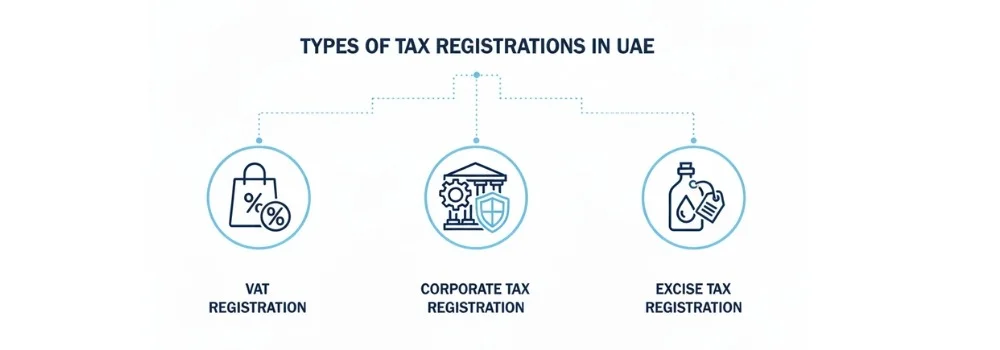
In the UAE, the tax system is designed to be integrated. Rather than having multiple different ID numbers for every small task, the government uses a few specific registrations that all fall under the umbrella of a tax identification number (TIN).
When you register for any of these, you are essentially getting your official tax identity.
VAT Registration
This is the most common type of tax registration. If your business sells goods or services and its turnover is high enough, you must register for Value Added Tax. This registration generates a TRN number in Dubai and the other emirates, which serves as your primary tax identification number (TIN) for everyday business.
To complete the process, businesses must prepare the documents required for VAT registration in UAE, which typically include a trade license, passport copies of owners or partners, Emirates ID (if applicable), bank account details, and financial records showing business turnover.
Corporate Tax Registration
Since 2023, almost all businesses in the UAE, including those in Free Zones,s must register for Corporate Tax.
Even if your company qualifies for a 0% tax rate, you still need to apply for a tax identification number specifically for corporate tax reporting. This ensures the government can track your profits and confirm you are following the rules.
Once registered, businesses are required to maintain proper financial records so they can accurately Calculate Corporate Tax in UAE and submit their annual tax returns in compliance with the regulations set by the authorities.
Excise Tax Registration
This registration is for businesses that deal with specific goods like tobacco, energy drinks, or sugary beverages. Because these items have a different tax rate, you need an excise tax registration.
Like the other types, this process will give you a unique company identification number to use on your customs and tax forms.
One Portal, Multiple Numbers
The important thing to remember is that each of these registrations is handled through the same Federal Tax Authority (FTA) portal. While each registration might generate a unique number for that specific tax, they all link back to your main taxpayer profile.
Step-by-Step Process to Get a TIN (TRN) in the UAE
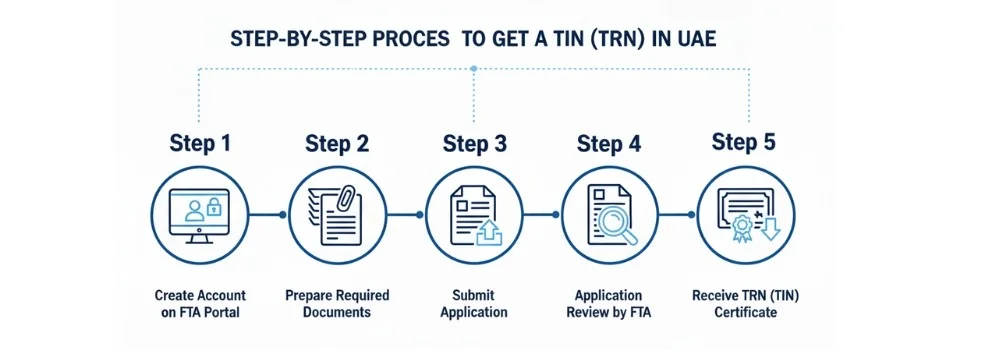
The application process for a Tax Registration Number (TRN), the UAE’s version of a TIN, is entirely digital. By using the EmaraTax portal, you can complete your registration from your home or office.
Follow these steps to apply for a tax identification number correctly:
Step 1: Create an Account on the FTA Portal
The first move is to visit the official Federal Tax Authority (FTA) website. You will need to sign up for an EmaraTax account using a valid email address and mobile number. Once you verify your account via email, you can log in to your personal dashboard.
Step 2: Prepare Your Required Documents
To avoid delays, have digital copies of these documents ready before you start. The FTA is very strict about clear, valid paperwork:
- Trade License: A valid copy of your business license.
- Identity Documents: Passport copies and Emirates IDs for all owners and authorized signatories.
- MOA (Memorandum of Association): Or any similar document that shows the company’s ownership structure.
- Bank Account Details: You will need your IBAN and bank name (a bank validation letter is often helpful).
- Financial Proof: A signed declaration of your turnover for the last 12 months, supported by sample invoices or audit reports.
Step 3: Submit Your Application
Once logged in, select the option to register for VAT or Corporate Tax. You will be guided through an online form where you must:
- Enter your business activity details (what you actually sell or do).
- Provide your physical office address in the UAE.
- Upload the documents you prepared in Step 2.
- Declare your expected revenue for the next 30 days.
Step 4: Application Review by the FTA
After you hit submit, the FTA will review your application. This usually takes between 5 to 20 business days. During this time, the authority might email you to ask for “additional information” or clarification on your financial figures. Keep an eye on your inbox so you can respond quickly.
Step 5: Receive Your TRN (TIN) Certificate
When your application is approved, your Tax Registration Number will appear on your dashboard. You can then download your official VAT Registration Certificate. This document is proof of your tax status, and you should keep it safe as you’ll need to show it to banks, suppliers, and customers.
How Long Does It Take to Get a TIN in the UAE?
The official timeline to receive your tax identification number (TIN) is generally between 5 and 20 working days. Because the UAE uses a digital-first system, the process is usually smooth and does not require physical visits to government offices.
Most people receive their TRN number in Dubai or other emirates within the first two weeks. However, this depends on how busy the Federal Tax Authority (FTA) is at the time of your application.
Average Processing Time
For a standard application with clear documents, you can often see an approval in about 10 working days. If you are a resident applying for an individual taxpayer identification number, the process might even be faster if your Emirates ID details are up to date.
Businesses applying for a UAE tax identification number for business should plan for the full 20-day window. This gives the FTA enough time to verify your trade license and financial turnover proof.
Factors Affecting Approval Time
The most common reason for a delay is document clarity. If your passport copy or trade license is blurry, the FTA will ask you to resubmit it. This back-and-forth can add several days to your wait time.
Another factor is the accuracy of your financial data. When you apply for a tax identification number, your reported turnover must match the invoices you provide. If the numbers are confusing, the authority will take extra time to review your file.
Peak Registration Periods
At the end of a financial quarter or right before a new tax deadline, many people get a TIN online at the same time. This high volume of applications can lead to minor delays in the system.
To get your tax identification number (TIN) as quickly as possible, it is best to submit your application well before your business hits the mandatory registration limit. This ensures you stay compliant without the stress of a last-minute rush.
Cost of Getting a TIN Number in the UAE
One of the best things about the UAE tax system is that it is very affordable to get started. The government has made the digital process accessible so that businesses can stay compliant without high upfront costs.
No Government Fee for VAT Registration
The Federal Tax Authority (FTA) does not charge any government fees to apply for a tax identification number through the EmaraTax portal. Whether you are performing a mandatory registration or choosing to do so voluntarily, the online application itself is free of charge.
This applies to both VAT and Corporate Tax registrations. As long as you handle the application yourself using the official portal, you will not have to pay the government a dirham to receive your TRN number in Dubai or any other emirate.
However, businesses must still understand the types of VAT in UAE and ensure they comply with all tax regulations set by the Federal Tax Authority to avoid potential penalties.
Optional Certificate Charges
While the registration is free, there is a small cost if you want an official, physical-style paper. Most businesses simply download the digital UAE tax identification number for a business certificate for free.
However, if you require a printed, attested VAT registration certificate for specific legal reasons or international banking, the FTA usually charges a small administrative fee, which is typically around AED 250.
Consultant Service Charges
Many business owners prefer to hire a professional to handle their tax identification number for UAE residents or company registration. This is where you might encounter a cost.
Tax consultants and accounting firms in the UAE usually charge a service fee to:
- Review your financial documents for accuracy.
- Ensure you meet the turnover thresholds correctly.
- Manage the back-and-forth communication with the FTA.
These fees vary depending on the complexity of your business, but they are commercial charges paid to the consultant, not to the government.
Avoid Late Registration Penalties
While it is free to get a TIN number online, it can be very expensive if you wait too long. If your business crosses the mandatory turnover limit and you fail to apply within 30 days, the FTA can issue a late registration fine of AED 10,000.
Staying on top of your application is the best way to ensure that the cost of getting your company identification number stays at zero.
TIN for Individuals in the UAE
When it comes to personal taxes, the UAE remains one of the most attractive places to live. However, the introduction of Corporate Tax has changed the rules for some individuals. It is important to know if you are viewed as just a resident or as a “business person” in the eyes of the law.
Do Salaried Employees Need a TIN?
If you are a salaried employee working for a company in the UAE, the answer is generally no. You do not need to apply for a tax identification number for UAE residents because the country does not levy personal income tax on wages or salaries.
Your employer handles their own corporate tax, and your take-home pay is not taxed by the Federal Tax Authority (FTA).
For most people in this category, your Emirates ID serves as your primary identification for all government and banking services.
You only need to worry about a tax identification number (TIN) if you start a side business or earn significant income from activities outside of your job.
TIN for Freelancers and Sole Proprietors
Freelancers and people running sole establishments are in a different category. If you have a freelance permit or a professional license, you are considered a “Natural Person” carrying out a business activity. You will need to apply for a tax identification number if your business revenue is high enough.
For VAT, you must register and get a TRN number in Dubai or your emirate if your taxable sales exceed AED 375,000. For Corporate Tax, the rules are slightly different.
Even as an individual, you are required to register for a UAE tax identification number for business if your gross turnover from your business activities exceeds AED 1 million in a calendar year.
Corporate Tax for Natural Persons
The UAE Corporate Tax law applies to “Natural Persons” (individuals) only if they are conducting a business. It is important to know that not all money you receive counts toward the AED 1 million threshold. The government excludes certain types of personal income to keep things simple for residents.
Income that does not count toward your tax threshold includes your salary, personal investment income like dividends or capital gains, and income from personal real estate.
If your only income comes from these sources, you stay outside the scope of Corporate Tax and do not need a tax identification number (TIN).
Important Deadlines for Individuals
If you are an individual who crosses the AED 1 million business turnover limit, you must be careful about timing. For the 2026 tax year, natural persons who exceed the threshold are generally required to register for Corporate Tax by March 31 of the following year.
Failing to register on time can lead to a flat penalty of AED 10,000. If you are unsure if your side hustle or freelance work puts you over the limit, it is a good idea to keep clear records of your total sales from January to December. This simple habit will help you decide when it is time to get a TIN number online and stay compliant.
How to Verify a TIN Number in the UAE
The UAE’s Federal Tax Authority (FTA) provides a free tool that allows anyone to check the validity of a Tax Registration Number (TRN). You do not even need to be logged into an account to use it.
To verify a number, visit the TRN Verification tool on the official FTA website. Once there, you simply type in the 15-digit number provided by the supplier and complete a quick security check.
If the number is real, the system will immediately show you the legal name of the business in both English and Arabic.
Importance of Validating Supplier TRN
Checking a supplier’s tax number is more than just a formality; it is a vital step for your own tax compliance. If you pay VAT to a supplier who does not have a valid TRN, the government will not allow you to claim that tax back.
This means your business ends up losing 5% on every purchase from an unregistered vendor.
Furthermore, verifying these numbers helps you avoid fraud. Some companies might add a “tax fee” to their invoices without actually being registered with the government.
By using the verification tool, you can be sure that the tax you pay is actually going to the Federal Tax Authority and not into someone else’s pocket.
Penalties for Not Registering for VAT
While the UAE is a business-friendly environment, the government takes tax compliance seriously to ensure fairness across the market. If you are required to register for VAT and miss the deadline, you may face significant financial consequences.
As of 2026, the Federal Tax Authority (FTA) has refined the penalty framework to be more consistent. Here is what you need to know about the current penalties for not registering for VAT on time.
Late Registration Fines
The most immediate penalty for failing to register for VAT when required is a fixed late registration fine. In the UAE, if your business turnover crosses the mandatory threshold of AED 375,000, you have 30 days to submit your application to the FTA.
If you miss this 30-day window, a flat administrative penalty of AED 10,000 is typically applied. This fine is issued regardless of whether you owe a large amount of tax or just a small amount. The goal of this penalty is to encourage businesses to step forward and register as soon as they reach the legal limit.
Administrative Penalties for Non-Compliance
Beyond the initial late registration fine, there are other administrative penalties that can add up quickly. If a business continues to operate without a valid TRN number in Dubai or other emirates, they are technically unable to file tax returns.
From April 14, 2026, the UAE has moved toward a more harmonized penalty system. Under these new rules, late tax payments generally attract an annualized penalty of 14%, which is calculated and applied monthly on any outstanding tax amounts. Additionally, failing to submit a tax return on time can lead to a monthly fine of AED 500 for the first year of delay.
Compliance Requirements to Avoid Fines
The best way to stay safe is to maintain clear financial records. The FTA expects businesses to keep all their invoices, receipts, and accounting books for at least five years. If you are audited and cannot produce these records, you could face separate penalties starting at AED 10,000.
If you realize you have missed your registration deadline, it is better to act sooner rather than later. In some cases, the FTA offers voluntary disclosure options or one-time waivers for businesses that correct their status before an audit begins. Taking proactive steps can often lead to a reduction in the total amount of fines you have to pay.
Recovering from Penalties
If your business has already been issued a fine, you may be able to apply for a “reconsideration” or a waiver.
To do this, you must show a valid reason for the delay, such as a technical error on the portal or a significant medical emergency. You generally have 40 business days from the date the penalty was issued to file this request.
Who to consult for TIN in the UAE
To secure your tax identification number without the stress of navigating complex regulations alone, you should partner with an experienced firm like HFA Consulting. As expert VAT consultants in Dubai, they specialize in managing the entire registration process on the EmaraTax portal, ensuring that your documentation is perfect and your application meets all Federal Tax Authority (FTA) standards.
Their team of certified professionals can help you determine whether you meet mandatory or voluntary thresholds, manage your TRN acquisition, and provide ongoing support to keep your business compliant and free from costly late-registration penalties.
Conclusion
Securing your tax identification number (TIN) in the UAE is a straightforward digital process that begins by creating an account on the EmaraTax portal and submitting your trade license and financial documents to the Federal Tax Authority. While the system is designed to be simple, staying on top of your registration is a critical part of tax compliance in the UAE, as it allows your business to operate legally, reclaim VAT, and avoid the heavy fines associated with late registration.
If your business structure is complex or if you are unsure about reaching the mandatory thresholds for VAT and Corporate Tax, it is always a smart move to seek professional assistance to ensure your application is processed without any delays or errors.
FAQS
Is TRN the same as TIN in the UAE?
Yes, for all practical purposes, the TRN number in Dubai and the rest of the UAE is the same as a TIN. While international banks or foreign tax authorities may ask for a tax identification number (TIN), the Federal Tax Authority issues the Tax Registration Number (TRN) to serve this exact function for individuals and businesses.
Can I get a TIN without VAT registration?
Yes, you can obtain a tax ID without registering for VAT by registering for Corporate Tax instead. Since Corporate Tax is now mandatory for most businesses regardless of their turnover, you will receive a UAE tax identification number for business during the corporate tax registration process, even if you haven’t hit the VAT threshold yet.
Is TIN required for Free Zone companies?
Yes, is TIN mandatory in the UAE for Free Zone companies? Absolutely. Even if your company is located in a Free Zone and benefits from a 0% tax rate, you are still required to register with the FTA. This ensures you have a valid company identification number to file your tax returns and maintain your legal standing in the country.
Can I cancel my TRN?
You can cancel your TRN through a process called Tax Deregistration. This is usually done if your business stops operating, if you sell the company, or if your taxable turnover falls below the voluntary threshold for a specific period. You must apply for tax identification number cancellation within 20 business days of becoming eligible to avoid late deregistration fines.


Zeeshan Khan
My name is Zeeshan Khan, and I’m a UAE-based business and tax consulting professional with hands-on experience in VAT compliance, corporate tax advisory, business setup, and regulatory services. I work closely with startups, SMEs, and established companies to help them navigate UAE tax laws, improve compliance, and make informed financial decisions. With a strong understanding of FTA regulations, corporate structuring, and commercial taxation in the UAE, my focus is on translating complex laws into clear, practical guidance for business owners. Through my writing, I aim to provide accurate, up-to-date insights that help businesses stay compliant, reduce risk, and operate confidently in the UAE market.